• An Open Book: TMSW’s Library
  • Copyright
  • Food for Thought Recipes
  • My Right Eye: A Medical Memoir by Marci Rich
  • Praise and Awards
    • Writing Badges
  • The Midlife Second Wives’ Hall of Fame
  • Who is The Midlife Second Wife?
    • Contact
    • FAQ
  • Read Me On The Huffington Post

The Midlife Second Wife ™

~ The Real and True Adventures of Remarriage at Life's Midpoint

The Midlife Second Wife ™

Category Archives: The Healthy Life

To the Middle and Beyond! (What Will We Do with Longevity?)

28 Monday Nov 2011

Posted by themidlifesecondwife in Midpoints, The Healthy Life

≈ 7 Comments

Tags

Boomer Project, boomers, Life, middle-age, midlife, the 60s generation

All right, it’s time for a reality check. Unless I live to be 110, I’m technically past my midlife shelf life—so far over the rainbow as to be nearly under it. (But what was I going to call this blog, anyway? The Over-the-Hill Second Wife? The Old Second Wife? To Infinity and Beyond with the Midlife Second Wife? These are hardly euphonious, and the first two less than complimentary.) I was reminded—painfully—of the disparity between my chronological age (55) and a more accurate midpoint (say, 40 or so), this morning while catching up on my local newspaper reading. The Richmond Times-Dispatch runs a monthly column, “Viva the Vital!” by a boomer named Matt Thornhill; he’s president of the Boomer Project, based here in my adopted hometown. The Boomer Project provides advice and information about our robust demographic to organizations and corporations. For example, did you know that we Boomers and our elders spend $3.5 trillion dollars annually on goods and services? But back to Thornhill and his Thanksgiving Day column. He started things off with a quote by comedienne Rosanne Barr, who said: “C’mon, I ain’t living to age 106, so I am waaay past the halfway point.”

Ouch. Thanks, Rosanne. Thanks, Matt. No, really—thanks. Because this got me thinking—always a good exercise when writing a blog.

Many of us in our 50s and 60s don’t feel old. Do we? And if we’re careful and follow all of the good advice out there, Thornhill reminds us that thanks to the miracle of modern medicine and technologies, the new normal is such that we could very well live—and live well—into our 80s and beyond. And if such is the case, we’ve got a good 20 to 30 years to fill.

It’s nice to have the extra time. But what are we going to do with it?

Thornhill writes that he and his colleagues at the Boomer Project “believe that boomers are going to fulfill their ‘promise’ as a generation by individually living out their own personal promise or agenda.” You might recall that ours is the generation that intended to change the status quo in the 1960s. Thornhill quotes Tom Brokaw, who famously chronicled our generational predecessors in The Greatest Generation. Apparently Brokaw thinks that we baby boomers squandered our opportunity to make a lasting, positive difference in the world.

I’m happy to read that Thornhill disagrees with Brokaw’s assessment. And here’s where we can take up the challenge. If you believe, as Thornhill does, that we still have the opportunity, in the next 20 years, to apply “our collective wisdom and experience from our ever-increasing trips around the sun, [then] our legacy as a generation is in front of us.” We can effect positive change on “companies, organizations, governments, each other and other generations,” as long as we “live our promise.” And Thornhill believes that it is our personal promises, as boomers, that will make the difference; he predicts that most of them will be outwardly focused.

What is your promise—to yourself, your family, your community? I’ve already made one or two—and I should mention that these are nothing like New Year’s resolutions. When the opportunity is appropriate, I’ll share my promise on the blog. But I would love to know what the boomers among you think:

Did we, as a generation, blow our chance to leave a lasting and positive legacy? Or is the best, as Frank Sinatra sang, yet to come?

Share this:

  • Click to share on Facebook (Opens in new window) Facebook
  • Click to share on X (Opens in new window) X
  • Click to share on Pinterest (Opens in new window) Pinterest
  • Click to share on LinkedIn (Opens in new window) LinkedIn
  • Click to email a link to a friend (Opens in new window) Email
  • Click to print (Opens in new window) Print
  • Click to share on Tumblr (Opens in new window) Tumblr
  • Click to share on Pocket (Opens in new window) Pocket
  • Click to share on Reddit (Opens in new window) Reddit
Like Loading...

A Tale of Two Deaths: Losing My Mother to Alzheimer’s—Part I

14 Monday Nov 2011

Posted by themidlifesecondwife in Relationships and Family Life, The Healthy Life, Transitions

≈ 18 Comments

Tags

Alzheimer's disease, Conditions and Diseases, Death, Dementia, Grief Loss and Bereavement, Health, Life, Neurological Disorders

A note to readers: This post was honored by BlogHer, the Women’s Publishing Network, with a Voice of the Year award for 2012. I have since retitled it and it will appear as Part One of Have You Met My Daughter? My Mother, Her Alzheimer’s, and Me in an e-book anthology jointly published by BlogHer and Open Road Media. I am working to complete Have You Met My Daughter? and will post forthcoming essays, in serial form, on this blog.

A person with dementia (or Alzheimer’s Disease) suffers two deaths. The first death occurs when you discover the illness taking hold, erasing the vivacious mind and the vital spirit of the person you once knew. The second death is when the physical body expires. For these reasons, a bereaved person who loses a loved one—first to dementia, later to death—grieves twice. And although much has been written about mid-lifers—the so-called “sandwich generation“—who are caught between caring for ill or elderly parents while still raising children, perhaps there is room in the literature for one more account. This November, to mark National Alzheimer’s Disease Awareness Month and National Family Caregivers’ Month—and in honor of my mother—I am beginning to write a series of essays about how I loved my mother and how I lost her—not once, but twice.

“Have you met my daughter?”

This was the question my mother, who had impeccable manners, regularly posed to co-workers or acquaintances when introducing me to them for the first time.

“Have you met my daughter?”

This was the question my mother regularly posed to the women seated with her at a table in the secured-wing of the assisted living facility where I regularly visited her. Without fail, each and every time I entered the room, she would ask these same women:

“Have you met my daughter?”

There was, of course, tremendous solace in the fact that despite her illness, my mother did recognize me as her daughter. Nevertheless, it was heartbreaking to see how her memory, her very sense of self, had deteriorated.

The signs had been there for a while; it just took time for me to connect the dots. My mother had always been what used to be called “high-strung.” She suffered from panic attacks, and was fearful of many things, including learning how to drive after my father died.

She had also always been something of an pack-rat. Today, there is a name for this: compulsive hoarding. But at the time when I was grappling with this issue in terms of my own mother, I did not know it was an illness for which there might be a treatment; I simply put it down to another of my mother’s eccentricities. I would clear out as much of the clutter as she would permit (there remained piles that I was forbidden to touch), and a week or so later, my efforts were obliterated. It was not at all unlike Sisyphus pushing his boulder up the mountain.

After several years of this, the hoarding had gotten so out of control that I began to fear for my mother’s safety. I was able to convince her that she needed help; she allowed me to hire a cleaning woman to do her laundry, dust, vacuum the floor, and keep the bathroom and kitchen clean.

It was ultimately the cleaning woman—or, more to the point, the existence of the cleaning woman—which brought home to me the awful realization that something was far more seriously wrong with Mom than eccentric hoarding.

She and the cleaning woman didn’t hit it off, largely because Mom did not like anyone else touching her things. The woman, goodhearted and a good worker, called me to complain about what she could see was a losing battle. I was struggling over how to handle the situation when it resolved itself. Mom called me late one night in a real panic; I needed to come over at once. There was a terrible problem.

When I arrived, she pointed to a hole in the dining-room window screen—no more than two inches in diameter.

“That woman you hired is stealing from me,” she said in a tremulous voice tinged with outrage. “Do you see that? That’s how she’s getting in. She’s sneaking in, crawling in through that hole.”

To be continued …

NOTE: The Alzheimer’s Association is not responsible for information or advice provided by others, including information on websites that link to Association sites and on third party sites to which the Association links. Please direct any questions to weblink@alz.org.

Share this:

  • Click to share on Facebook (Opens in new window) Facebook
  • Click to share on X (Opens in new window) X
  • Click to share on Pinterest (Opens in new window) Pinterest
  • Click to share on LinkedIn (Opens in new window) LinkedIn
  • Click to email a link to a friend (Opens in new window) Email
  • Click to print (Opens in new window) Print
  • Click to share on Tumblr (Opens in new window) Tumblr
  • Click to share on Pocket (Opens in new window) Pocket
  • Click to share on Reddit (Opens in new window) Reddit
Like Loading...

Walk as Though Your Life Depends on It

12 Saturday Nov 2011

Posted by themidlifesecondwife in The Healthy Life

≈ 1 Comment

Tags

exercise, Health, Walk-ilates, Walking

Canadian geese on the Vita Trail at Byrd Park in Richmond

My grandmother started walking five miles a day when she was 60. She’s 97 now and we don’t know where the hell she is.

—Ellen DeGeneres

I’ve never been much of a runner. Oh, who am I kidding? I’ve never been a runner. I remember getting winded in high school before ever reaching the first curve in the outdoor track. Now that I’m older, my knees are shot. And it wasn’t from running, I can tell you that. And so, especially after my back gave me so much trouble this fall, I’ve begun walking regularly—physical therapist’s orders. My friend Andrea and I meet at Byrd Park in Richmond three mornings a week and walk two miles on the Vita Trail, or walking path. I took this picture of Canadian geese in September with my iPhone, during a layover in their Southern migration. (I know they’re looking for food, but seriously, why walk when you can fly?)

In truth, I have always liked walking. My mother never learned how to drive (well, she did after my father died, but that’s another story), so we walked a lot of places. Or took a taxi, which I found excruciatingly embarrassing, especially when it involved going to the supermarket where I was certain someone from school would see us; or we would bide our time until she could line up my grandfather or one of her friends to drive us where we needed to go.

I remember running—walking—errands for her when I was young; going to Dombrowski’s, the corner store, to pick up milk and bread. If she wanted something that they didn’t carry, I’d walk down one more block to Frank’s Market. I walked to church (one mile); to my grandparents’ house (a quarter-mile); and—when I was really in a jam, home from high school (just under three miles). And all of this before anyone ever really thought of walking as exercise. Back then, it was just the easiest way to get from one place to another.

Never an athlete, I looked for the path of least resistance when it came to my physical education requirement in college. That’s how I discovered power walking. It was great! I could actually burn calories, get my heart rate up, and tone my legs simply by putting one foot in front of the other at a brisk pace. Who knew?

Now that I’m in my fifties, exercise is more crucial than ever before, and not just because of my age. My father died of a heart attack at the age of 48, so genetics isn’t necessarily on my side; I need aerobic exercise to help combat the hand I was dealt. The genes that my mother contributed brought their own shortcomings to the table. She had severe osteoporosis; a fractured hip, her second, led to her death in 2000 along with complications from dementia. I’ve been diagnosed with osteopenia, so a weight-bearing exercise such as walking is hugely beneficial for someone with my history. I’ll be writing more about issues of bone loss in future posts. But as for walking, it is clear that the health benefits are legion.

It’s not easy to incorporate regular and varied exercise into your life if it was never really there to begin with, so for me, walking is the least expensive and most advantageous thing I can do right now. I do have to be cautious, however; after breaking my left leg at the knee several years ago, I find myself in pain if I start out too quickly. With the weather turning colder, both knees are stiff and sore. I know that I’ll have to find a walking substitute soon.

I might try this new thing called Walk-ilates, moves that focus on weak muscles affecting one’s stride. That sounds good. (Although you apparently need a magic circle and a foam-roller-thingie to do the exercises. I used to have a magic circle, but I can’t remember—did I sell it before moving to Virginia? Is it packed away up in the attic? These are the thoughts that deter me from getting on with an exercise program.)

Walk-ilates won’t fulfill my need for aerobic exercise during the winter months, but for that I might be able to incorporate the steps in our townhouse. Or pretend to be a goose and chase the cat around.

Share this:

  • Click to share on Facebook (Opens in new window) Facebook
  • Click to share on X (Opens in new window) X
  • Click to share on Pinterest (Opens in new window) Pinterest
  • Click to share on LinkedIn (Opens in new window) LinkedIn
  • Click to email a link to a friend (Opens in new window) Email
  • Click to print (Opens in new window) Print
  • Click to share on Tumblr (Opens in new window) Tumblr
  • Click to share on Pocket (Opens in new window) Pocket
  • Click to share on Reddit (Opens in new window) Reddit
Like Loading...

Curb Shoes: We Love Them, They Don’t Love Us

25 Tuesday Oct 2011

Posted by themidlifesecondwife in The Healthy Life, The Well-Dressed Life

≈ 1 Comment

Tags

Clothes, Fashion, High Heels, Shoes, Stilettos

Acrylic platform shoes.

Image via Wikipedia

A couple of weeks ago, a friend of the blog wrote to say that around the time I used her euphemism for high heels—curb shoes—in my interview with Dr. Amanda Miller, she was, coincidentally, trying on a pair of gorgeous ones. Before I share with you what C. had to say, you’ll want to know that according to the Guardian (and reported by Huff Post Style), a recent study revealed that 40-percent of high-heel wearers have suffered an accident in them. Hurts just to think about it, doesn’t it? You can read the complete Guardian article here, or visit Huffington Post‘s take on the story here.

You’ll recall that my friend’s term refers to the fact that the shoes one wears are impossible to walk in: “Please pick me up at the curb or drop me off at the curb.” Hence, curb shoes. Here’s her story:

In the end I chose not to buy them due to the very concerned look on my husband’s face as he watched me (try) to walk around the store. He didn’t appreciate my reasoning, which went like this: “But when I am just standing in place they look fabulous!” I, too, have been suffering with back problems, which have been attributed to leg length discrepancy. I’ve been working with a chiropractor and massage therapist over the past year and I regularly “engage my core.” I am seeing results slowly but surely.

Be careful, ladies. It’s a fashion runway out there, and we’re all Carrie Bradshaw, just one sashay away from disaster.

Share this:

  • Click to share on Facebook (Opens in new window) Facebook
  • Click to share on X (Opens in new window) X
  • Click to share on Pinterest (Opens in new window) Pinterest
  • Click to share on LinkedIn (Opens in new window) LinkedIn
  • Click to email a link to a friend (Opens in new window) Email
  • Click to print (Opens in new window) Print
  • Click to share on Tumblr (Opens in new window) Tumblr
  • Click to share on Pocket (Opens in new window) Pocket
  • Click to share on Reddit (Opens in new window) Reddit
Like Loading...

Postscript: A Perfect Cup of Coffee

25 Tuesday Oct 2011

Posted by themidlifesecondwife in Food for Thought, Indulgences, The Healthy Life

≈ Leave a comment

Tags

American Association for Cancer Research, Beverages, Brigham and Women's Hospital, Cancer, Coffee, Food, Washington Post

A photo of a cup of coffee.

Image via Wikipedia

Well, it just gets better and better. Today the Washington Post reported on new research related to my favorite beverage. According to findings of the American Association for Cancer Research, coffee-drinkers are at a reduced risk for developing basal cell carcinoma, the most common form of skin cancer. The odds are better for women than for men. (Sorry, guys.) My thanks to Lucy Carson and her awesome Twitter feed for bringing this to my attention. You can read the article here, along with last week’s post and your favorite cup of joe. Bottom’s up!

Share this:

  • Click to share on Facebook (Opens in new window) Facebook
  • Click to share on X (Opens in new window) X
  • Click to share on Pinterest (Opens in new window) Pinterest
  • Click to share on LinkedIn (Opens in new window) LinkedIn
  • Click to email a link to a friend (Opens in new window) Email
  • Click to print (Opens in new window) Print
  • Click to share on Tumblr (Opens in new window) Tumblr
  • Click to share on Pocket (Opens in new window) Pocket
  • Click to share on Reddit (Opens in new window) Reddit
Like Loading...

A Perfect Cup of Coffee: The Best Part of Waking Up

19 Wednesday Oct 2011

Posted by themidlifesecondwife in Food for Thought, Indulgences, The Healthy Life

≈ 5 Comments

Tags

American Medical Association, Archives of Internal Medicine, Beverages, Coffee, Cream, Food, Ginger ale, Harvard University, Health, Ice cream, New York City, Oberlin Conservatory of Music, Punch, recipes, Richmond Times-Dispatch, Upper West Side, Vanilla, Whipped cream

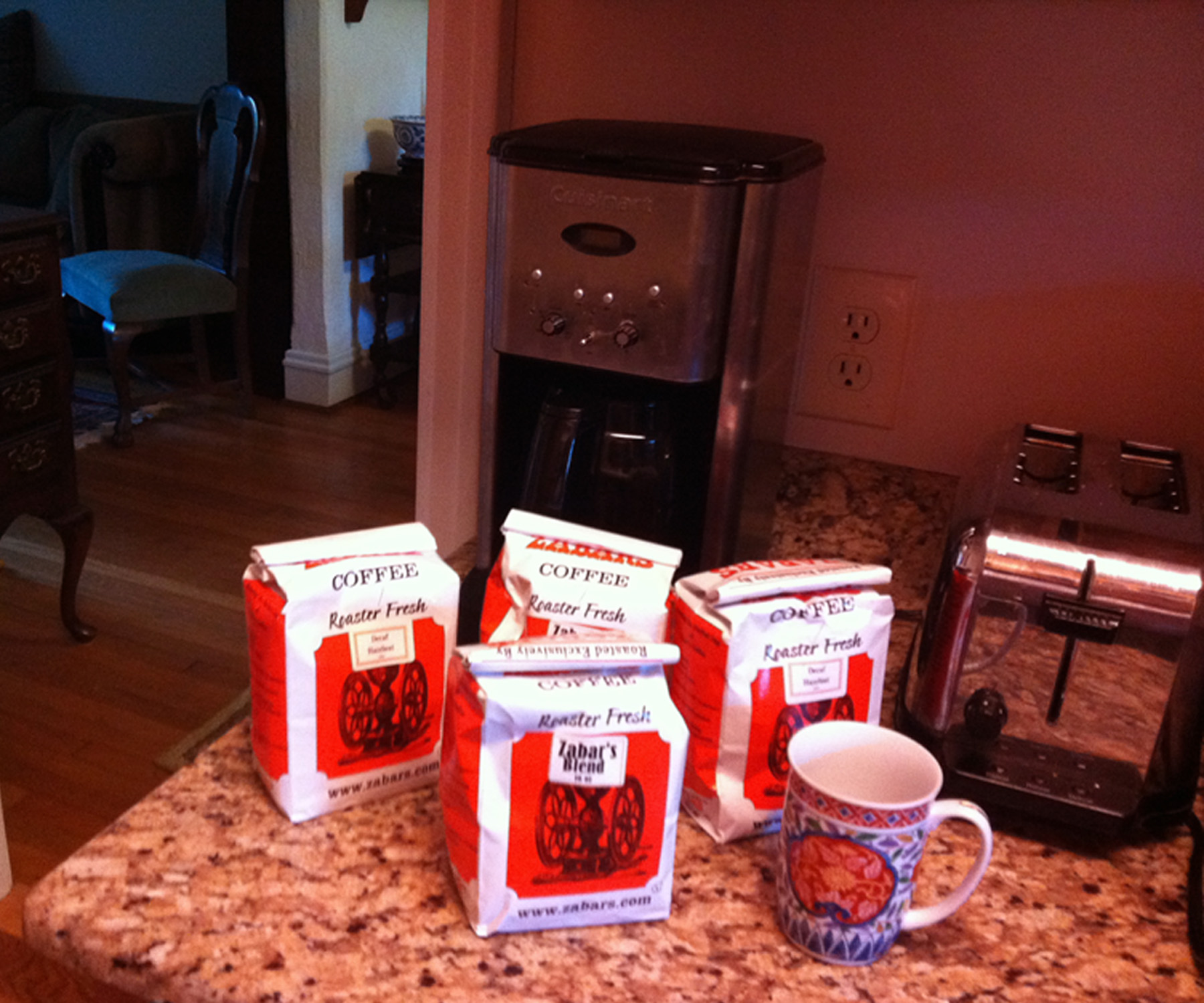
National Coffee Day 2011 has come and gone (it was September 29), but, as Kismet and UPS Ground would have it, I was able to celebrate the occasion with my shipment of Zabar’s coffee.

I first discovered the wonders of Zabar’s miraculous brew on a trip to New York City several years ago. I was traveling for the Oberlin Conservatory of Music, where I worked, and my hotel was just down the block from the famed Upper West Side delicatessen. I dropped in to start my day with a cup of coffee and a bagel, and I was transported. The coffee I made at home didn’t taste like this: this was rich and smooth, with varying notes of flavor, and not at all bitter. I bought two pounds of the Number 7 grind to take back with me to Ohio—Zabar’s blend, the roast I had ordered—and hazelnut decaffeinated. To this day I order two pounds of each (shipping is free at these quantities), and I keep them in the freezer until my canister needs refilling.

My mornings have always seem rushed. (Of course they do! I can’t work up any traction until I’ve had my coffee!) And as much as I’d like to tell you that I grind my own beans for each pot, the process is much more streamlined. Nevertheless, the methodology I’ve devised is specific, never varies, and never fails to yield what I believe to be the perfect cup of coffee:

My canister is always filled with equal parts Zabar’s blend and Zabar’s hazelnut decaf, and I use two coffee scoops of this to ten cups of water in my automatic drip coffee maker. But before I push the filter drawer in and flip the switch on, I sprinkle cinnamon on top of the grounds.

I have served coffee this way every day for years, and every time that I have company. The results are always the same—delicious—and friends and family want to know my secret. So I go to my freezer, pull out the bags of Zabar’s, and tell them.

And now I’m telling you.

(Truth be told, I rarely make coffee anymore. Why? My husband, who is not a coffee drinker, typically wakes up before I do. He makes the coffee most mornings, and brings me a fresh cup with the Richmond Times-Dispatch. Sorry ladies. He’s taken.)

You know, now that I think about it, I have been drinking coffee for as long as I can remember. My first sense-memory is that of a comforting concoction prepared for me by my mother. I must have been around ten or so. Milk filled at least two-thirds of the mug, but the coffee taste was unmistakably there. It brought to mind chocolate that wasn’t chocolate. I was hooked, promptly began dunking my buttered toast, and never looked back.

Turns out my mother might have been on to something.

A “Healthy Living Brief” on the Huffington Post reported on a recent Harvard University study, the results of which are fascinating, and a shot of caffeine in the arm of women who might be admonished for drinking too much of the beverage:

Women who consumed two to three cups of caffeinated joe per day had a 15-percent lower risk of depression than non-coffee drinkers, while those who drank four-plus cups daily had a 20-percent lower risk. In general, women are more likely than men to be diagnosed with depression.

“Our results support a possible protective effect of caffeine, mainly from coffee consumption, on risk of depression,” the researchers wrote … in the Archives of Internal Medicine. The researchers followed more than 50,000 participants in the Nurses Health Study—one of the largest women’s health studies in the U.S.—for 10 years.

And guys, take heart. National Public Radio’s report on this study also noted earlier research, including a study among men, suggesting that caffeine could possibly have a protective effect against certain prostate cancers.

The Harvard study’s authors did caution that their results must be replicated before any firm  conclusions can be drawn about caffeine and depression risk. The Archives of Internal Medicine is a peer-reviewed medical journal published by the American Medical Association.

The AMA might not think too highly of the following recipe, given its quantities of luscious half-and-half, whipping cream, and ice cream, but all (good) things in moderation, right? I discovered this delicious coffee punch at a holiday open house hosted by a wonderful cooking school in Vermilion, Ohio—Laurel Run. Owner Marcia DePalma is not only a culinary genius, she is also a wonderful teacher. I attended some of her cooking classes when I lived in Ohio. With typical generosity, she graciously allowed me to share her recipe with you. I’ve made this twice, and it was a huge hit with my guests. If you’re hosting a party this holiday season and want your guests to mingle, you might think about having several smaller bowls of this stationed throughout your house; people will cluster around it, I promise you.

Laurel Run’s Creamy Coffee Punch
Makes 60 4-ounce servings

2 ounces instant coffee
2 quarts (8 cups) hot water
2-1/4 cups sugar
2 quarts half-and-half
1 tablespoon Nielsen-Massey vanilla
1 quart ginger ale, chilled
1 pint heavy cream, whipped
1/2 gallon French vanilla ice cream
freshly grated nutmeg

Dissolve instant coffee in hot water; cool. Add sugar and half-and-half, mixing well. Chill. When ready to serve, pour coffee mixture into a punch bowl. Add chilled ginger ale, whipped cream, and ice cream. (Let some of the ice cream chunks remain.) Grate a light dusting of fresh nutmeg on top before serving.

Share this:

  • Click to share on Facebook (Opens in new window) Facebook
  • Click to share on X (Opens in new window) X
  • Click to share on Pinterest (Opens in new window) Pinterest
  • Click to share on LinkedIn (Opens in new window) LinkedIn
  • Click to email a link to a friend (Opens in new window) Email
  • Click to print (Opens in new window) Print
  • Click to share on Tumblr (Opens in new window) Tumblr
  • Click to share on Pocket (Opens in new window) Pocket
  • Click to share on Reddit (Opens in new window) Reddit
Like Loading...

A Talk With Physical Therapist Dr. Amanda Miller

03 Monday Oct 2011

Posted by themidlifesecondwife in Monday Morning Q & A, The Healthy Life

≈ 1 Comment

Tags

American Physical Therapy Association, bone density, Connie Schultz, exercise, Health, heel lifts, leg fractures, leg length discrepancy, limb length discrepancy, lower back pain, Marlo Thomas, orthopedics, osteopenia, osteoporosis, Pelvic floor, pelvic obliquity, Physical therapy, Pilates, postural anomaly, Virginia Commonwealth University, Women's Health

Welcome to the “The Midlife Second Wife’s” debut feature—Monday Morning Q & A. In the months to come you can expect to read interviews with experts on a wide range of topics. Among those with whom I’ll be speaking are financial planners, authors, fashionistas, relationship and dating experts, life coaches, artists and artisans, lawyers, therapists, doctors, cooks, butchers, bakers, and even a real honest-to-goodness candlestick maker. Who knows? I might even snag an interview with my hero (and, some have said, doppelgänger), Marlo Thomas. At least, I’ll try! And although these interviews won’t appear every Monday, at least not at the start, I do want you to know that on select Mondays, we’ll be learning from others.

Incidentally, that’s one of the things I’ve come to love about writing this blog. I’m not an expert on anything, really. Well, maybe on life. Because, like you, I am living it. And as Pulitzer Prize-winning columnist Connie Schultz wrote, Life Happens. It happens to me, to my loved ones, to you, to all of us. I want to understand it, learn from it, and move forward—with as much grace and grit as I can muster. Do you know what I think is really cool? As followers of this blog, you get to join me on the journey.

Why does this matter to me? Well, for one thing, I don’t like pain and I don’t like trouble; yet I’ve had plenty of both. And so have you. No one among us gets a free pass. But if even one sentence that I write in this blog helps you avoid either, I’ll be able to consider mine a life well-lived.

So, on to today’s inaugural interview. A suggestion before you start: You might want to take another look at “There Was a Crooked Woman…,” parts one and two, for some context. To recap, Dr. Miller treated me (quite successfully) for severe lower back pain, and I am eager to share with you what I have learned—and continue to learn—from her.

I came to see you for treatment of lower back pain, and you determined that I have limb-length discrepancy—my left leg is slightly longer than my right. Do you see many such cases? Would you say that it’s a common occurrence in the general population?

Leg-length discrepancy is a controversial topic, especially when it comes to treatment. There is a difference between true leg-length discrepancy and apparent leg-length discrepancy that results from other postural anomalies. I think the estimation in the literature is anywhere from a 40-percent to 70-percent prevalence in the population.

That’s around half of the population! To be clear, we’re speaking only about the United States, correct?

Correct.

What makes it controversial? What treatments are considered “controversial?”

The effects of LLD on function and the magnitude of LLD that warrants treatment are controversial. There is disagreement regarding the role that LLD plays in musculoskeletal disorders. There is also not a “gold standard” or most preferred way of accurately measuring discrepancy.

As you know, I broke my left leg several years ago—that’s the leg that’s out of whack. In my case, did the fracture lead to true, rather than apparent, leg-length discrepancy? I guess I want to know the meaning behind the terms “true” and “apparent.” And when you say “postural anomalies,” what do you mean? Can you give me some examples?

True—or structural—LLD can be caused “traumatically” by fractures and repairs, fractures affecting the growth plates in children before they have finished growing, and total hip replacements. They can also be congenital, such as congenital dislocation of the hip, or other skeletal disorders. Postural anomalies include impairments such as scoliosis, and muscle imbalances causing changes in standing/sitting posture. For instance, if you are a swimmer and breathe only to one side during freestyle, you may develop shortening of your oblique muscles—the the trunk muscles that do rotation and side-bending—on one side. That shortening can lead to a slight sidebend/rotation at rest in standing or sitting.

Do fractures always lead to LLD? Would the fact that my orthopedic surgeon had to install a plate in my leg (at the knee joint) have contributed to the problem I’ve been having?

Fractures and other surgeries don’t always cause leg-length discrepancies, but it’s something to be aware of, certainly. And again, leg-length discrepancies don’t always cause pain or dysfunction.

Might either osteopenia or osteoporosis cause LLD?

Changes in bone density can be a factor; muscular asymmetries that change the way the spine, pelvis, and hips move are also factors. For instance, if someone is prone to standing on their left leg with hip cocked, they can cause asymmetric muscle shortening that can appear as a pelvic obliquity or leg-length discrepancy.

Pelvic obliquity. You referenced that when you were treating me; that’s when I discovered you are a pelvic-floor specialist. Could you please talk a moment about what you mean by “pelvic obliquity”?

Pelvic obliquity refers to an apparent change in the bony alignment of your pelvis, often caused by muscle imbalances. The contributing muscles may be of your pelvic floor, or back/hips/trunk.

If LLD can lead to lumbago, or lower back pain, to what other medical issues can it contribute?

Anything from ankle, knee, and hip-dysfunction, all the way up to neck and shoulder pain. Leg-length discrepancy, or any postural dysfunction, can change the way you move and carry out normal activities of daily living, as well as recreational or athletic activities.

How does one even know to check for LLD? If a person is suffering from chronic lower back pain, is LLD something for which a doctor should check?

Your basic primary care doctor—and even most orthopedic doctors—will look for postural dysfunction, and, hopefully, refer you to a musculoskeletal specialist for further work-up. If you are having any dysfunction, and a possible leg-length discrepancy may contribute, make an appointment with a physical therapist

Let’s talk about appearances. You initially thought I would need to wear a heel lift, but determined that my discrepancy was subtle enough that I could do without one. If a person does need to wear a heel lift, does that mean he or she can no longer wear certain styles of shoes? It gets awfully hot in Virginia in the summertime; must a person forgo flip-flops and sandals? And what about high heels?

If a patient needs a heel lift for a true discrepancy, as opposed to an apparent discrepancy, then they will need to wear comfortable shoes that they can put the heel lift in whenever they are doing a significant amount of standing or walking. Flip-flops are inadvisable for anyone who has back pain, unless they provide a lot of support. Some sandals have removable inserts that heel lifts can go under. High heels are dependent on the height of the heel and the width of the back of the shoe. Of course, if all you do in your shoes is walk from your car to your office, and then you sit all day, shoe choice is not as big of a concern.

A friend of mine has a name for the high heels you just described. She calls them “curb shoes”—as in: “I’m wearing high heels, so please pick me up/drop me off at the curb.” But what about a situation where your job has you sitting all day; that’s not good, is it?

The sitting or the shoes??? Neither are great. If you can’t walk comfortably in your shoes, you should probably not be wearing them. If you have to wear them, keep your flats in your purse, and use those for walking.

Other than heel lifts, are there other things a person can do to alleviate not only the leg discrepancy, but also its symptoms? Short of stretching with a medieval torture rack?

Exercise!! If your muscles are stronger, they are better able to control motion and transfer load across your lumbo-pelvis, which means improved stability and decreased pain and irritation across the joint. Appropriate shoe wear and good body mechanics are also essential.

Let’s talk about exercise, then. The first thing you had me doing were exercises to strengthen my core; in fact, I shared your exercise for “setting” one’s TA, or transverse abdominis, in part two of “There Was a Crooked Woman…” Why are these exercises important? And can you talk a moment about what it means, exactly, to strengthen one’s core?

Sure. The core is made up of four muscle groups: the transverse abdominis that you mention, which is the deepest abdominal muscle; the pelvic floor muscles; the multifidus, or the deepest back muscle, and the respiratory diaphragm. These muscles work to optimize intra-abdominal (inner abdominal) pressure in order to help stabilize the spine during load transfer or movement. We often see core dysfunction in people with back, pelvic, or abdominal pain. I believe that the first step in treating this kind of back pain is to improve the function and use of core muscles, along with pain management techniques and lifestyle modifications such as body mechanics—for example, how you transition from a sitting to a standing position.

Yes! Another thing you had me think about was how I’ve been getting up from a chair. I must first “engage my core” in the manner of the exercise I published last week, right?

That’s right. This is something that should happen automatically but often doesn’t in people who have pain.

As I recall, when I was in pain it really wasn’t all that easy to “engage my core,” but I see how important it is. What other exercises are helpful in alleviating lower back pain? And isn’t that something of an oxymoron? If one is in pain, won’t exercise lead to more pain?

Actually, oftentimes movement helps decrease back pain, especially once you are out of the acute phase. A gentle walking program, strengthening and stretching exercises, core work, are all helpful. Avoid a lot of high-impact stuff at first, and make sure motions and activities that you are doing are comfortable and controlled. Never ever hold your breath with exercise, remember to exhale on exertion, and don’t forget to engage your pelvic floor!

I’ve started walking three mornings a week with a friend; I’m up to two miles a morning now.

That’s good! Keep it up.

What about core work? You have Pilates reformers in your exercise studio, and I really enjoyed trying them out. Pilates is all about core work, isn’t it?

That’s right. Pilates does a great job of incorporating all components of your core, including your diaphragm and pelvic floor.

You mentioned pain-management techniques earlier. There’s always some confusion about this when I speak with my friends. Does one apply heat at the immediate onset of pain, or ice? At the end of each session at Progress Physical Therapy, either you or one of your assistants would apply ice to my back, and you told me to ice my back after doing my home exercises. Is there ever a good time for heat-therapy?

Ice is better for inflammation; heat is better for muscle tightness. Always try ice first if you are unsure which category you fall into. Heat can, at times, make inflammation worse.

Hmmmm. “Fall into.” Not the best choice of words when speaking with someone like me! Is there anything I didn’t ask you that you wish I had?

Nothing that I can think of! The moral to the story is keep active. And if you have any specific questions about your core, or specific limitations, please see your physical therapist.

I will, Dr. Miller. Thanks so much for being my first guest on the blog.

You’re welcome!


Dr. Amanda Miller is a member of the clinical staff at Progress Physical Therapy in Glen Allen, Virginia. She earned a Doctor of Physical Therapy degree at Virginia Commonwealth University’s School of Physical Therapy in 2009, and, in 2006, a Bachelor of Science degree at Virginia Tech, where she majored in human nutrition, foods, and exercise and minored in psychology. Dr. Miller is a member of the Women’s Health and Orthopedic sections of the American Physical Therapy Association, and serves as Central District chair of the Virginia Physical Therapy Association. She is also a member of the National Vulvodynia Association and is a clinical instructor at Virginia Commonwealth University.

Share this:

  • Click to share on Facebook (Opens in new window) Facebook
  • Click to share on X (Opens in new window) X
  • Click to share on Pinterest (Opens in new window) Pinterest
  • Click to share on LinkedIn (Opens in new window) LinkedIn
  • Click to email a link to a friend (Opens in new window) Email
  • Click to print (Opens in new window) Print
  • Click to share on Tumblr (Opens in new window) Tumblr
  • Click to share on Pocket (Opens in new window) Pocket
  • Click to share on Reddit (Opens in new window) Reddit
Like Loading...

There Was a Crooked Woman … Part II

26 Monday Sep 2011

Posted by themidlifesecondwife in The Healthy Life

≈ 2 Comments

Tags

American Academy of Orthopaedic Surgeons, Bride of Frankenstein, Health, Heidi Klum, lower back pain, Orthopedic, Pelvic floor, Physical therapy, Transversus abdominis muscle

Well, what do you know about that? Herewith, the cause of all my back trouble:

One of my legs, the right one, is shorter than the other by about, oh, one centimeter, according to Dr. Amanda Miller, my physical therapist. That’s almost a half-inch, isn’t it?

No wonder my back had me in the throes of agony.

A reader commented on Part I of “There Was a Crooked Woman …” that she’s in the same predicament, and has heard the situation is not unusual.

That got me thinking …

According to the American Academy of Orthopaedic Surgeons, limb length discrepancies, as they are called, are not at all uncommon in the general population. The AAOS website references a study of 600 military recruits. Thirty-two percent of them had a one-fifth to three-fifths-inch difference between the lengths of their legs, a “normal” variation.

Isn’t this, like having flat feet, the sort of thing that disqualifies one from service? You can find a list of medical eliminators on the Military.com website. Apparently, crookedness can indeed keep you home. There it is, in the section on Lower Extremities:

(2) Shortening of a lower extremity resulting in a noticeable limp or scoliosis.

I remember being checked for scoliosis when I was a child; fortunately, I was spared that malady. But I never thought I had a limp until a clerk at our dry cleaners chastised me for dragging myself into the shop one afternoon.

“You’ll have to step livelier than that!”

“Well, I can’t step any livelier,” I said. “My back is killing me. And you know what? I’ve just come from seeing my physical therapist. She says that one of my legs is shorter than the other.”

“Honey, I could have told you that. You limp.”

Interesting. Someone I see twice a month, at best, had noticed what neither I nor my husband could see. I have a limp.

So much for my dreams of slinking down the runway during Fashion Week.

I have a theory about why one leg is shorter than the other. (Notice how I have yet to say, “One leg is longer than the other?” Typical. I must learn to accentuate the positive.)

Anyway, the theory: My left leg is taller now because I broke it several years ago. Slipped on the ice on my driveway. When I was single. On Valentine’s Day. Should have had a blog back then.

The break was at the knee, a “tibial plateau fracture,” the orthopedic surgeon called it. I was in the hospital for 18 days.

At the time, no one told me that because of all the hardware in my knee, I would be gifted with an extra half-inch in addition to the thrill of TSA pat-downs whenever I trigger the alarm at airport security.

The thing is, the dimensions seem off to me. I have actually lost height over the years. Where I was once a leonine five feet seven and one-half inches, I am now, on a good day, five feet six. Where did these inches go? Oh yes. Never mind. I remember. Next subject.

We’ll explore the wonderful world of osteoporosis and osteopenia in a future post. And maybe, if I’m feeling brave, the weight gain that comes with being an incredible shrinking woman of 55.

For now, I want to tell you that after several sessions with Dr. Miller, I was feeling much better. The first thing I learned from her—and perhaps the most valuable—was the importance of “engaging my core.”

I’m something of a sloucher. It’s true. And what with all the transitions of this whopping big year, I allowed the modest exercise regimen I enjoyed in Ohio to fall by the wayside. One year of no exercise—save walking the dog, trudging up and down the stairs, running the vacuum, and, ah, getting to know my new husband better—will wreak havoc on the body’s vital systems. In my case, the skeletal and muscular ones were in pretty shabby shape.

Being in such pain, I couldn’t just jump on the nearest treadmill. I had to begin gently, and from within. The first set of exercises Dr. Miller assigned me were a dream for a phys-ed slacker such as myself. She taught me how to “set” my TA, or my

Transversus Abdominus

For those of you playing along at home, here’s what you do to “set” your TA:

  1. TAKE A NORMAL BREATH IN, AND A NORMAL BREATH OUT.
  2. AT THE END OF YOUR EXHALE, SLOWLY AND GENTLY CONTRACT YOUR PELVIC FLOOR MUSCLES.
  3. HOLD THE CONTRACTION FOR 2-4 BREATH CYCLES.
  4. RELAX AND REPEAT 10 TIMES IN A ROW, 3 TIMES PER DAY.

The best positions in which to practice this, progressing from the easiest to the hardest, are:

Hooklying (on your back with knees bent)
Sidelying (practice lateral rib expansion with inhale in this position)
Prone (practice belly very gently rising away from the mat, NOT pushing into it)

There are several “muscle cues” one uses in order to engage the pelvic floor:

Imagine slowing the flow of urine
Imagine yourself drawing in a tampon
Pull the anus toward the pubic bone

You definitely should not hold your breath. And you should not see your tummy bulging, your belly button moving dramatically, or your ribs popping up. Dr. Miller’s image, which I like very much because it involves food, is to think of a bowl of cereal on my abdomen. Under no circumstances am I to tip that bowl of cereal. After several days of setting my TA, applying ice to my back, and taking the anti-inflammatory pills Dr. Miller asked my other doctor to prescribe, I was beginning to feel better. I was walking, if not like Heidi Klum, than less like the Bride of Frankenstein.

Next Monday, Dr. Amanda Miller of Progress Physical Therapy will be the inaugural guest on “The Midlife Second Wife’s” newest feature: MONDAY MORNING Q & A. Stay tuned!

Share this:

  • Click to share on Facebook (Opens in new window) Facebook
  • Click to share on X (Opens in new window) X
  • Click to share on Pinterest (Opens in new window) Pinterest
  • Click to share on LinkedIn (Opens in new window) LinkedIn
  • Click to email a link to a friend (Opens in new window) Email
  • Click to print (Opens in new window) Print
  • Click to share on Tumblr (Opens in new window) Tumblr
  • Click to share on Pocket (Opens in new window) Pocket
  • Click to share on Reddit (Opens in new window) Reddit
Like Loading...

There Was a Crooked Woman … Part I

19 Monday Sep 2011

Posted by themidlifesecondwife in The Healthy Life

≈ 3 Comments

Tags

aging, back pain, bone density, DEXA scan, Health, Kegel exercise, lumbago, Massage, midlife, osteopenia, osteoporosis, Pelvic floor, Physical therapy, wellness

My thanks to G.W. for the graphic!

One recent morning, after stripping off the sheets on the bed in the guestroom, I noticed the mattress was slightly askew. Because I’m an editor as well as a writer, I possess certain innate characteristics. The misalignment of a mattress will bother me as much as the improper deployment of a parallel construction.

I nudged the offending bedding with my knee and immediately felt a shift in my lower right back, accompanied by a spongy sort of “thunk.” And then the pain.

It was mild at first, an annoyance more than anything. I gathered up the sheets and took them down to the laundry. But the discomfort progressed with the day, and by afternoon, when I could barely make it home from walking the dog, I called John to report: woman down.

Welcome to midlife, the land of lumbago.

A week went by without improvement. I finally sought relief by cashing in a Living Social massage coupon for the Richmond Alternative Center for Health. Robin, the massage therapist, came out to greet us. John set off on a self-guided tour of the facility while I limped alongside Robin, following her into a serene, softly-lit massage studio. I studied the comfortable-looking table from various angles, trying to calculate the least painful approach for getting into a prone position. It was obvious Robin was going to have her hands full with this one.

The massage was soothing the way aloe is soothing to a burn—waves of intermittent calm punctuated by bursts of pain. By the end, though, all of my muscles—especially those of my lower back—were relaxed. Until, that is, I tried to get up from the table. Everything seized up again; I stiffened like the Bride of Frankenstein as I struggled to regain my footing. Robin appraised the situation.

“You really should call your doctor if you’re not better by Monday.”

As advice goes, this was excellent. X-rays taken of my lower back looked fine, my doctor said; there were no disc issues or fractures. (I had been worrying about a fracture, actually; a recent bone density test, or DEXA scan, revealed that two of my vertebrae were a hair’s breadth away from osteoporosis. I’ve had osteopenia for years.) She prescribed muscle relaxers and physical therapy. Now here’s where things get interesting.

A friend recommended Progress Physical Therapy in neighboring Glen Allen. I was now heading (well, limping) straight down the path of Kismet. I  scheduled a time with Dr. Amanda Miller because, as I recall, hers was the first available appointment. Little did I know that she specializes in pelvic floor problems. Her examination revealed that something about my own pelvic floor was apparently awry; it was as crooked as the mattress that got me into this jam in the first place. Dr. Miller’s meticulous examination revealed something else as well. She told me to bend over and try to touch my toes, then asked:

“Did you know that one of your legs is shorter than the other?”

To be continued …

Share this:

  • Click to share on Facebook (Opens in new window) Facebook
  • Click to share on X (Opens in new window) X
  • Click to share on Pinterest (Opens in new window) Pinterest
  • Click to share on LinkedIn (Opens in new window) LinkedIn
  • Click to email a link to a friend (Opens in new window) Email
  • Click to print (Opens in new window) Print
  • Click to share on Tumblr (Opens in new window) Tumblr
  • Click to share on Pocket (Opens in new window) Pocket
  • Click to share on Reddit (Opens in new window) Reddit
Like Loading...
Newer posts →

Twitter Updates

Tweets by midlife2wife

Company

  • 183,601 Guests since 8/24/11

Receive notifications of new posts by email.

Join 1,202 other subscribers

Topics

  • Current Events
  • Food for Thought
  • Giveaways
  • House and Garden
  • Humor Me
  • Indulgences
  • Inspiring Women
  • LifeStyles
  • Love
  • Midpoints
  • Monday Morning Q & A
  • Money Matters
  • Nostalgia
  • Portraits of the Artist
  • Product Reviews
  • Relationships and Family Life
  • Remarriage
  • Second Weddings
  • Second Wife Hall of Fame
  • Secrets to a Happy Relationship
  • Special Events
  • Technology
  • The Beautiful Life
  • The Cultured Life
  • The Healthy Life
  • The Life Poetic
  • The Musical Life
  • The Reading Life
  • The Well-Dressed Life
  • The Writing Life
  • Transitions
  • Travel
  • Well-Dressed
  • What's the Buzz?

RSS Feeds

  • RSS - Posts
  • RSS - Comments

Archives

  • July 2019 (1)
  • December 2014 (1)
  • November 2014 (1)
  • October 2014 (2)
  • August 2014 (1)
  • June 2014 (2)
  • May 2014 (2)
  • April 2014 (3)
  • March 2014 (3)
  • February 2014 (3)
  • January 2014 (4)
  • December 2013 (9)
  • November 2013 (2)
  • October 2013 (3)
  • September 2013 (6)
  • August 2013 (5)
  • July 2013 (6)
  • June 2013 (2)
  • May 2013 (3)
  • April 2013 (1)
  • March 2013 (1)
  • January 2013 (3)
  • December 2012 (7)
  • November 2012 (7)
  • October 2012 (12)
  • September 2012 (9)
  • August 2012 (6)
  • July 2012 (4)
  • June 2012 (5)
  • May 2012 (4)
  • April 2012 (1)
  • March 2012 (10)
  • February 2012 (8)
  • January 2012 (9)
  • December 2011 (10)
  • November 2011 (30)
  • October 2011 (18)
  • September 2011 (12)
  • August 2011 (2)

Networks

NetworkedBlogs
Blog:
The Midlife Second Wife ™
Topics:
Relationships, Life, After 50
 
Follow my blog

bloglovin

The Blogs of Others

  • A Baby Boomer Woman's Life After 50
  • A.B. Westrick
  • An Empowered Spirit
  • Apart from my Art
  • Author Meg Medina
  • Better After 50
  • Books is Wonderful
  • Darryle Pollack: I Never Signed Up For This
  • Diana Patient: Photography
  • Empty House, Full Mind
  • GenerationBSquared
  • Grandma's Briefs
  • Grown and Flown
  • Midlife at the Oasis
  • Midlife Boulevard
  • Midlife Mixtape
  • Reason Creek
  • Relocation: The Blog
  • Romancing Reality
  • Second Lives Club
  • The Boomer Rants
  • WHOA Network
  • WordCount

COPYRIGHT © 2011 — 2024  Marci Rich and The Midlife Second Wife™ Keyword Communications, LLC. All Rights Reserved.

Blog at WordPress.com.

  • Subscribe Subscribed
    • The Midlife Second Wife ™
    • Join 450 other subscribers
    • Already have a WordPress.com account? Log in now.
    • The Midlife Second Wife ™
    • Subscribe Subscribed
    • Sign up
    • Log in
    • Report this content
    • View site in Reader
    • Manage subscriptions
    • Collapse this bar
 

Loading Comments...
 

    %d