• An Open Book: TMSW’s Library
  • Copyright
  • Food for Thought Recipes
  • My Right Eye: A Medical Memoir by Marci Rich
  • Praise and Awards
    • Writing Badges
  • The Midlife Second Wives’ Hall of Fame
  • Who is The Midlife Second Wife?
    • Contact
    • FAQ
  • Read Me On The Huffington Post

The Midlife Second Wife ™

~ The Real and True Adventures of Remarriage at Life's Midpoint

The Midlife Second Wife ™

Tag Archives: Cooking

Simple Poached Salmon

08 Wednesday Feb 2012

Posted by themidlifesecondwife in Food for Thought

≈ 3 Comments

Tags

Cooking, Food, recipes, Salmon, Seafood, Slow cooker

If you got married in the 1970s, chances are one of your shower gifts was a “Crock Pot,” now more commonly known as a slow cooker. The outer shell of mine was in the popular color of the day—avocado. (Don’t you agree that styles and color trends often change for the better?)

That particular Crock-Pot, shaped rather like a pickle barrel without the center bulge, was more upright than roaster-shaped, which is to say you couldn’t fit in all that much. I recall making exactly one dish in it—kielbasa sausage and sauerkraut. I recall not making it very often. Relegated towards the back of a cupboard, the Crock-Pot eventually made some unknown bargain hunter quite happy at a garage sale.

Flash forward to this millenium, and an article that caught my eye in the January 29, 2003 edition of the New York Times. Noted cookbook author Mark Bittman’s “Low and Slow is the Way to Go” made me rethink my antiquated notions of slow cooker cooking. (His recipe for short ribs with Chinese flavors is off-the-hook delicious. I haven’t made it in a while but I should move it up in the rotation. Just re-reading this article made me want it.)

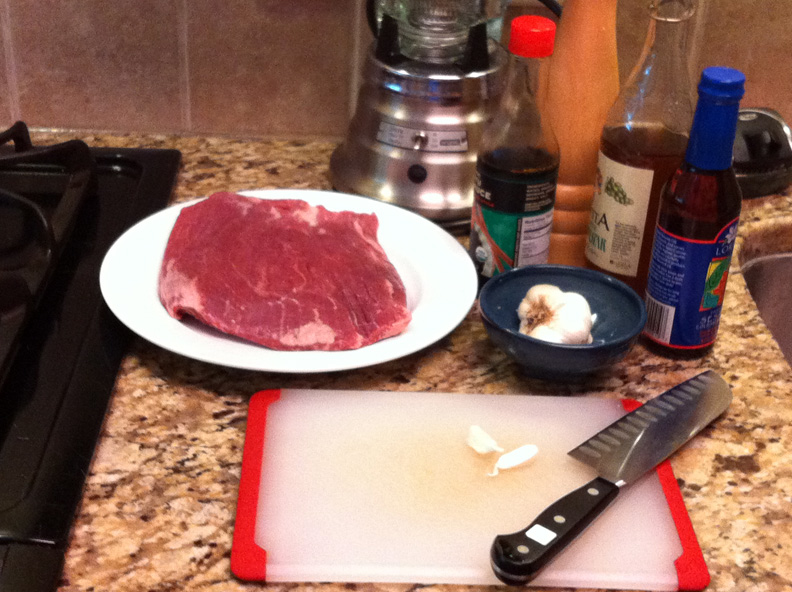
Reading his article for the first time made me covet the kind of slow cooker he was using. Unfortunately, the photo isn’t included in the online version of the story, but you can see it in my mise en place photo for today’s recipe. With its gleaming stainless steel shell and spacious oval shape, it’s one of my favorite pieces of kitchen equipment. I bought it nearly 10 years ago. I’m still using it. I love it. (But not as much as I love John.)

This recipe for poached salmon is delectable. I never prepared fish all that much back in Ohio; even though we lived near Lake Erie, I never made fried perch. I’m just not a huge fan of fried food. I also didn’t live near a good seafood store. I know people who rave about the seafood at Costco, but I prefer a small shop where they truck the fish in fresh daily, and everybody knows your name. Since moving to Richmond, I shop at Yellow Umbrella, where they truck their fish in two or three times a day. (I love Yellow Umbrella as much as I love my slow cooker.)

I bought a one-pound fillet of organically raised, low-density New Zealand salmon for this—it’s one of our favorites. The recipe comes from volume two of Lynn Alley’s wonderful book, The Gourmet Slow Cooker: Regional Comfort-Food Classics, published by Ten Speed Press. My thanks to Lynn for giving me permission to include her recipe in TMSW!

Copyright © 2006 by Lynn Alley. All rights reserved. Used with permission of the author.

Simple Poached Salmon

—Serves 4

1 cup water
1/2 cup dry white wine
1 yellow onion slice (I typically use 2)
1 lemon slice (I typically use about 3 slices)
1 sprig dill (If seasonal and the bunch is large. If using a packaged herb, I use about 4-5 sprigs…and I always buy organic)
1/2 teaspoon salt (I use Kosher)
4 (6-ounch salmon fillets…for two people I buy a one-pound fillet)

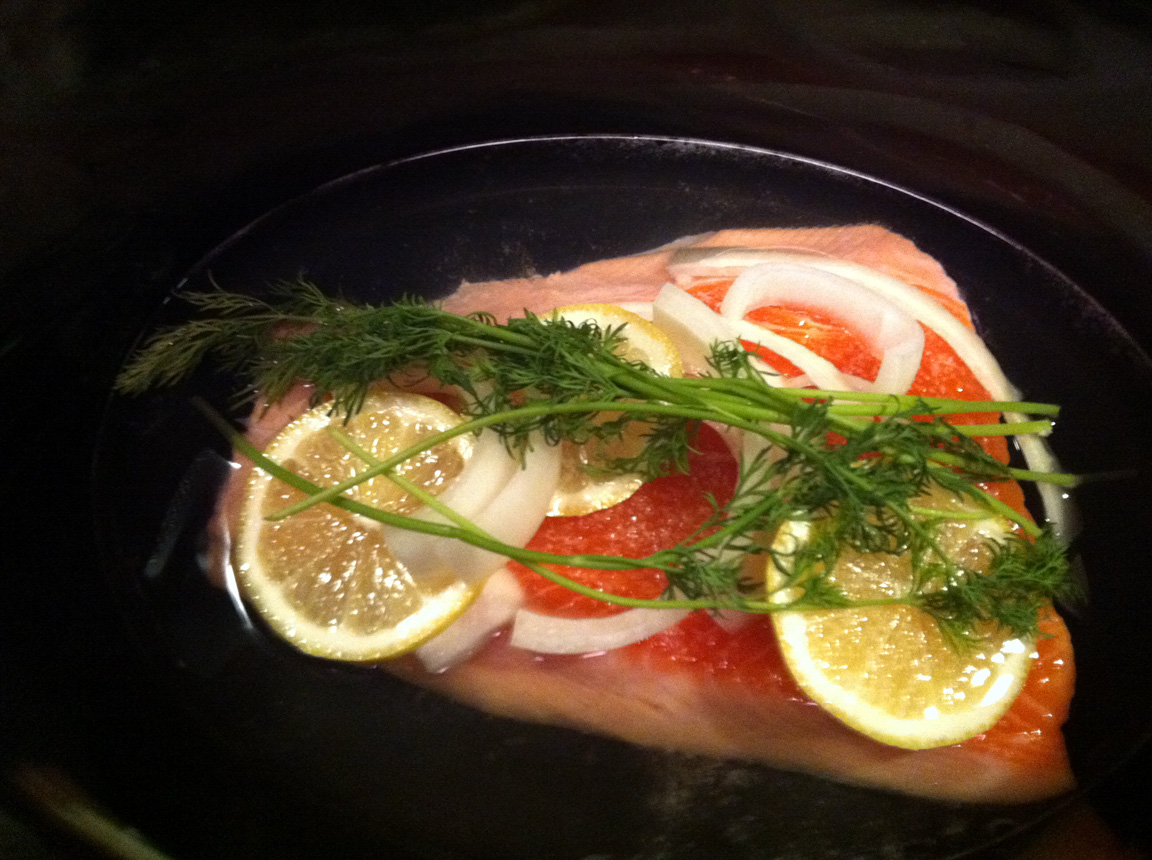
Combine the water and wine in the slow cooker and heat on high for 20 to 30 minutes. Add the onion, lemon, dill, salt, and salmon.

Cover and cook on high for about 20 minutes, until the salmon is opaque and cooked through according to taste. (Since I didn’t portion out the fillet, what you see below actually took longer than 20 minutes to cook—closer to 45 minutes.) Serve hot or cold.
From Lynn Alley’s notes to the recipe:

Poaching salmon, or any fish for that matter, in the slow cooker is a no-brainer. Although it isn’t a traditional dish for long, slow cooking, it is one of the things that the low, even temperatures of the slow cooker does well with. Poached salmon, needing no oil to cook, makes a light lunch paired with lemon rice. steamed vegetables, and salad, or a sumptuous dinner with herbed mashed potatoes and grilled vegetables. SUGGESTED BEVERAGE: Salmon, a classic Pacific Northwest ingredient, generally fits like a glove with pinot noir, Oregon’s most beloved grape.

My notes:

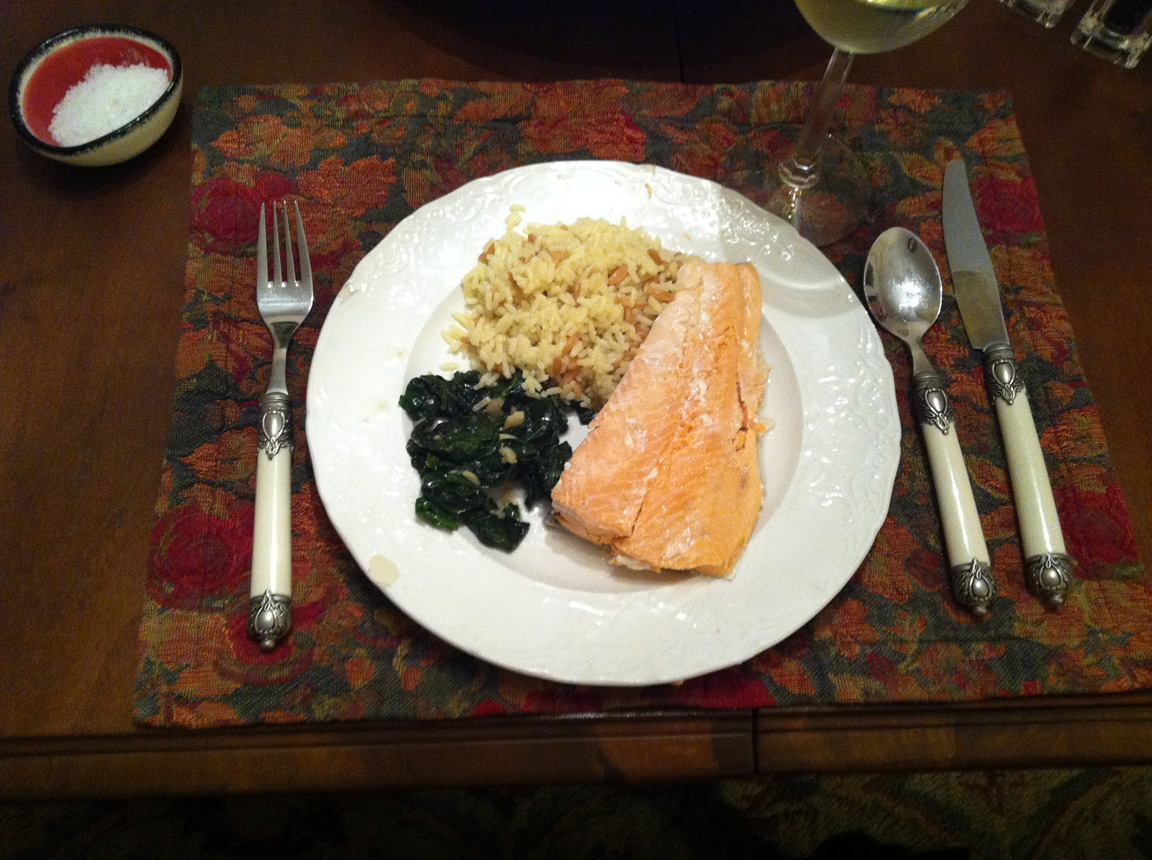
I serve this hot with rice pilaf and either roasted asparagus or sautéed spinach. Our wine that evening was James River Cellars’ Chardonel. 
Share this:

  • Share on Facebook (Opens in new window) Facebook
  • Share on X (Opens in new window) X
  • Share on Pinterest (Opens in new window) Pinterest
  • Share on LinkedIn (Opens in new window) LinkedIn
  • Email a link to a friend (Opens in new window) Email
  • Print (Opens in new window) Print
  • Share on Tumblr (Opens in new window) Tumblr
  • Share on Pocket (Opens in new window) Pocket
  • Share on Reddit (Opens in new window) Reddit
Like Loading...

Baked Kibbee (With a Memory Side Trip to Sittoo’s Kitchen)

01 Wednesday Feb 2012

Posted by themidlifesecondwife in Food for Thought

≈ 12 Comments

Tags

Cooking, Food, Middle Eastern Cooking, recipes

It’s time for equity in ethnic cooking here at The Midlife Second Wife. Regular readers of the blog know that I’m half Sicilian and half Lebanese, and that I’m proud of both aspects of my heritage. But yesterday, when I was compiling an index to the recipes, which you can find at the top of the site, I was struck by an egregious oversight: Italy and Sicily are represented, but Lebanon has nary an olive or a slice of pita bread to acknowledge its treasured place in my lineage. That changes today. I’m proud to share with you two recipes that, when combined, create a whole that is deliciously greater than the sum of its parts. I’m talking about Kibbee Bis-Sayniyyi, or Baked Kibbee.

My Grandmother Abookire prepared kibbee regularly, along with other wonderful dishes such as tabouli, homus, stuffed grape leaves, and kousa. I also have sublime memories of her baking, in her basement summer kitchen, what we now call pita bread, but which she called Syrian bread. The aroma filled the old, American Foursquare house. Sittoo (Arabic for Grandmother) employed an assembly line technique: the small, round discs of dough, having adequately risen, waited beneath kitchen towels on a long folding table for their turn in her antique Magic Chef gas oven. Using a worn, long-handled bread paddle, she pulled the piping hot loaves out of the oven and set them on a separate table. At this point I’d make my move: I’d grab a hot loaf with a spare towel, carry it upstairs to the main kitchen, slather it with butter, and settle on the front porch glider. There, in a carbohydrate-comfort food-stupor, I’d watch the summer traffic roll by on Route 20.

After Sittoo and Jiddu, my grandfather, moved from Ohio to Southern California, she would write to my mother and me regularly n her spidery, upward-slanted hand—often including some of her recipes. Her command of English was remarkable; she and my grandfather had been born and raised in Lebanon, but she was educated at American Christian schools. Nevertheless, I found it difficult to decipher her instructions. To compensate, over the years I’ve acquired substitute recipes that are just as delicious. (In truth, the ingredients and methodology are fairly universal.) I do believe, though, that watching her cook during those impressionable early years left their imprint on the way I squeeze water out of bulgur and use my hands to assemble tabouli. Or maybe all of this is simply embedded in my DNA.

These recipes are from a wonderful cookbook compiled by members of St. Anthony’s Maronite Catholic Church in Glen Allen, Virginia. I purchased the cookbook at their annual Lebanese Food Festival, held each May on the church grounds. In fact, the festival was the first place John took me during my first “official” visit to Richmond. If I  was thrilled to discover that a thriving Lebanese community existed in what would soon be my new hometown, imagine my delight when I tasted the food! If you live in or near Richmond (or plan to visit), mark these dates on your calendar: the 28th Annual Lebanese Food Festival takes place May 18 through 20, 2012. You can visit the church’s website for more information. My thanks to Father George for giving me permission to include these cooking instructions, ever-so-slightly adapted, from Timeless Lebanese Recipes.

Kibbee Bis-Sayniyyi
(Baked Kibbee)
Serves 8-10

To make this recipe, you actually have to make two other recipes first:

1 basic kibbee recipe
1 basic hashwee recipe
Canola oil

Let’s do that now, beginning with

Hashweh
(Meat and Pine Nut Filling)

1/4 cup pine nuts
2 tablespoons butter
1/2 pound ground lamb or beef
1 medium onion, finely chopped
1/4 teaspoon cinnamon
1/4 teaspoon allspice
salt and pepper to taste (I use Kosher salt)

Brown the pine nuts in butter until golden. Then add meat, onion, and spices. Sauté for 10 to 12 minutes. Recipe may be increased if more filling is needed.

After preparing this, I keep it in the refrigerator, in a covered bowl, until I’m ready to use it later that day.

Kibbee
(Basic Recipe)

1 and 1/2 cups bulgur #1 (if you’re using lamb, add an additional 1/2 cup)
1 large onion, pureed in blender
salt to taste
1/4 teaspoon pepper
1/8 teaspoon cinnamon (optional…I’d never dream of omitting this!)
1 teaspoon allspice
2 pounds (4 cups) extra lean lamb or beef (I prefer using lamb)

Cover bulgur (wheat) with cold water. Rinse three times. Drain and press between palms of hands to remove excess water. Work onions and spice together with fingers. Knead meat and spices thoroughly. Add crushed wheat and continue kneading. Dip hands in ice water while kneading in order to soften kibbee. (Ingredients must be kept cold.)

Optional: Run the kneaded mixture through a meat grinder, if available, for a finer consistency. (I don’t own a meat grinder, but I remember my grandmother had one permanently affixed to her kitchen table.)

Now, with both recipes prepared, it’s time to make the baked kibbee:

Cover the bottom of a 9 x 12 cape pan or glass Pyrex dish with canola oil. Spread a half-inch layer of kibbee on the bottom of the pan. (It is easier to take several large balls, pat them flat, and place them in the pan, piecing the kibbee to form an even layer on the bottom of the pan.) Then, go over the kibbee with your hand and smooth it evenly.* Spread the hashwee stuffing evenly over the kibbee layer. Place the remaining kibbee over the hashwee, using the same method. (The top layer should be thicker than the bottom.)

With a sharp knife, score the top layer 1/2 inch deep in a diamond-shaped design 1 inch apart. Pour a bit of canola oil across the top. Bake in a 400-degree oven for 25 minutes. Lower the heat to 300-degrees and bake for 20-30 minutes more. The baked kibbee should be golden brown. When serving, cut along the diamond-shaped wedges.

*Important: When smoothing the layers of kibbee by hand, keep dipping your hands in cold water so the kibbee will not stick to your hands. Smooth well.

I like to serve this with rice pilaf and tabouli. (I’ll share my recipe for tabouli with you at a future date.) Don’t forget the pita bread. Sadly, I’ve never tried to bake my own. I should; there’s a recipe for it in the church’s Timeless Lebanese Recipes! If I do, you can be certain I’ll let you know.

Bil-hanā’ wa ash-shifā’!*

*Bon appétit!

Share this:

  • Share on Facebook (Opens in new window) Facebook
  • Share on X (Opens in new window) X
  • Share on Pinterest (Opens in new window) Pinterest
  • Share on LinkedIn (Opens in new window) LinkedIn
  • Email a link to a friend (Opens in new window) Email
  • Print (Opens in new window) Print
  • Share on Tumblr (Opens in new window) Tumblr
  • Share on Pocket (Opens in new window) Pocket
  • Share on Reddit (Opens in new window) Reddit
Like Loading...

Greek Penne Pasta

27 Friday Jan 2012

Posted by themidlifesecondwife in Food for Thought

≈ 4 Comments

Tags

Cooking, Feta, Food, Pasta, Pine nuts, recipes

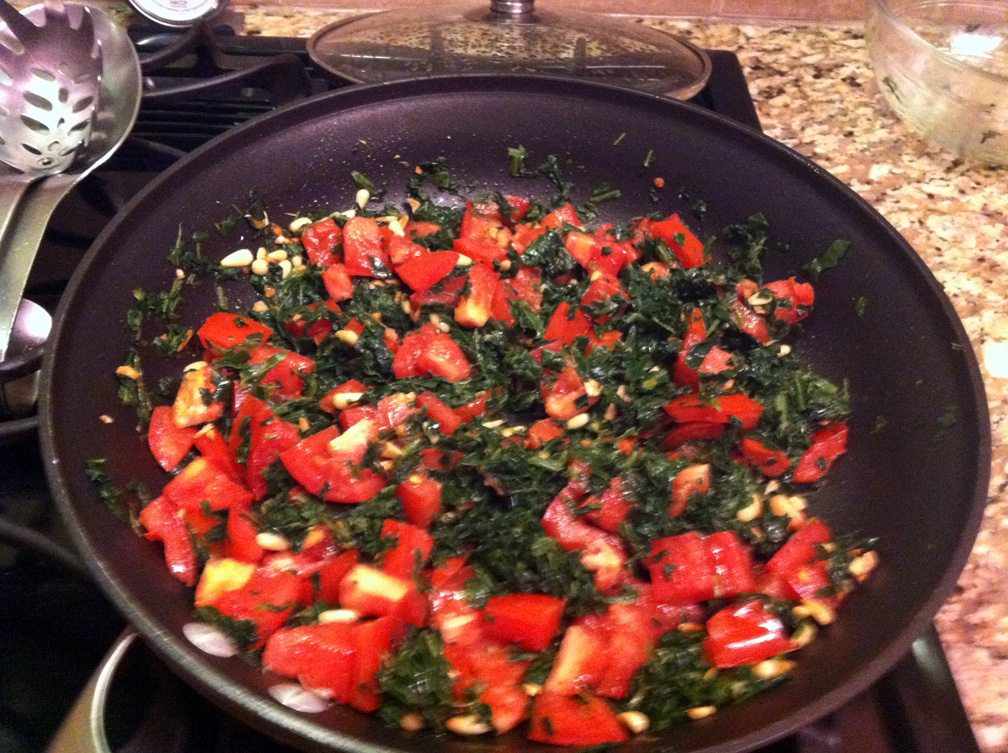
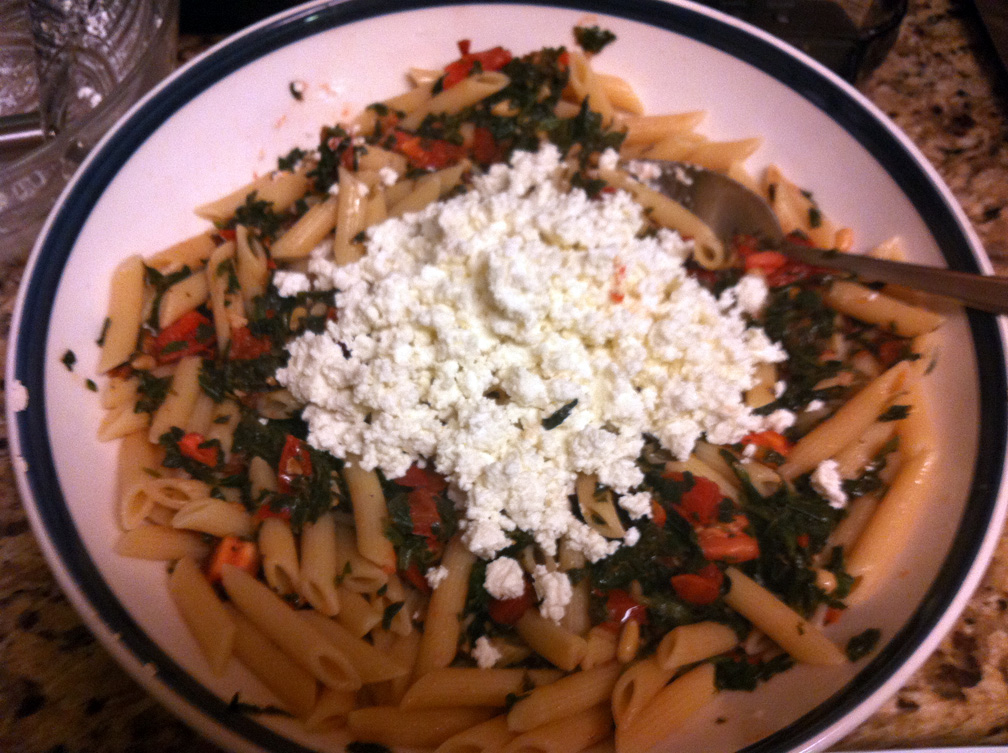
Do I love pasta? Of course I do—I’m half Sicilian! But this recipe, with its decidedly Greek flavors, is one of my favorite ways to prepare it. It’s quite simple to make, with only nine ingredients. (Remember the block of frozen spinach I disparaged in one recent recipe? It makes an important appearance here. Sometimes frozen works just fine.)

Because this dish has so few ingredients, each is essential to its success; this is not the time to skimp. Pine nuts are expensive right now, but you’ll only need two tablespoons’ worth for this—buy a small package, keep them in an air-tight container in the refrigerator, and they’ll last you for months. The feta cheese should be the best you can find; Ellwood Thompson’s, in Richmond, has a Bulgarian feta made from sheep’s milk. It lends just the right bite. Don’t substitute canned tomatoes for fresh; if tomatoes aren’t in season—or you can’t find good quality plum tomatoes in the produce section—wait until summer to make this. Serve it warm, as soon as it’s ready, but know that it keeps beautifully for several days in the refrigerator, and also tastes delicious cold.

Greek Penne Pasta

—Serves 6

12 ounces penne
5-1/2 teaspoons good olive oil
2 tablespoons pine nuts
5 cloves garlic, minced
1 (10-ounce) package frozen chopped spinach, thawed and well-drained
4 large plum tomatoes, chopped (about 8 ounces)
8 ounces feta cheese
1/2 teaspoon Kosher salt
1/8 teaspoon freshly ground black pepper

Cook the pasta according to the directions on the package. Drain and set aside. If necessary, cover to keep warm.

Heat a large non-stick skillet with 1/2 teaspoon olive oil, then add 3 teaspoons more to the skillet; heat the oil over medium heat. Add the pine nuts and garlic. Cook and stir about 5 minutes, or until the pine nuts are lightly golden. Then stir in the spinach (be sure it’s well-drained—I squeeze it in my hands to get rid of any excess moisture) and tomatoes. Cook about 3 minutes or until heated through, stirring occasionally. Season lightly with salt and pepper.


Meanwhile, using a pastry blender, crumble the feta in a medium-size bowl and set aside.

To serve, place half of the hot pasta in a large bowl and drizzle with 1 teaspoon of the remaining olive oil. Gently toss until coated. Add the remaining pasta, drizzle with the remaining 1 teaspoon olive oil and gently toss. Then add the spinach mixture and toss. Finally add the feta cheese, additional salt and pepper to taste, and toss until well combined.

Adapted from Healthy Homestyle Cooking by Evelyn Tribole (Rodale Press 1994)

Share this:

  • Share on Facebook (Opens in new window) Facebook
  • Share on X (Opens in new window) X
  • Share on Pinterest (Opens in new window) Pinterest
  • Share on LinkedIn (Opens in new window) LinkedIn
  • Email a link to a friend (Opens in new window) Email
  • Print (Opens in new window) Print
  • Share on Tumblr (Opens in new window) Tumblr
  • Share on Pocket (Opens in new window) Pocket
  • Share on Reddit (Opens in new window) Reddit
Like Loading...

One Skillet, Three Power Foods (Hint: One of Them is Spinach)

15 Sunday Jan 2012

Posted by themidlifesecondwife in Food for Thought, The Healthy Life

≈ 5 Comments

Tags

Cooking, Food, Garlic, Olive oil, recipes, Spinach

Before …

While there are certain vegetables that leave me cold no matter how they’re prepared (can you say Brussels sprouts?), I have always loved spinach. I’ve gone on the record before about the excellence of my mother’s cooking and baking. Nevertheless, the cooking going on in her kitchen circa 1950s and 1960s often gave preference to the convenience factor; her method of preparing spinach, for example, consisted of thawing a block of Birdseye. To her credit, she did spritz the cooked green mush with fresh lemon. How many nutrients we ended up with I cannot say.

When I began to cook, I reached back a generation for my Sicilian grandmother’s approach to cooking the leafy green vegetable: sautéed with garlic in olive oil.

This recipe—such a nice, bright accompaniment to grilled fish or meat—is so simple and swift as to be laughable. And exactly how good is it for you? Let’s take the three ingredients one by one, shall we?

Spinach

  • Rich in minerals such as potassium, manganese, zinc, magnesium,  iron, and calcium
  • Source of such vitamins as folate, niacin, Vitamin A, B6, and C
  • Packed with thiamine and riboflavin, and such beta carotene and lutein
  • Low in fat

Translated, this means that spinach is good for your eyesight, as it protects you from age-related macular degeneration and cataracts; it’s good for your blood pressure and helps prevent atherosclerosis and heart attack; it strengthens your muscles and helps with bone mineralization; and it includes other neurological, antiulcerative, and anti-cancerous benefits.

Garlic

  • Boosts our natural supply of hydrogen sulfide, which acts as an antioxidant, relaxing blood vessels and increasing blood flow
  • A garlic rich diet appears to protect against various cancers, including breast, prostate, and colon cancer

Olive Oil

Yes, olive oil is a fat. But it’s a good fat, just like Glinda in The Wizard of Oz is a good witch. The reason the fat in olive oil is healthy is because it is a monounsaturated fatty acid, which helps to lower your total cholesterol.

… and After

As for simple and swift, you’ll have this prepared in under 10 minutes. Don’t believe me? Go ahead, time it.

Sicilian Sautéed Spinach

—Serves 4

1 bunch of fresh (preferably organic) spinach
2 cloves garlic, minced
1-2 tablespoons olive oil
Kosher salt to taste

Wash and rinse spinach, remove stems, and tear into medium-size pieces

Preheat your non-stick skillet over medium heat for about 30 seconds, then add olive oil. Increase the heat to medium-high and heat the oil for about 30 seconds more.

Add garlic to hot oil, stirring quickly. Don’t let it burn or brown.

When garlic looks translucent, add a handful or two of spinach, stirring quickly with tongs. The spinach will cook down quickly; add the rest in batches until it’s all cooked down and bright green. Sprinkle kosher salt, to taste, to bring out the flavors. Serve.

Share this:

  • Share on Facebook (Opens in new window) Facebook
  • Share on X (Opens in new window) X
  • Share on Pinterest (Opens in new window) Pinterest
  • Share on LinkedIn (Opens in new window) LinkedIn
  • Email a link to a friend (Opens in new window) Email
  • Print (Opens in new window) Print
  • Share on Tumblr (Opens in new window) Tumblr
  • Share on Pocket (Opens in new window) Pocket
  • Share on Reddit (Opens in new window) Reddit
Like Loading...

Republican Fudge Even a Democrat Could Love!

27 Tuesday Dec 2011

Posted by themidlifesecondwife in Food for Thought, Indulgences

≈ 7 Comments

Tags

Candy, Chocolate, Cooking, Fudge, recipes

Having already established my feelings about chocolate in this venue, I won’t restate them other than to add an important point I neglected to make at the time: I am a bipartisan chocolate lover. When it comes to chocolate, I suffer no compunctions about crossing the aisle. Indeed, I so appreciate the essential characteristics of milk as well as dark chocolate, that I sometimes combine both in a baking recipe. Perhaps it’s best not to tell anyone. Especially Fox News.

Today’s recipe is vintage—so old that I suspect it’s in the public domain. I saved this recipe for “Mamie Eisenhower’s Million Dollar Fudge” ages ago, and I have the yellowing newspaper clipping to prove it. (I hope that the estate of Mamie Eisenhower does not sue me for copyright infringement. If they do, I’ll offer to settle the case by shipping the Eisenhower descendents batches of their matriarch’s incredibly decadent fudge.) Christmas might be over, but you can still sneak this in before your New Year’s resolution has you abstaining from sweets. You’re welcome.

Mamie Eisenhower’s Million Dollar Fudge

—Makes about 2 pounds

4 and 1/2 cups sugar
Pinch of salt
2 tablespoons butter
1 12-ounce can evaporated milk
1 12-ounce package semi-sweet chocolate chips (My preference is for Ghirardelli‘s)
3 4-ounce packages German sweet chocolate (I used Baker’s brand)
2 7-ounce jars marshmallow cream
2 cups chopped nuts (I had pecans in the freezer so that’s what I used for this recipe)

Boil the sugar, salt, butter and milk in a large, heavy saucepan for 6 minutes.

Put the chocolate chips, German chocolate, marshmallow cream and nuts in a large bowl (I used the bowl of my KitchenAid mixer.) Very carefully, pour the boiling syrup on top and beat until chocolate is completely melted. Pour into a greased 9-by 13-inch pan. Let stand a few hours before cutting. Store in an airtight tin. (I find that the fudge keeps best if I leave it in the pan—covered with foil and kept in the refrigerator—and simply cut into squares what I need for serving or gifting.) Even if I do store it in a tin, it’s best to keep this refrigerated.

Share this:

  • Share on Facebook (Opens in new window) Facebook
  • Share on X (Opens in new window) X
  • Share on Pinterest (Opens in new window) Pinterest
  • Share on LinkedIn (Opens in new window) LinkedIn
  • Email a link to a friend (Opens in new window) Email
  • Print (Opens in new window) Print
  • Share on Tumblr (Opens in new window) Tumblr
  • Share on Pocket (Opens in new window) Pocket
  • Share on Reddit (Opens in new window) Reddit
Like Loading...

Barbara Kafka’s Basic Chicken Stock

14 Wednesday Dec 2011

Posted by themidlifesecondwife in Food for Thought

≈ 4 Comments

Tags

Broth, chicken, Cooking, Food, Roasting, Simmering, Soup, Stock (food)

The lovely bones go into the pot. The chicken is reserved for another use.

Barbara Kafka calls chicken stock “the universal solvent of the kitchen.” I wholeheartedly agree. So many recipes that I love call for chicken stock, and it’s essential that I have it on hand. As one reader pointed out last week, store-bought stock—even the organic versions—are laden with salt. This recipe is not. This is what you’ll want to use. Besides being embarrassingly easy to make, it’s economical, and it will fill your home with the aroma of simmering goodness—a perfect antidote to a cold autumn or winter day.

Last week I featured Kafka’s recipe for roasted chicken. Please bear that in mind as you consider this post; to state the obvious, roast chicken is the first step in making homemade stock. Again, my thanks to Barbara Kafka for giving me permission to share these recipes from her wonderful book Roasting: A Simple Art.

The finished stock, ready for measuring and freezing

Basic Chicken Stock
This makes about 3 quarts

Carcass and bones from a 5- to 6-pound roasted chicken, plus uncooked neck and giblets (I also add the wing tips I’ve trimmed before roasting the chicken); or 6 pounds chicken bones, necks and wings

3 quarts water or stock, or to cover by 2 inches
(I’ve never added stock and don’t recommend it doing so. See BK’s notes below.)

If using a whole chicken carcass, cut it up. Place the chicken parts or bones and parts in a stockpot with water to cover by 2-3 inches. Cover the pot and bring to a boil. Skim off the fat and scum that rise to the top. Lower the heat so liquid is just barely boiling. Cover if desired. Cook 8 to 16 hours, skimming occasionally, adding more cold water as needed. The more skimming, the clearer the stock.

Pour the stock through a sieve and let cool at room temperature as time permits; then refrigerate. Remove the art from the surface and any sediment from the bottom.

Use as is, refrigerate for 1 week, or freeze for 6 to 9 months.

Some notes from Barbara Kafka, adapted from her introduction to this recipe:

  • Make the stock without vegetables; they can always be added later. Vegetables cloud the stock and can cause it to turn and sour. (Kafka points out that she also doesn’t know until she uses the stock what she wants the flavorings to be.)
  • Stock made from the bones saved from plates and the carcass of a roasted bird, with its giblets added, will be richer than stock made from unroasted parts.
  • Tie up the gizzards and hearts in a piece of cheesecloth to fish them out easily after an hour’s cooking time. (I have to admit I never seem to have cheesecloth on hand, and I always forget to remove the giblets from the pot after an hour. Never harmed my stock, as far as I can tell!)
  • Before using the bones of a roast chicken for stock, remove all the good meat and save it for another use. (You can see from the picture that’s exactly what I did; the following day I made chicken pot pie, and will share that recipe with you next week.)
  • Note that the pieces of tendon and all parts that look and feel unattractive are good for the flavor of the stock.
  • Once a chicken is roasted, it is easy to pull the carcass apart—cut it if you are fastidious. (I’m not fastidious. I just rip the thing to pieces.) But having the bones in smaller pieces means that less liquid is needed to cover them (and that yields a richer stock).
  • Use a stockpot that is tall in proportion to its diameter; this minimizes the amount of liquid required and constantly rotates the liquid over the bones, which should be covered by liquid by several inches. (When Kafka doesn’t have time to let the stock simmer for many hours, she cheats by adding canned stock to the water for a base. I’ve never done this and I suspect she doesn’t do it often herself. I should ask her!)
  • The key to the success of this stock is long simmering. Don’t be alarmed, but if I start my pot going after an evening meal, I’ll keep it simmering all through the night and into the next day. Just keep the flame on at its lowest—after the initial boiling, all you really want to do is keep it lightly percolating—one or two “burps” at a time. I keep the lid on, but slightly askew to let some of the heat escape.
  • Why don’t you want it to boil the entire time? Because, according to Kafka, boiling risks binding the fat and dissolving solids into the gelatinous liquid. And long simmering dissolves all the gelatinous bits, which is what you want. The bones fall apart, as she says, “having given their all.” It takes about eight hours minimum; she likes to keep it going up to sixteen hours, if possible, and so do I.

Share this:

  • Share on Facebook (Opens in new window) Facebook
  • Share on X (Opens in new window) X
  • Share on Pinterest (Opens in new window) Pinterest
  • Share on LinkedIn (Opens in new window) LinkedIn
  • Email a link to a friend (Opens in new window) Email
  • Print (Opens in new window) Print
  • Share on Tumblr (Opens in new window) Tumblr
  • Share on Pocket (Opens in new window) Pocket
  • Share on Reddit (Opens in new window) Reddit
Like Loading...

Two Chickens, Many Meals (Thanks to Barbara Kafka)

07 Wednesday Dec 2011

Posted by themidlifesecondwife in Food for Thought

≈ 4 Comments

Tags

Barbara Kafka, chicken, Cooking, Food, Roasting

You know the old saying: “Give people roasted chicken, they’ll eat for a day. Teach them how to roast a chicken, they’ll eat forever.” What? That’s not how it goes? Well, it does now. Barbara Kafka is the person who taught me how to roast a chicken, although she wasn’t aware of that when I called her this morning, at her home in Manhattan, to ask for permission to publish two of her recipes on The Midlife Second Wife. As far as I’m concerned her beautiful book, Roasting, A Simple Art, is the last word on that most fundamental kitchen skill. And her “continuous kitchen” philosophy is smart and economical, especially if you’re on a budget. I’m always amazed by the number of meals I can eke out of one or two roast chickens.

Kafka’s premise, that fish, fowl, meat—even vegetables and some fruits—are best roasted at extremely high oven temperatures (500-degrees Fahrenheit), has proved infallible in my kitchen. I have roasted chicken, standing rib roast, turkey, asparagus, cherry tomatoes, leeks, and more using this principle. The results are always wonderful: the high-heat method seals in flavor, yielding a crispy, succulent exterior and an interior that is moist and delicious. You’ll never serve a dry turkey again.

Another Kafka principle to which I adhere is the “continuous kitchen.” Let’s use chicken as an example. I typically roast two at the same time. After we’ve dined on one, I reserve all of the bones and trim the carcass of all meat, which I reserve for leftovers (another roast chicken dinner, sandwiches, chicken salad, or a casserole). I do the same with the extra bird that has not been served. All of the bones, the wing tips (which I’ve removed before roasting), and the neck and giblets (saved before roasting) get tossed into my stockpot and filled with water. Do you see where I’m going with this? Homemade chicken stock—lots of it—to keep in your freezer. You’ll be able to read Kafka’s recipe for basic chicken stock in my next cooking post—or her book, if it’s not too late to add something to your holiday wish list.

Copyright © 1995 by Barbara Kafka. All rights reserved. Used with permission.

Today I’ll be sharing her famous recipe for roasted chicken. My thanks to Barbara Kafka for giving me permission to do so.

A few words of warning, though: The only aspect of her method that could rightly be called Kafkaesque—having a touch of danger—is the method itself. Roasting at 500-degrees Fahrenheit is perfectly safe to do, provided you have taken a few advance precautions:

  1. Make sure that your oven is clean, as in spotless. If you don’t have time to clean your oven before trying this, don’t do it. Self-cleaning ovens are best (so much easier on the back), but I’ve successfully used the high-heat method in an ordinary oven.
  2. Make sure the rack is placed at the lowest section of your oven. I actually remove the top rack and rest my roasting pan on the bottom rack. Kafka might disagree with this; her instructions invariably say to place the rack in the center or bottom third of the oven. But when I’ve tried that I’ve found my food browned too quickly, so I’d lower the temperature slightly (or cover the top with foil) to avoid burning. (Every oven varies in temperature; mine have always seemed to be on the high end.) I’m also a worrier when it comes to high heat, and prefer the extra cushion of space at the top, especially if grease is popping energetically.
  3. Don’t leave the kitchen unattended while you’re doing this. That shouldn’t be an imposition; it’s a quick method, and you’re sure to have other related tasks to perform. Just stay nearby.
  4. Keep your oven fan on, and open a door or window if it gets too smoky. (Didn’t clean the oven first, did you?)
  5. Take care when opening your oven door to remove or check on what you’re roasting. Avert your head (especially if you wear glasses…trust me) and wait a few seconds before proceeding.
  6. Practice safe kitchen. Have a fire extinguisher nearby, and keep pets and children away from the oven area while you’re cooking.

Now, let’s begin.

Simplest Roast Chicken

Serves 2 to 4
Total roasting time: 50 to 60 minutes


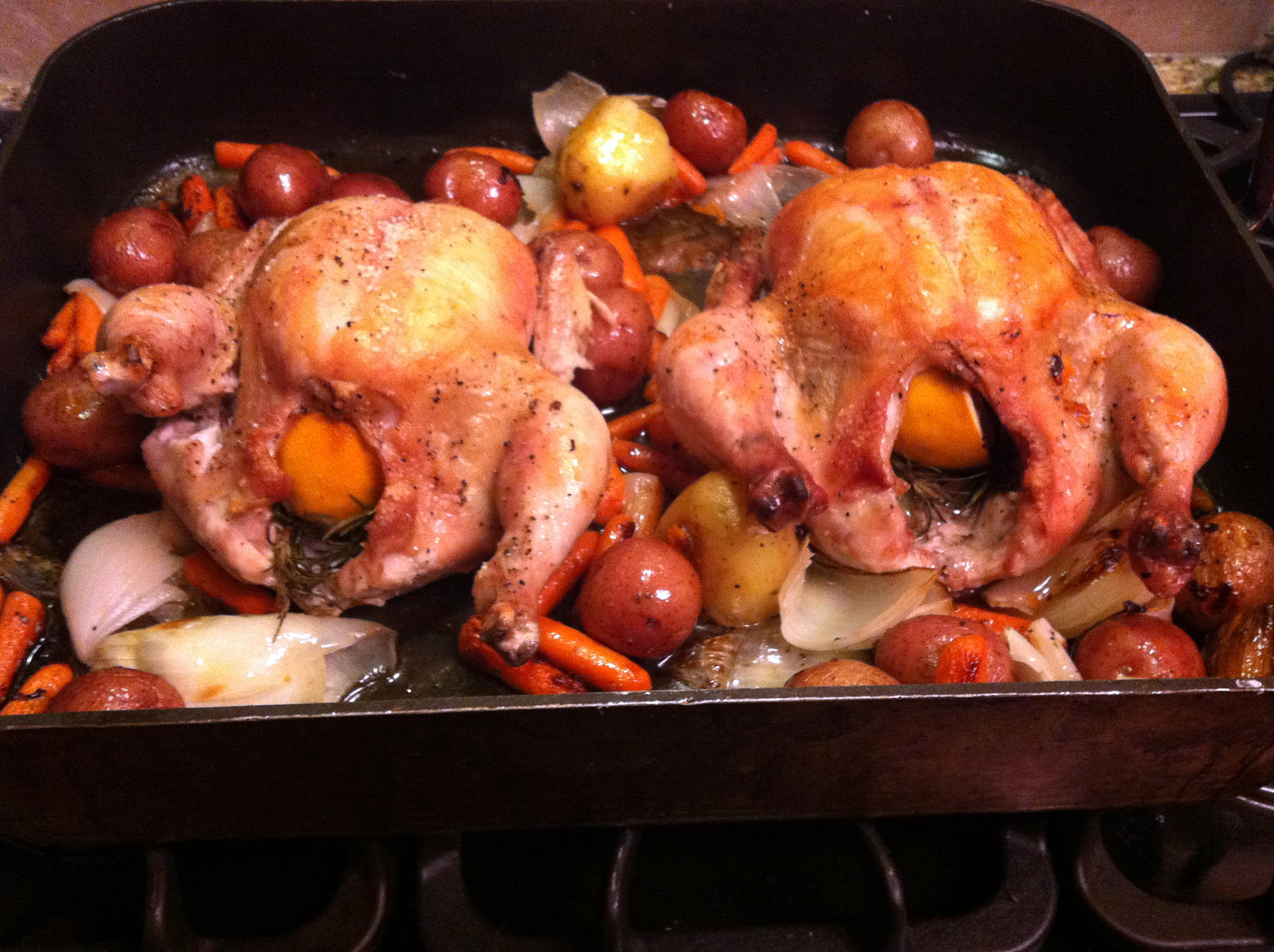
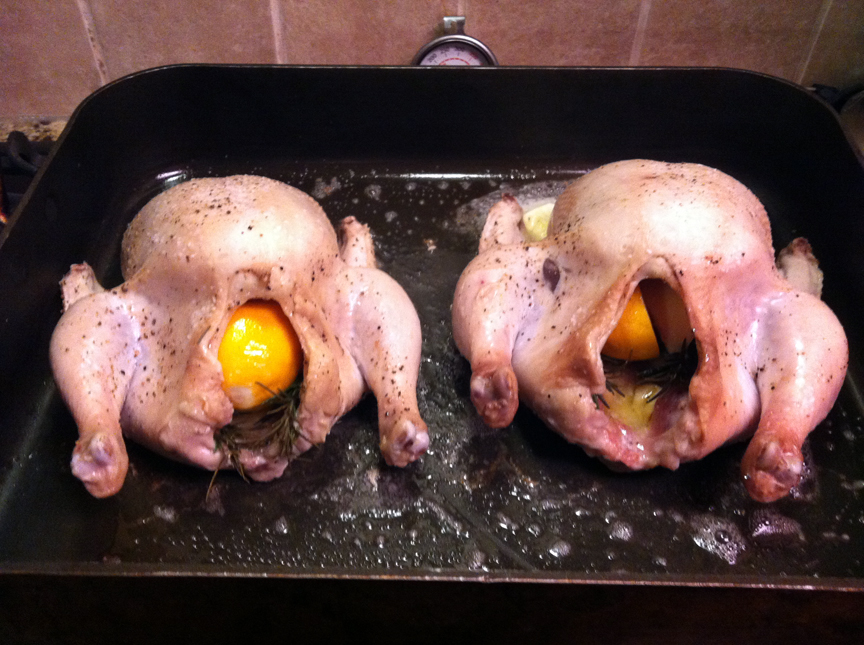
5- to 6-pound chicken, wing tips removed (the chickens shown in the photograph were about 3 pounds each)

1 lemon, halved (I used two, for two chickens)
4 whole garlic cloves (again, doubled for two birds)
Kosher salt, to taste
Freshly ground black pepper, to taste
1 cup Basic Chicken Stock (page 42 of her book) or canned, water, fruit juice, or wine, for deglazing

Place rack on second level from bottom of oven. (See my note above.) Heat oven to 500 o F.

Remove the fat from the tail and crop end of the chicken. Freeze the neck and giblets for Basic Chicken Stock. [Or refrigerate them in a sealed plastic bag if making stock the same day or the next.] Reserve chicken livers for another use.

Stuff the cavity of the chicken with the lemon, garlic, and butter, if using. Season the cavity and skin with salt and pepper. [I also added some sprigs of fresh rosemary.]

The stuffed chickens after 10 minutes of roasting

Place the chicken in a 12x8x1½-inch roasting pan [slightly larger if adding vegetables] breast side up. Put in the oven legs first and roast 50 to 60 minutes, or until the juices run clear. After the first 10 minutes, move the chicken with a wooden spatula to keep it from sticking.**

**At this stage, I incorporate elements from Kafka’s recipe for Roast Chicken with Crispy Potatoes:

2 pounds small red new potatoes, peeled or not and quartered (I did not quarter them when I made this, and rather wish I had done.)
1-2 medium onions, peeled, left whole, optional, or 6 cloves garlic, unpeeled, optional (I only used onions)
My addition: a package of baby carrots

Sprinkle vegetables with salt and pepper and add to the roasting pan after the first 10 minutes of roasting. At 15-minute intervals, until the end of roasting time, stir the vegetables around with a wooden spoon so that they don’t stick to the pan.
Back to the standard recipe:

Remove the chicken to a platter by placing a large wooden spoon into the tail end and balancing the chicken with a kitchen spoon pressed against the crop end. As you lift the chicken, tilt it over the roasting pan so that all the juices run out and into the pan.

Pour off or spoon out excess fat from the roasting pan and put the roasting pan on top of the stove. Add the stock or other liquid and bring the contents of the pan to a boil, while scraping the bottom vigorously with a wooden spoon. Let reduce by half. Serve the sauce over the chicken, or, for crisp skin, in a sauceboat.

If you’ve added potatoes, onion, carrots, etc., remove them to a serving platter as well. Season with salt and pepper to taste, and then deglaze the pan.

Next week, I’ll share Barbara Kafka’s method for making Basic Chicken Stock. And, for the holiday week, my food gift to you will be the Casserole Queens’ recipe for Chicken Pot Pie—just the thing to have on hand when company begins to fill your home!

Share this:

  • Share on Facebook (Opens in new window) Facebook
  • Share on X (Opens in new window) X
  • Share on Pinterest (Opens in new window) Pinterest
  • Share on LinkedIn (Opens in new window) LinkedIn
  • Email a link to a friend (Opens in new window) Email
  • Print (Opens in new window) Print
  • Share on Tumblr (Opens in new window) Tumblr
  • Share on Pocket (Opens in new window) Pocket
  • Share on Reddit (Opens in new window) Reddit
Like Loading...

Mimi’s Marinara Sauce With Meatballs and Sausage

29 Tuesday Nov 2011

Posted by themidlifesecondwife in Food for Thought

≈ 6 Comments

Tags

Cooking, Food, Marinara sauce, Pasta, recipes, Sauces

This recipe for marinara sauce with meatballs and sausage, a family favorite, has been in my cooking repertoire since the Carter Administration, which is to say a very long time. I’ve made a number of adjustments and refinements to the original recipe over the years, chief among them the addition of dry red wine. I love cooking with wine—it’s such a generous thing to do for your dinner guests! The Clemenza cooking scene in The Godfather provided the inspiration for this enhancement—after the movie was released on video I had a chance to study his method—so I suppose we ought to thank Francis Ford Coppola. (He produces his own wine, too.) You’ll notice, however, that I don’t precook the meatballs or the sausage before adding them to the pot; they get cooked along with everything else, since the sauce simmers at least four hours on the stove. I tried precooking the meat only once, and found that the sauce took on an entirely different flavor. I prefer my method, since it retains the tenderness of the meat and prevents it from drying out, but by all means, adjust this recipe to your own tastes. You might also wish to substitute turkey sausage and turkey meatballs for the red meats shown here. As my Grandma Monia used to say: Mangia!

MIMI’S MARINARA SAUCE WITH MEATBALLS AND SAUSAGE*

1 large (28-ounce) can whole tomatoes (I prefer San Marzano Italian plum tomatoes)
3 12-ounce cans tomato paste
water
salt, freshly-ground pepper, and garlic salt to taste
one-quarter cup sugar
one-half to 1 cup dry red wine, such as Chianti or Cabernet Sauvignon
one-half cup grated Parmesan cheese, or to taste**
1 and one-half pounds hot Italian sausage, cut into 4-inch sections
1 and one-half pounds sweet Italian sausage, cut into 4-inch sections
2 pounds ground chuck
4 cloves garlic, minced
¼ cup chopped Italian parsley
6 eggs
4 cups (approximate) seasoned Italian bread crumbs
1 cup (approximate) grated Parmesan cheese**
salt and freshly-ground pepper

I begin by making the meatballs so that they’re ready to add to the simmering sauce.

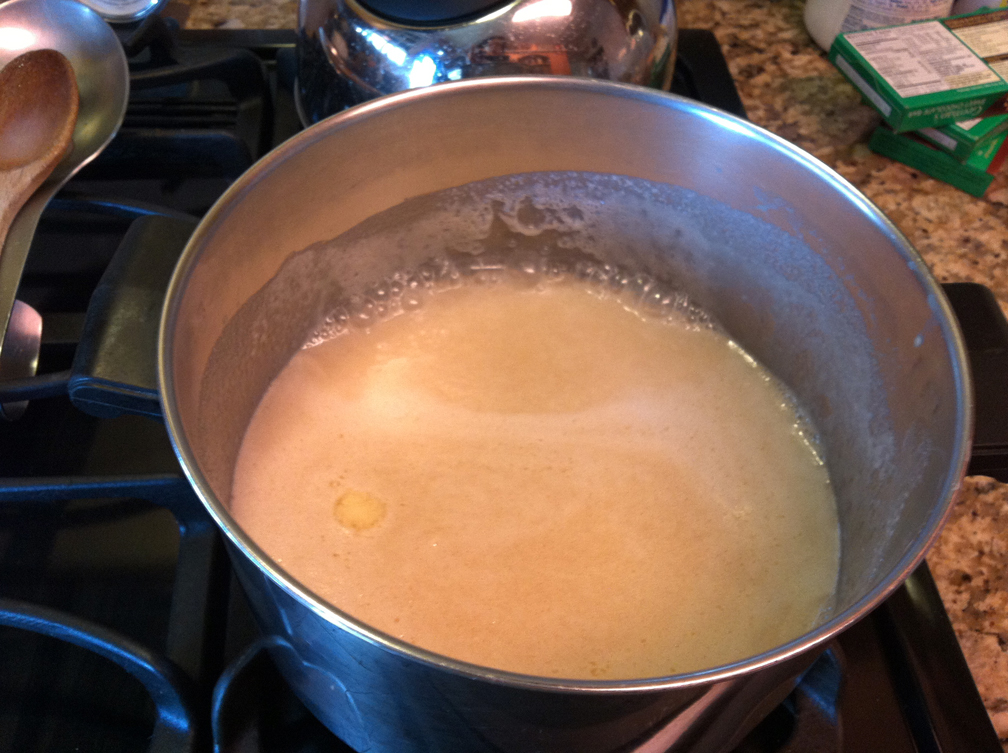
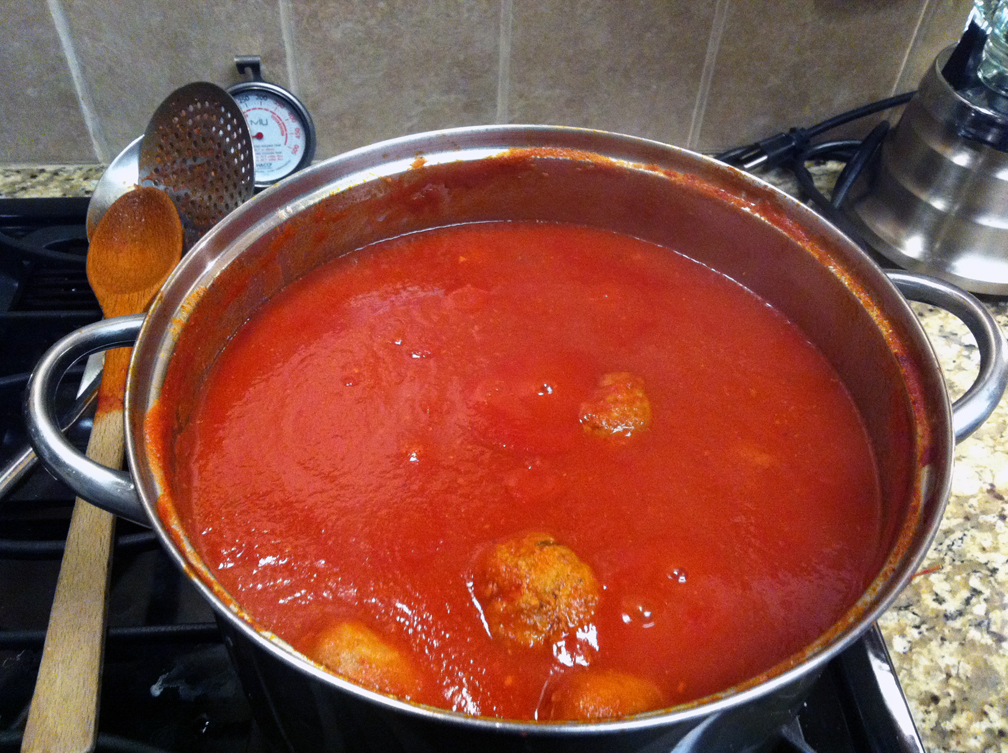
In increments, so that everything is blended well, combine ground chuck, garlic, chopped parsley, eggs, breadcrumbs, Parmesan cheese, and salt and pepper. (If you prefer, substitute garlic salt for the garlic in the meatballs.) Keeping a small bowl of water nearby, wet your hands and break off the meat into about 2-inch pieces, rolling into meatballs. Continue the process, wetting your hands as you go. (Take a look at the picture above; the meatball simmering in the pot is the size you’re going for. And take care not to overdo it with the breadcrumbs; you want the meatballs to adhere, but you don’t want them to be dry.) When all of the meatballs have been made, set aside in the refrigerator in a covered bowl.

Chop the canned tomatoes and put them in a large pot, adding one can of water and three cans of tomato paste. Stir well to combine, then add water to the pot until you’ve filled the pot slightly halfway. (Too much water and your sauce will be thin and, well, watery. Plus, when you add your meat and the sauce begins to boil and then simmer, too much water will make the sauce boil over. Trust me: you don’t want that.)

Over medium heat, begin bringing this mixture to the boil, adding salt, pepper, garlic salt to taste along with the sugar before it gets to the boiling point. (Let your taste preferences be your guide in terms of how much seasoning to use. I sprinkle everything fairly liberally to begin with, stir and simmer, and then check my seasonings a couple of times throughout the cooking process.) Add the wine and the Parmesan cheese to the sauce, and stir well, bringing to a boil.

Add the sausage to the sauce.

Add the meatballs to the sauce.

Return everything to a boil, then reduce the heat to low and simmer slowly for four hours. Continue to stir the pot, using a wooden spoon, and scrape up from the bottom in case you’ve let the heat get too high and the sauce starts to burn. The secret here is a SLOW, STEADY SIMMER. If your dinner is delayed for some reason, one of the beautiful aspects of this recipe is that you can keep this pot of sauce simmering for an extra hour. Make sure that you cook it for the full four hours, though, because you want to make sure that your meat is done. Check the sausage before serving; if it’s pink inside, keep simmering it, and the sauce, until done.

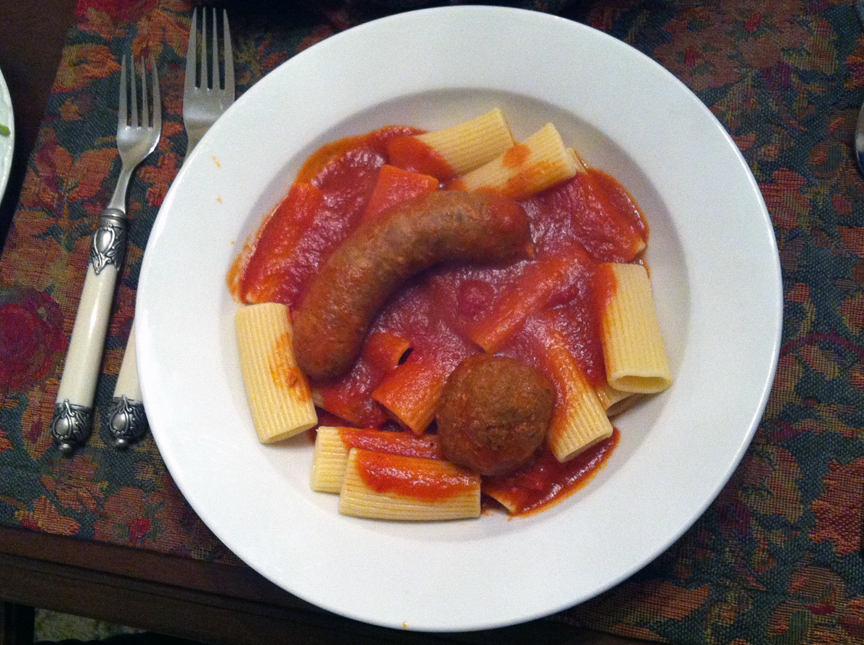
This is a hearty sauce, so serve it over a substantial pasta like rigatoni, rather than a delicate angel hair pasta. Toss together a green salad, add a loaf of crusty Italian bread, and mangia!

*Mimi is John’s nickname for me.

** A word about the Parmesan cheese. If I’m economizing (and aren’t nearly all of us economizing?) I’ll use Kraft grated Parm. But on the rare occasions when we’re splurging, I’ll grate fresh Parmigiano-Reggianno cheese for this recipe; I firmly believe in using the freshest, best ingredients that one can afford, and there’s nothing like the real thing.

P.S. Your entire house will smell amazing while you’re cooking this sauce!

Share this:

  • Share on Facebook (Opens in new window) Facebook
  • Share on X (Opens in new window) X
  • Share on Pinterest (Opens in new window) Pinterest
  • Share on LinkedIn (Opens in new window) LinkedIn
  • Email a link to a friend (Opens in new window) Email
  • Print (Opens in new window) Print
  • Share on Tumblr (Opens in new window) Tumblr
  • Share on Pocket (Opens in new window) Pocket
  • Share on Reddit (Opens in new window) Reddit
Like Loading...

The Casserole Queens’ Sweet Potato Casserole

20 Sunday Nov 2011

Posted by themidlifesecondwife in Food for Thought

≈ 2 Comments

Tags

Casseroles, Cooking, recipes, The Casserole Queens

Ordinarily I only share recipes that I’ve kitchen-tested, but with Thanksgiving a few days away, you might be in desperate need of a side dish, and I’m not cooking this year’s holiday meal. (More on that in a separate post.) But if I were laying out my usual spread, believe me, I’d make room on my menu for this casserole—oven unseen—courtesy of the Casserole Queens.

(Actually, if you ask any of my previous guests over the years, they’ll tell you that many’s the time I’ve experimented with new recipes when having them over for dinner. I’m just a gal with a Santoku knife and a sense of adventure.)

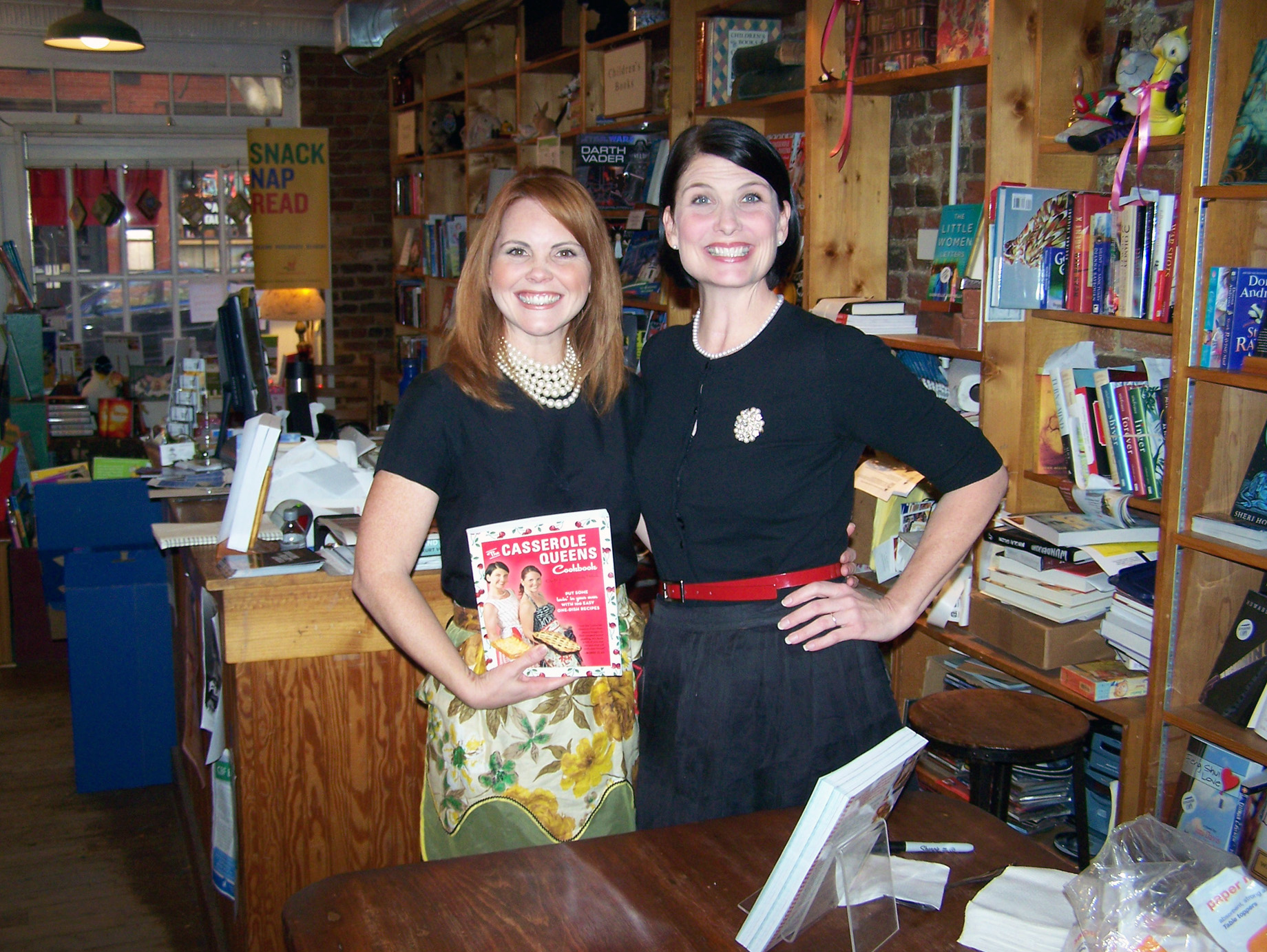
John and I met Crystal Cook and Sandy Pollock a few weeks ago, when they came to Richmond for an author signing at Fountain Bookstore. Even if you didn’t know they hail from Austin, Texas, where they run a food-delivery service, you’d guess it right off: their down-home, friendly hospitality gives it away. You want to bask in the light of their warmth. You want them to invite you to dinner.

Crystal Cook, left, and Sandy Pollock: The Casserole Queens

Crystal and Sandy came to culinary prominence with their recipe for Chicken Pot Pie, which caught the eye of Bobby Flay. He featured them, and their recipe, in an episode of the Food Network’s Throwdown! with Bobby Flay. The Casserole Queens Cookbook, published this year by Clarkson Potter, made the New York Times’ best-seller list. Their book tour included a stop in New York City, where they cooked with Al Roker on the Today Show.

Casseroles represent the ultimate in comfort food, especially for us baby-boomers, who cut our teeth on macaroni and cheese and tuna noodle casserole. A patron at the bookstore called this type of cooking “emotionally significant,” and the phrase is perfect. Mid-lifers, I’m talking to you now. Weren’t casseroles some of your favorite meals from childhood? Don’t you feel a flush of warm memories just thinking about them? Now imagine those meals crafted with a 21st-century point-of-view. Sandy trained at the French Culinary Institute; together with Crystal she has given these time-honored recipes a sophisticated twist. The staff at Fountain Books had prepared Chicken Pot Pie, Mandarin Meatloaf, and Lemon Bars for us to sample. Delicious. Toothsome. May I please wrap some up in a napkin to take home with me? And yes, emotionally significant. As soon as I get my writing deadlines under control, I intend to cook my way through their entire book.

In honor of Thanksgiving, here is a recipe for sweet potatoes that puts a spin on that old chestnut. If you make it, by all means—please leave a note in the comment section and tell us how it was! When I get back into the kitchen, I’ll report on my own attempt at Chicken Pot Pie.

My thanks to Crystal and Sandy for giving me permission to share this recipe with you!

Sweet Potato Casserole

—Makes 6 to 8 servings

8 large sweet potatoes
2/3 cup packed light brown sugar
2/3 cup pecans, toasted
1/2 cup all-purpose flour
5 tablespoons unsalted butter, plus more for greasing the casserole dish
3/4 cup heavy cream
1/2 cup pure maple syrup
1 large egg, beaten
2 teaspoons vanilla extract
1 teaspoon salt

1. Preheat the oven to 400-degrees Fahrenheit.

2. Wash the sweet potatoes, dry well, and put on a baking sheet. Bake for about 1 hour or until soft. Remove the potatoes from the oven.

3. Reduce the oven temperature to 375-degrees.

4. Put the brown sugar, pecans, flour, and 5 tablespoons butter in the bowl of a food processor. Pulse until crumbly. Transfer the mixture to a bowl and put in the refrigerator until ready to use.

5. In the bowl of a stand mixer, fitted with the paddle attachment, add the cream, maple syrup, egg, vanilla, and salt. Peel the baked sweet potatoes, and add the flesh to the bowl. Beat the sweet potato mixture on medium-high speed until smooth.

6. Grease a 9 x 13-casserole dish with some butter. Pour the sweet potato mixture into the dish and smooth the top with the back of a spoon. Sprinkle the pecan topping evenly over the dish. Bake for 40 minutes or until heated through and the top has browned.

Copyright © 2011 by Crystal Cook and Sandy Pollock. All rights reserved. Used with permission.

Share this:

  • Share on Facebook (Opens in new window) Facebook
  • Share on X (Opens in new window) X
  • Share on Pinterest (Opens in new window) Pinterest
  • Share on LinkedIn (Opens in new window) LinkedIn
  • Email a link to a friend (Opens in new window) Email
  • Print (Opens in new window) Print
  • Share on Tumblr (Opens in new window) Tumblr
  • Share on Pocket (Opens in new window) Pocket
  • Share on Reddit (Opens in new window) Reddit
Like Loading...

Marinated Flank Steak

17 Thursday Nov 2011

Posted by themidlifesecondwife in Food for Thought

≈ 2 Comments

Tags

Cooking, Food, Grilling, recipes, Steak Marinades

Mise en place for this recipe

Be honest. Are you growing just a bit weary of the holiday recipes that are flooding your inbox? Are you tired of seeing glossy, garnished turkeys gleaming out at you from the covers of the food magazines in the grocery check-out line? Or is your Thanksgiving menu all set, but you’re at a loss for what to cook tomorrow night?

I thought so.

Grilling season might be over in many parts of the U.S., but for those of us who like some char with our meat, there’s no time like the present.

This recipe is so easy that I almost hesitate to share it, lest you think I’m coasting. It yields such a delicious meal, however, that it seems a shame to keep it from you. You can serve this with any number of sides; I like to kick it old-school, with baked potatoes and a salad or green vegetable. My thanks to an old friend, Anne Morse of Hudson, Ohio, for giving me this recipe back in the 1970s.

For great tips on grilling the perfect flank steak, I’ve included a link. And meat should be at room temperature before throwing it on the flames, so remember to take your marinated steak out of the refrigerator at least an hour before you’re ready to grill.

Enjoy!

Marinade for Flank Steak

—From the kitchen of Anne Morse

One-half cup soy sauce
One-half cup sesame oil
3 tablespoons red wine vinegar
Freshly-ground pepper
2 medium cloves garlic, crushed

Mix together the first four ingredients. Add the garlic. Pour over flank steak and marinate for 24 hours, turning occasionally.

Share this:

  • Share on Facebook (Opens in new window) Facebook
  • Share on X (Opens in new window) X
  • Share on Pinterest (Opens in new window) Pinterest
  • Share on LinkedIn (Opens in new window) LinkedIn
  • Email a link to a friend (Opens in new window) Email
  • Print (Opens in new window) Print
  • Share on Tumblr (Opens in new window) Tumblr
  • Share on Pocket (Opens in new window) Pocket
  • Share on Reddit (Opens in new window) Reddit
Like Loading...
← Older posts
Newer posts →

Twitter Updates

Tweets by midlife2wife

Company

  • 184,397 Guests since 8/24/11

Receive notifications of new posts by email.

Join 1,202 other subscribers

Topics

  • Current Events
  • Food for Thought
  • Giveaways
  • House and Garden
  • Humor Me
  • Indulgences
  • Inspiring Women
  • LifeStyles
  • Love
  • Midpoints
  • Monday Morning Q & A
  • Money Matters
  • Nostalgia
  • Portraits of the Artist
  • Product Reviews
  • Relationships and Family Life
  • Remarriage
  • Second Weddings
  • Second Wife Hall of Fame
  • Secrets to a Happy Relationship
  • Special Events
  • Technology
  • The Beautiful Life
  • The Cultured Life
  • The Healthy Life
  • The Life Poetic
  • The Musical Life
  • The Reading Life
  • The Well-Dressed Life
  • The Writing Life
  • Transitions
  • Travel
  • Well-Dressed
  • What's the Buzz?

RSS Feeds

  • RSS - Posts
  • RSS - Comments

Archives

  • July 2019 (1)
  • December 2014 (1)
  • November 2014 (1)
  • October 2014 (2)
  • August 2014 (1)
  • June 2014 (2)
  • May 2014 (2)
  • April 2014 (3)
  • March 2014 (3)
  • February 2014 (3)
  • January 2014 (4)
  • December 2013 (9)
  • November 2013 (2)
  • October 2013 (3)
  • September 2013 (6)
  • August 2013 (5)
  • July 2013 (6)
  • June 2013 (2)
  • May 2013 (3)
  • April 2013 (1)
  • March 2013 (1)
  • January 2013 (3)
  • December 2012 (7)
  • November 2012 (7)
  • October 2012 (12)
  • September 2012 (9)
  • August 2012 (6)
  • July 2012 (4)
  • June 2012 (5)
  • May 2012 (4)
  • April 2012 (1)
  • March 2012 (10)
  • February 2012 (8)
  • January 2012 (9)
  • December 2011 (10)
  • November 2011 (30)
  • October 2011 (18)
  • September 2011 (12)
  • August 2011 (2)

Networks

NetworkedBlogs
Blog:
The Midlife Second Wife ™
Topics:
Relationships, Life, After 50
 
Follow my blog

bloglovin

The Blogs of Others

  • A Baby Boomer Woman's Life After 50
  • A.B. Westrick
  • An Empowered Spirit
  • Apart from my Art
  • Author Meg Medina
  • Better After 50
  • Books is Wonderful
  • Darryle Pollack: I Never Signed Up For This
  • Diana Patient: Photography
  • Empty House, Full Mind
  • GenerationBSquared
  • Grandma's Briefs
  • Grown and Flown
  • Midlife at the Oasis
  • Midlife Boulevard
  • Midlife Mixtape
  • Reason Creek
  • Relocation: The Blog
  • Romancing Reality
  • Second Lives Club
  • The Boomer Rants
  • WHOA Network
  • WordCount

COPYRIGHT © 2011 — 2024  Marci Rich and The Midlife Second Wife™ Keyword Communications, LLC. All Rights Reserved.

Blog at WordPress.com.

  • Subscribe Subscribed
    • The Midlife Second Wife ™
    • Join 450 other subscribers
    • Already have a WordPress.com account? Log in now.
    • The Midlife Second Wife ™
    • Subscribe Subscribed
    • Sign up
    • Log in
    • Report this content
    • View site in Reader
    • Manage subscriptions
    • Collapse this bar
 

Loading Comments...
 

    %d