• An Open Book: TMSW’s Library
  • Copyright
  • Food for Thought Recipes
  • My Right Eye: A Medical Memoir by Marci Rich
  • Praise and Awards
    • Writing Badges
  • The Midlife Second Wives’ Hall of Fame
  • Who is The Midlife Second Wife?
    • Contact
    • FAQ
  • Read Me On The Huffington Post

The Midlife Second Wife ™

~ The Real and True Adventures of Remarriage at Life's Midpoint

The Midlife Second Wife ™

Tag Archives: Love

On This Day in History …

14 Thursday Jun 2012

Posted by themidlifesecondwife in Relationships and Family Life

≈ 2 Comments

Tags

Anniversaries, Dating, Life, Love, Match.com, Relationships

On this day in history, three years ago, Marci Janas met John Rich. Fourteen months later, to the day, they were married. And so began the journey of The Midlife Second Wife.

Three years is a long time in midlife. It often seems, as with dogs, that there’s a seven-to-one ratio at play; aging progresses more quickly. Time certainly passes more quickly. The pages of the calendar don’t turn, they blow past—as though caught in a hurricane. And, as the wind blows, we’re more keenly aware than ever of our mortality, and of how precious each day really is.

I’m waxing philosophical with this anniversary because it is amazing to me that I’ve now known John for three whole years. Readers familiar with our story know we met on Match.com. Our first date—our first meeting—was at the Allen Art Museum on the campus of Oberlin College. We met outside the beautiful Cass Gilbert-designed jewel box of a building, and paused to get acquainted on the arbor bench under the tree at the top of the screen. We call it our “Laughing Tree.” If you don’t know that story, then by all means go and read it. Then come back. There’s something else I want to tell you.

And that is this—a wonderful thing that has made us smile each June 14th for the last two years. There are no “pages” to a calendar any longer, not really. (Some metaphors are difficult to abandon.) Like most everyone, John and I use the calendar on our iPhones or laptops. So when John and I were planning our first meeting, he entered this into the calendar on his phone: “June 14. Meet Marci at art gallery.” By some error of fateful import, however, he also clicked “Repeat this event.” Now, every June 14, this entry shows up on his calendar:

“Meet Marci at art gallery.”

Now that’s one way to ensure you never forget an anniversary.

Happy third-year-of-knowing-you, John. Here’s to many more.

Share this:

  • Click to share on Facebook (Opens in new window) Facebook
  • Click to share on X (Opens in new window) X
  • Click to share on Pinterest (Opens in new window) Pinterest
  • Click to share on LinkedIn (Opens in new window) LinkedIn
  • Click to email a link to a friend (Opens in new window) Email
  • Click to print (Opens in new window) Print
  • Click to share on Tumblr (Opens in new window) Tumblr
  • Click to share on Pocket (Opens in new window) Pocket
  • Click to share on Reddit (Opens in new window) Reddit
Like Loading...

My Blood Donor Valentine

14 Tuesday Feb 2012

Posted by themidlifesecondwife in Love, Relationships and Family Life, The Healthy Life

≈ 8 Comments

Tags

Blood donation, Blood transfusion, Generosity, Health, Life, Love, Valentine's Day, Whole blood

John, hooked up to the apheresis machine at Virginia Blood Services.

Yesterday, to honor John on his birthday, I shared with you the key to his character: his favorite book is Shel Silverstein’s The Giving Tree. Today’s post, I hope, conveys just how much I love and admire my Valentine, and I think this picture tells more of the story.

Every two weeks, John spends a couple of hours hooked up to an apheresis machine at Virginia Blood Services. The device is a type of centrifuge which extracts the blood platelets and some of the plasma from John’s whole blood, returning the red cells and most of the plasma back to him but retaining the life-giving platelets. As I understand it, platelets are an essential part of cancer and organ transplant treatments. John has been donating either whole blood or platelets for most of his adult life; he first gave blood when he lived in Pittsburgh in the late 1980s, after learning about an area child, suffering from leukemia, who needed platelets for treatment.

I’m not afraid of needles or anything, but I’ve never given blood before. My blood pressure has always trended on the low side; I am, unfortunately, one of those people with a lower than usual supply of energy. I suppose I just assumed that giving blood would have an adverse effect on me, depleting my precious stores of vitality.

But on Sunday I accompanied John to Virginia Blood Services and, to my pleasant surprise, I passed the initial screening. I then got myself tethered to a tube and proceeded to have one pint of whole blood siphoned from myself, feeling rather like a pump at a gas station. The whole procedure took about eight minutes. And although John’s method of donating—apheresis—takes about two hours, the process is typically kinder to his system than giving whole blood, because the machine returns the vital red cells to him. Giving whole blood, in which one relinquishes red cells, platelets, plasma and all, can tend to leave a person feeling weaker than giving via apheresis. I’m glad to say, however, that after drinking a can of sugared soda at the advice of the technician (something I never do), I only felt tired, not light-headed or ill in any way.

Here are some facts, courtesy of the Virginia Blood Services website, that are worth learning if you’ve ever considered donating blood but have yet to take the plunge:

  • More than 4.5 million patients need blood transfusions each year in the U.S. and Canada;
  • 43,000 pints of donated blood are used each day in the U.S. and Canada;
  • Someone needs blood every two seconds. Females receive 53 percent of blood transfusions; males receive 47 percent;
  • In the United States, less than 10 percent of the 38 percent eligible to donate blood do so annually;
  • About one in seven people entering a hospital need blood;
  • One pint of blood can save up to three lives.

It’s astonishing to think that the pint of blood I donated on Sunday could save three lives. I’m ashamed that I’ve never been so selfless before this. John’s generous nature has influenced me. And that’s one of the many gifts he’s given me that money can’t buy.

Happy Valentine’s Day, everyone!

Share this:

  • Click to share on Facebook (Opens in new window) Facebook
  • Click to share on X (Opens in new window) X
  • Click to share on Pinterest (Opens in new window) Pinterest
  • Click to share on LinkedIn (Opens in new window) LinkedIn
  • Click to email a link to a friend (Opens in new window) Email
  • Click to print (Opens in new window) Print
  • Click to share on Tumblr (Opens in new window) Tumblr
  • Click to share on Pocket (Opens in new window) Pocket
  • Click to share on Reddit (Opens in new window) Reddit
Like Loading...

Happy Birthentine’s Day to TMSH!

13 Monday Feb 2012

Posted by themidlifesecondwife in Love, Relationships and Family Life, Special Events

≈ 3 Comments

Tags

Birthdays, Generosity, Life, Love, Shel Silverstein, Valentine's Day

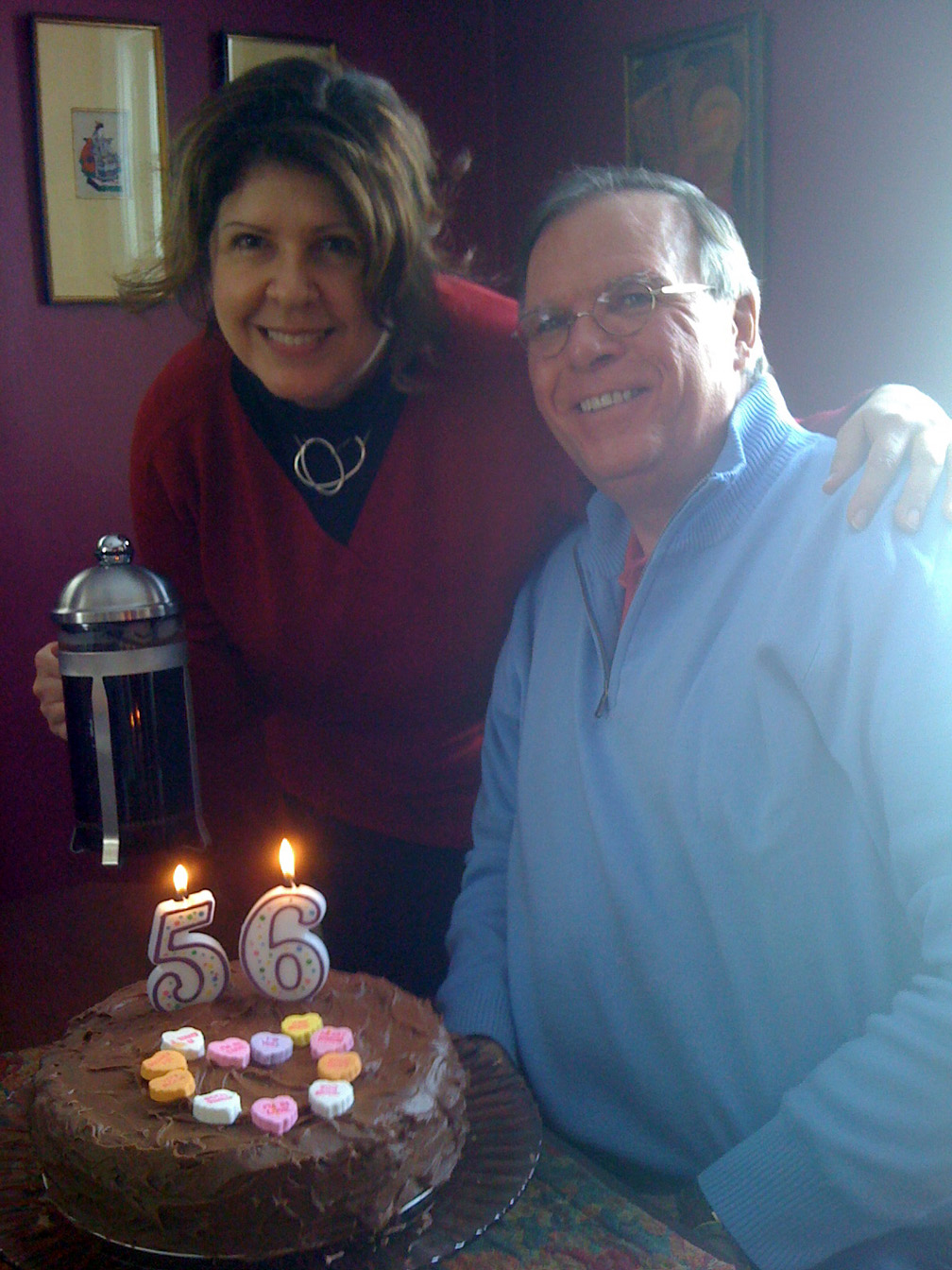
Celebrating John's birthday in 2010. We became engaged the previous month.

Today we celebrate Birthentine’s Day—the eve of Valentine’s Day and John’s birthday. Fifty-eight years ago, in Bronxville, New York, Patricia Cade Rich and John Irving Rich announced to the world the arrival of John Junior, their first-born. I’m awfully glad of this, because if they hadn’t, then where would I be? Probably back in Ohio, freezing while scraping the ice off my car in order to drive to my former job, where I would work long hours, stop at Tooo Chinoise to pick up Chicken Lo Mein, and take it home for dinner. Would I be loveless? Sad to think about this, but yes. Quite possibly I would be, because if the love of my life had not been born, he would not have managed—against all odds of time and space and circumstance—to find me. Certainly I would not be writing this blog, for without The Midlife Second Husband there would be no Midlife Second Wife.

Pat and Jack, I wish you were still alive so I could know you, and thank you, and tell you that I love you for the amazing son you raised.

What do you give a man who has given you the best of everything that money can’t buy? (I can’t tell you here, because then he won’t be surprised when he opens his present tonight at dinner.)

What I can tell you is that when it comes to giving, John has no equal. When we first met, he advised me that if I wanted the key to understanding him, I needed to know that his favorite book was The Giving Tree, by Shel Silverstein.

I needn’t tell you that it is the tree—not the little boy—that John identifies with in the book.

Tomorrow is Valentine’s Day. To mark the occasion, I will be writing a post that I hope will give you some idea of what a giving person my John is. But now I must go. I have a present to wrap.

Share this:

  • Click to share on Facebook (Opens in new window) Facebook
  • Click to share on X (Opens in new window) X
  • Click to share on Pinterest (Opens in new window) Pinterest
  • Click to share on LinkedIn (Opens in new window) LinkedIn
  • Click to email a link to a friend (Opens in new window) Email
  • Click to print (Opens in new window) Print
  • Click to share on Tumblr (Opens in new window) Tumblr
  • Click to share on Pocket (Opens in new window) Pocket
  • Click to share on Reddit (Opens in new window) Reddit
Like Loading...

Breaking Eggs, Making Omelets: The Midlife Marriage Proposal

23 Monday Jan 2012

Posted by themidlifesecondwife in Midpoints, Relationships and Family Life, Remarriage, Transitions

≈ 4 Comments

Tags

Life, Love, midlife, Remarriage

MorgueFile Image

Someone very wise once told me: “If you want to make an omelet, you have to break some eggs.” Two years ago today, my husband John proposed marriage while we were enjoying a breakfast of omelets at one of our favorite haunts in Oberlin, Ohio—the Black River Café. We had been dating for a little more than seven months. We were each in our 50s. We were about to break a whole lot of eggs.

Nothing worth having in life is without sacrifice, which is what my sage friend was getting at. John was most definitely worth having. There were, however, a few built-in challenges. At the time of John’s proposal, he had been out of work for a year and in the midst of a nationwide job search. The chances were slim-to-zero that he would find a position in his field that would keep him—I mean us, for we were becoming an us—in Northeast Ohio. I was quite aware that by accepting his proposal, life as I knew it could change seismically. The metaphor represented by our breakfast was not lost on me.

I’ve written about this subject before, in an essay for the Richmond Times-Dispatch, so I’ll try not to go over old ground. What strikes me about this lovely little anniversary we’re marking today is not so much the eggs that we broke (for that you can read the essay), but the omelet we’ve made and continue to make.

Tom Hanks’ character Forrest Gump famously said: “Life is like a box of chocolates. You never know what you’re gonna get.” With all due respect, I think that somewhat misses the mark; it suggests that you just sit back and let life come at you, like a barrage of chocolate-covered confections. Sure, you make a selection from the sampler, but it’s already there for you, prepared and preconceived. Or, if you like,  preordained.

For my money, life is more like an omelet. You have to break something (or break with something)—a routine, a way of life, the place you’ve lived—to create anew. You can fill it with whatever you like, and it sustains you. But the key difference is this: you are an active participant in its making, rather than a passive recipient in the taking.

So what is this omelet that John and I are making, anyway? It derives, as I said at the outset, from a whole lot of broken eggs: a move to a different part of the country, a new job for him, a new career path for me, a separation for both of us from our children.

This omelet/life of ours is spartan because of where we’re starting from—we won’t get fat off of it.

A year-long layoff brings with it debt; an inability to find work in a new city means a career change and a sporadic income. We’re building this new life with an eye toward nutrition rather than frills. What do we need? What are the essentials? What can we postpone or get by without? We allowed ourselves a wedding, to mark the life-moment for us and for our children so we would all have a real, glorious memory—but we have postponed a honeymoon. We rented for almost the first year of our marriage, then bought a house that we could afford, not one that would have given us more space. We curtail what we spend on entertainment, on clothing, and on anything that doesn’t contribute to getting us back on solid financial ground.

No, we’re not getting fat from this omelet. But from these limitations comes a real awareness of what is most important in life: our love, our life together, our health and our happiness. This life, now, with its challenges and limitations, is delicious.

Remarriage at life’s midpoint brings with it an awareness of something else: ephemerality. I should add then that our omelet/life is notable for its shelf-life. We know we won’t live long enough to celebrate a 50th wedding anniversary. If we make it to our 80s, we could swing a silver anniversary. But no one knows this better than we do: You can get married in your 20s and 30s and have no guarantee of a golden wedding anniversary. So the bottom line is this: we don’t know how many years we get together. None of us do.

And this is why John and I celebrate these sweet little milestones in our life together.

Share this:

  • Click to share on Facebook (Opens in new window) Facebook
  • Click to share on X (Opens in new window) X
  • Click to share on Pinterest (Opens in new window) Pinterest
  • Click to share on LinkedIn (Opens in new window) LinkedIn
  • Click to email a link to a friend (Opens in new window) Email
  • Click to print (Opens in new window) Print
  • Click to share on Tumblr (Opens in new window) Tumblr
  • Click to share on Pocket (Opens in new window) Pocket
  • Click to share on Reddit (Opens in new window) Reddit
Like Loading...

The Triumph of Love: A Talk With Author Wendy Swallow

12 Monday Dec 2011

Posted by themidlifesecondwife in Love, Monday Morning Q & A, Relationships and Family Life, Remarriage, Second Weddings

≈ 2 Comments

Tags

Life, Love, Marriage, Premarital Counseling, Relationships, Remarriage, second marriages

Several months after John and I became engaged, I was assisting a journalist at the New York Times with a story—part of my regular duties as director of communications for the music conservatory where I worked. During our e-mail exchange, I mentioned that I was getting remarried, relocating to Virginia, and would soon be leaving my job. She wrote back to wish me luck and tell me about a book that crossed her desk when she was an editor at the Times Book Review. She found it “extremely interesting and well written,” she wrote, and sent me a link that led me to Wendy Swallow’s The Triumph of Love Over Experience: A Memoir of Remarriage. Something told me to read it—most likely the voice inside my head suggesting that after a quarter century of marriage and seven post-divorce years on my own, advice from a person who had been in the trenches might be useful. Deeply in love, John and I share a common sense of how to be in the world and of the world—with the same values, faith, and politics—and we operate from the same zone of trust and honesty. We’ve always been able to communicate easily and openly about our relationship. Still, advice from an expert is always welcome, and I was curious to see how someone else navigated the waters we were about to enter. I should mention that Wendy and her second husband each had two sons when they remarried—all of them teenagers.


THE TRIUMPH OF LOVE OVER EXPERIENCE: A Memoir of Remarriage

By Wendy Swallow
296 pp. Hyperion.

Her book was a comfort to me, a survival guide, user’s manual, and road map all in one. I have recommended it countless times—and not just to second couples—anyone in a relationship will benefit from reading it. Regular followers of this blog already know that I’ve cited Wendy’s wisdom before. One of my favorite quotes appears on the “Secrets to a Happy Relationship” page, which you can find at the top of the blog. When I began formulating the editorial objectives for The Midlife Second Wife, I determined that mine would not be the only voice you would hear; a section devoted to interviews with experts was therefore essential. Wendy Swallow is the first person to whom I reached out. I’m pleased and honored that she agreed to do this interview. Here is an edited transcript of our conversation, which took place on Thursday, December 1, 2011:

Wendy, thanks so much for participating in this interview. I’ve been looking forward to our conversation for some time. So have some of my readers. One of them sent me this e-mail:

I’m not in midlife … and not a second wife, but I’m having thoughts and fears of a second marriage. I’m 43 and said that I would never remarry, but I have recently found someone who I would consider marrying and I’m scared as hell!

Based on the research you did for your memoir of remarriage—and based on your own happy experience—what do you say to people who are genuinely frightened by the prospect of “stepping off the cliff and hoping to be able to fly?”

Those fears need to be taken seriously. That doesn’t mean you give in to them, but you listen to them and examine them. You have to trust your gut on this stuff, but you also have to really believe strongly—and the research bears this out—that the people who do best in a remarriage are those who have really worked to process what happened in their first marriage and their divorce, and who have grown from those experiences. That means perhaps going into counseling, accepting your role in what did not go well in your former relationship and where those problems lay, and in your ongoing relationship with your ex—even if the person that you left seems mostly to blame for the marriage’s failure from your perspective. Everybody has to look at how they contributed to the marriage not working out—even going so far as to ask why you married that person in the first place. This is especially true if you have children. I believe strongly in this. I don’t think it’s an easy process to go through. But if you want to grow and be able to marry again, this is an important piece of the puzzle. You have to keep those lessons in front of you. Researchers find that people who do not do well in remarriage never really learned the lessons of their first failed marriage. The statistics for second marriages succeeding are not great. And for those who remarry a third time, the odds that that marriage won’t work increase, and they go up for each subsequent remarriage.

I know. The numbers are pretty grim. Your reminder that we learn the lessons from our past experiences is critically important. What other conscious decisions must a couple make, and what actions must they take, for their second marriage to have a shot at success?

One of the things Charlie and I told each other early on was this: “I just want to be clear: I’m not rescuing you.” We were mostly talking to ourselves. We married our first spouses because we wanted to help them be more stable in the world. After my marriage ended, it ultimately became more important to me that I be really stable and happy in my single, divorced life. I knew this for myself, but I wasn’t sure that Charlie saw that.

There’s a moment in the book where I write about how we went to counseling with a minister. At the very first session, she managed to surface the whole issue of money, because we had a wealth disparity in our relationship. It wasn’t a bad thing—we didn’t think that money was something we’d have to spend a lot of time worrying about. But we had slightly different attitudes to this disparity in our relationship—we had two alien cultures coming together—and we recognized that it could create challenges in the future. It took—it always takes—compromise and communication to work those things out, so having these counseling sessions helped us; even if you think you know what you’re doing, a little premarital counseling can go a long way.

I want to return to the topic of compromise, but first I have to say something about premarital counseling. In our case, that train had left the station; that’s why I was so glad to read your book. How risky is it to take on a second marriage without going through couples’ therapy first? What advice do you have for those who are leaving it to their own devices?

I do think there’s a lot of good literature out there, and many excellent books that deal with stepfamilies, so there are a lot of resources. You can get counseling in various ways. A wise, good friend can be helpful. Definitely you have to talk to each other.

Before I left my first husband, I remember talking to a friend who remarried. I asked him what worked in his second marriage that didn’t work in his first. He said that when he married his second wife, he told her, “If you have a problem with something I’m doing, tell me right away. Don’t let it snowball.” That was their mantra.

I really thought about that. If you establish that you can talk about the difficult issues together early, then that’s good.

Very early on, our kids got into this habit that we worried about at first: drinking milkshakes at 10 at night and watching South Park in the kitchen. At first Charlie and I hung around, but then we realized they had more fun without us there. So we started taking our dog out for a long walk while they had their time together. It was perfectly natural; we didn’t like South Park. We’d leave the house with the dog for those long walks, and that was when we could talk without people hearing us or wondering why we were huddled together and whispering. We were both working full-time and running all over D.C. with these kids to play practice, SAT prep—we had very little downtime with each other—so those walks were very helpful in giving us a chance to download. His boys would bring their issues to him, mine to me; kids communicate with their own parents, mostly. Sometimes there were things I needed to know, and I wanted to anticipate what level of support was required of me.

That’s a great example of using every opportunity to keep the lines of dialogue open. Let’s get back to the subject of compromise. It’s undoubtedly important, but is there such a thing as too much compromise?

I think you have to trust your gut. You might agree to compromise on something but it doesn’t sit right with you. Trusting your gut has two actions:

1. Listening to your inner feelings, and assessing those feelings. How fair are they?

2. Acknowledging that there may be something you either need to bring back or learn to deal with. Which is it?

It’s not enough to listen to your gut—you must assess your feelings. Let your rational, less emotional brain think about it. Once you’ve done that, ask yourself what you really think will be different after your compromise—what outcome are you looking for?

There’s a famous moment in our family when we all learned a lot about compromise. My youngest stepson, Sam (the second-youngest of the boys) was advocating for a cell phone; he went to a school that was farther from home than the others. We worried about the cost of four cell phones, thinking that if we got one for Sam, we’d have to get phones for all four boys, as they were close in age. It begged the question: Who is ready for something, and who isn’t?

Each boy got his own computer when they started high school; before that, they had to share. And they would be taking their computers to college. We thought we were being fair and equitable. But after much discussion about the cell phone, Sam turned to us and said, “Can no one be special anymore?”

The truth is, each boy was different and had different needs, but we were trying to homogenize everyone. Benjamin called it “the kindergarten effect.” When we all moved in together, I had a cubby for each boy, color-coded toothbrushes and towels. The boys saw it as infantilizing. The house would have run more smoothly if the Wendy-scheme had worked, but the boys weren’t in that place.

Sometimes you set out with a plan that you think is fair and equitable, but life is a lot messier than that. The boys picked up on the fact that we wanted to be fair and equitable—and they appreciated it—but we were also able to articulate that within the family, some had specific needs.

The lesson is, compromise is a double-edged sword. Sometimes an imposition of the will of one person over the other has to be negotiated.

Here’s another compromise-related question, and a timely one, with Christmas only two weeks away: How do you handle the holidays?

In the early days we had a little trouble, because although Charlie and I tried to organize things well in advance, not all parties involved were planners—they would do things at the last minute, or not consult with us, so the matter of who was even going to be with us was often up in the air.

We did okay, though. One of the things we decided early on was that because our kids were teenagers, we were not going to pretend to make a happy family out of the six of us just because we were cohabitating. Both our sets of boys spent time with their other parents. Both of us had joint custody, which was nice. Sometimes we just had his kids, sometimes just mine, sometimes all four, sometimes nobody. We’d have four different alternatives in a two-week period. My older sister, who is a minister, says, when something is stressful:

“I’m trying to hold this lightly.”

This Christmas we’re expecting to have all four boys together for the first time in four years; all four of them without other people. We’re still waiting for word on the fourth and hope we get him. But we’re “trying to hold it lightly.” If it doesn’t work, it’s not the end of the world.

I learned from my first marriage that the good moments in life are not necessarily going to happen on a designated day. Many wonderful moments take place on completely average days.

The other thing is, we really didn’t want the kids to feel the stress of two families on the holidays, so we would accept that the kids were happy with the parent they were with. We’d have a night two weeks into December where we did something special together, like decorate the tree. We learned to get very flexible.

People get into trouble when they have a preset romantic notion of how something should look, whether it’s marriage, or what a holiday is supposed to look like. Life is way more variable. What is precious in life is not a perfectly decorated tree with all people in their seats at the table. Life can be messy.We’ve had holidays where we didn’t even put lights on the tree. It just has to be good enough as it is.

Whatever it is, Charlie will always say, “Let’s make this fun.”

Our first Thanksgiving in a restaurant was kind of sad for me; it wasn’t with my big family. Charlie found this cool restaurant and we were seated way up high. It was a lovely experience, but partly it was because he said “Let’s just make this a really cool event they’ll always remember.

One day we were trying to choose a movie to rent, deciding which one would be the most fun. The boys said, “Let’s do several movies!” It wasn’t what I had in mind, but I took Charlie’s line and asked myself: “Is there some way to have fun here?

Compromise again, which takes negotiating. Pro and Con lists are great tools for that—especially for working through big decisions. For a couple about to get remarried, what in your view are the top three things that should appear on the Pro side of their ledger? And what top three items on the Con side of the list suggest trouble ahead?

On the Pro side, I think that these must be at the top of the list:

1. Both parties need to be tolerant, patient, mature, and capable of self-examination.

In my first marriage, I didn’t understand how mature I had to be in the world. In my second marriage, I learned, partly from working for many years, that there’s something about the business world that enables most people to deal with people even if they don’t like them. A lot of the attributes about how we behave outside of the family can help us be better members of our own family. I don’t think I should give voice to all of my angry moments. I do a lot of waiting, so I don’t feel so strongly about the issue and can then address it with my more mature self.

2. Each person needs to be truly loving. They have to really love each other—love all of each other—the whole ball of wax.

None of us are perfect. We will all disappoint each other at times. But who is really there for me? And who am I really there for? Charlie and I didn’t get married for three years; we didn’t make any rash movements. I had worked so hard to recover from my first marriage that it took my brain time to catch up with my heart in order to accept him with all of his baggage. I knew that it was going to take time. Research bears this out: Rapid remarriage is dicier statistically than thoughtful, careful remarriage.

I knew that there was a whole process that Charlie had to go through—that he and his ex had to go through—without me coming in.

3. Your kids have to be in a place where they will be able to cope with your remarriage.

Charlie and I did not move in together before we married—not for moral or religious reasons, but because I was not going to ask my children to be at the kitchen table with a stranger every morning unless I was sure that this was a permanent thing. And his kids were really not ready; it was a little harder for them when it did happen because their parents’ divorce was more recent.

Not all kids are going to be ready for their parents to remarry. I know marriages that have sort of gone forward without everyone at the table. It’s not that they won’t be successful; it’s just that things will be tougher. It can be painful. I’ve watched a couple of families whose kids went into battle mode. Our own kids did not need to make us unhappy; they were very relieved that their parents were happier once they remarried.

Now, for the Con side …

1. Any impulsive behaviors

One example of an impulsive behavior would be getting together when it is motivated by something other than “this is the smart thing to do.” One thing I found in my research is that women are more likely to remarry partly to solve financial problems. Many women come out of a divorce living a more reduced life, and they struggle significantly. Women are somewhat motivated by financial concerns; who can blame them? But if that is the main motivation, that’s a problem.

Another impulsive behavior is getting married in the first blush of love before you know who somebody is—acting impulsively towards remarriage rather than thinking it out carefully and taking the time to know who you’re marrying. When you remarry, it’s not just the person you’re marrying; it’s their larger family. It’s their baggage. It’s their divorce.

2. Wrangling over property and money from early on in the relationship

We’ve all heard stories of someone who married a person who dictated everything, including where they will live, because the person they are marrying is very established in their lives and their career. If one party is having to give up everything and the other is not giving up anything, that’s destabilizing. It makes you wonder why they’re not compromising. One area where this comes up in a big way, even subconsciously, is property.

When the kids and I moved into Charlie’s house (partly for financial reasons) there were advantages. It was closer to my job. We would be only two blocks from my ex, which was a huge boon for my kids. But it was their house. When we moved my stuff in, I put it all in the living room, then I asked for a shelf or two. We worked it all out, negotiating so that decisions weren’t made automatically and arbitrarily. If one person in a proposed remarriage is unwilling to compromise on some of this stuff, that’s a problem.

The issue of property is interesting. When I was interviewing people for my book, I met one couple that fought because the husband needed a home office and he took away his young step-daughter’s playroom. By the time I’d met them, she was a grown woman who no longer lived at home, but she still hadn’t forgiven him. It’s all about territoriality. People identify certain things, rooms, and buildings with different stages in their lives.

3. The person you remarry doesn’t share your basic values and integrity

Here’s another thing I learned from my divorce. My ex and I had less trouble deciding about how to deal with our kids afterward because he’s trustworthy. He had issues, but trust was never one of them. He never once missed a support payment. He never stood the boys up. We shared the same values on education and on who the boys would become. We shared the same religious life. We shared the basic values.

If either party lacks integrity, then there’s going to be a lot more distrust in a marriage, and trust is the most important thing. You have to really know a person to know if they’ve got a spotty trust history.

Wendy, you’ve written a book about divorce and a book about remarriage. Do you have any plans for a third book about relationships?  

I never really meant to write a memoir to begin with, and then I wrote two even though I thought I shouldn’t write one until I was 80 and my parents were gone. I don’t think I’ll write another book about relationships; I’m not really sure I have anything more to add to the literature at this point. I’ve just spent four years writing my first novel. I’m working with my agent, and hoping it will be published in the next year or so. Part of me wants to do more non-fiction. We now live in Nevada half of the year, and I’ve become very interested in climate change, especially as it relates to the West. When my kids were young, I had all sorts of story ideas in my head about families and kids with issues. Maybe if I ever have grandkids …

You’ve now been remarried for ten years. What would you tell your younger self if you could travel back in time to the eve of your wedding?

It would be to have confidence. I’d say, “Trust yourself and trust Charlie, because it’s all gonna be fine. You’ve made an excellent choice. Trust it and rejoice in it.” 

Wendy Swallow is an author and journalist who recently retired as an emeritus professor of journalism after nearly 20 years of teaching at American University in Washington, D.C.  She started her career as a reporter and editor on the financial desk of the Washington Post, covering the savings and loan crisis, local business, and regional environmental issues.  In academia, she researched and wrote about advertiser pressure on newspaper coverage and the influence of new technology on journalism.  More recently, she has turned to writing about family issues.  She has published two books with Hyperion, Breaking Apart: A Memoir of Divorce (2001) and The Triumph of Love Over Experience:  A Memoir of Remarriage (2005).  In addition to many newspapers, her work has appeared in MORE, Washingtonian, Ladies’ Home Journal, Readers’ Digest, Parenting, The National Journal, Washington Journalism Review, Journalism Quarterly, Journalism Educator, Newspaper Research Journal, and Extra!  She is currently working on an historical novel and divides her time between homes in Reno, Nevada, and Washington, D.C.  She and her husband Charles Shepard have four grown sons.

Share this:

  • Click to share on Facebook (Opens in new window) Facebook
  • Click to share on X (Opens in new window) X
  • Click to share on Pinterest (Opens in new window) Pinterest
  • Click to share on LinkedIn (Opens in new window) LinkedIn
  • Click to email a link to a friend (Opens in new window) Email
  • Click to print (Opens in new window) Print
  • Click to share on Tumblr (Opens in new window) Tumblr
  • Click to share on Pocket (Opens in new window) Pocket
  • Click to share on Reddit (Opens in new window) Reddit
Like Loading...

Outliers of Out-Loving

06 Sunday Nov 2011

Posted by themidlifesecondwife in Midpoints, Relationships and Family Life, Remarriage

≈ 4 Comments

Tags

Divorce, Love, Malcolm Gladwell, Marlo Thomas, Marriage, Relationship, Wendell Berry

The other day I posted an essay about the secrets to a happy marriage, sharing insights gleaned from a Marlo Thomas/Phil Donahue interview on the actress’ Huffington Post site.

Although John and I are nowhere near the 30-year partnership shared by Thomas and Donahue, it occurs to me that I nevertheless learned a fundamental secret to a happy marriage—or relationship—soon after meeting John. I keep these words close to my heart and even closer to my consciousness, because they map an objective I want to reach every day:

I want to out-love him.

John and I both divorced after long first marriages. We know that the statistics for successful second marriages aren’t great. But we are determined that ours be a union that will not only survive, but thrive. The notion of out-loving one another comes from John. He sets the standard. I just try to catch up.

He learned about out-loving from a premarital counseling class he took, ironically, prior to his first marriage. An older couple, married for decades, was advising the neophytes. The man was asked the secret to a happy marriage. He replied:

I can’t and won’t speak for my wife, but I can tell you my secret to a happy marriage: I just try to out-love her.

Wow. Who was this man? And is it too late to harvest his DNA?

Given the grim statistics of divorce in the U.S., it is apparent that not too many partners are trying to out-love their mates. But John shared this anecdote with me soon after we started dating. And boy, does he live up to it.

I call him an outlier of out-loving, to borrow Malcolm Gladwell’s term. An outlier is one who possesses characteristics outside the norm of the majority. The ability to out-love another can seem as rare as a pink diamond.

I sometimes have to remind myself that this is not a competition. Love—and the gestures, kindnesses, and consideration that stem from love—should come naturally, no? And it does, but to a point, and that point is usually when one partner is over-tired, over-worked, or over-stressed. It is human nature for patience to run ragged. It is human nature to become preoccupied and distracted. It is human nature to sometimes lack mindfulness.

It takes mindfulness to out-love one’s partner. Mindfulness of the bond that holds you close, mindfulness of the trust each of you places in the other, mindfulness of the fragility of life.

My objective in finding my soul-mate was to find the one man whose face was the last thing I want to see before taking my last breath. I’m one of the lucky ones; I found him. At our wedding, my friend, the wonderful poet Lynn Powell, read Wendell Berry’s “The Country of Marriage.” Here is an excerpt:

…                              We are more together
than we know, how else could we keep on discovering
we are more together than we thought?
You are the known way leading always to the unknown,
and you are the known place to which the unknown is always
leading me back. More blessed in you than I know,
I possess nothing worthy to give you, nothing
not belittled by my saying that I possess it.

More than any pink diamond, the gift of John’s love is more precious to me than any possession. I have no idea how many years we will have together, and so I want each day to count. This is especially true, I think, for couples who marry later in life. We are more aware, I think, of our mortality. I therefore want to spend what time we have together out-loving him. Every precious day.

Share this:

  • Click to share on Facebook (Opens in new window) Facebook
  • Click to share on X (Opens in new window) X
  • Click to share on Pinterest (Opens in new window) Pinterest
  • Click to share on LinkedIn (Opens in new window) LinkedIn
  • Click to email a link to a friend (Opens in new window) Email
  • Click to print (Opens in new window) Print
  • Click to share on Tumblr (Opens in new window) Tumblr
  • Click to share on Pocket (Opens in new window) Pocket
  • Click to share on Reddit (Opens in new window) Reddit
Like Loading...

Secrets of a Successful Marriage: Marlo Thomas and Phil Donahue

04 Friday Nov 2011

Posted by themidlifesecondwife in Relationships and Family Life, Remarriage

≈ 5 Comments

Tags

Byron Katie, Huffington Post, Life, Love, MarloThomas, Marriage, Phil Donahue, Remarriage

Marlo Thomas—award-winning actress, author, activist, producer, philanthropist, and social media maven, and Phil Donahue—pioneering television talk-show host, Emmy Award-winner, and writer, put a whole new spin on “meeting cute” when Thomas was a guest on The Phil Donahue Show in 1977. Romantic sparks flew, and wedding bells ensued three years later. It was Thomas’ first marriage and Donahue’s second, effectively making her a midlife second wife. Thirty-one years later, they are still married. What are their secrets for a happy marriage?

Thomas, who has emerged as a formidable presence on the social media scene with a website on the Huffington Post, a Facebook fan page, and more than 19,000 followers on Twitter, recently interviewed her husband for Huff Post’s “Mondays With Marlo.” The premise for the live webcast is brilliant: Several days before a guest is to appear, Thomas invites people to submit questions via her social media sites and then, during the webcast, via a live comment stream. She curates and moderates the questions, presenting them to her guest. To my surprise, she read mine:

Marriage, especially remarriage, represents many things: the renaissance of romantic love, the renewal of hope, the reinvention of each partner. Phil, when you and Marlo got married, how do you think you influenced her reinvention? How did she influence yours?

Charmingly discomfited by this and other personal questions—Donahue is clearly far more comfortable fielding queries about his career, politics, and the Occupy Wall Street movement, for example—he nevertheless attempted a game answer. And Thomas joined in:

Phil: Well, Marlo wants this marriage to succeed. That is very obvious. …It’s really impressive. This is her first marriage, and she’s very proud of that.

Marlo: It’s my last marriage, too. And so how did we reinvent each other? Part of my reinvention was that I wanted to get married to someone. That was new.

Phil: Well, I’ve reinvented. I no longer leave the towel on the floor. I call at night if we’re separated: ‘Hi. You good? Okay.’ That was part of my rehabilitation.

So that’s easy enough to do, wouldn’t you say? Stay connected when apart, and don’t leave the dirty towels on the floor. And I love that Thomas said that her marriage to Donahue is her last marriage. But the secret to a long and happy marriage? That question came from a viewer named Florence. Here’s what they had to say in response:

Phil: Don’t think the worst of your spouse. In other words, I think we go to war not for what is true, but for what we think is true.…Don’t go to war for what you think your spouse is going to do.

Marlo: That’s such good advice, and I have to take it, too.Whenever I think I know exactly what you’re thinking I’m completely wrong. I do think that men are from Mars and women are from Venus.

“Don’t think the worst of your spouse.” It sounds so simple, doesn’t it? But is it simple to implement?  It is so easy for us to jump to conclusions, or to allow old insecurities and fears to surface, and with them, old ways of interpreting information. Remember the baggage post from last month?

Let’s have someone else weigh in on this.

TIME magazine has called Byron Katie “a spiritual innovator for the new millennium.” A friend told me about her books several years ago. In Loving What Is: Four Questions That Can Change Your Life, Katie writes:

It’s not the problem that causes our suffering; it’s our thinking about the problem.

Our thinking. Thinking the worst of our spouse. Thinking that can spiral into problems greater than whatever is at hand. Turning that thinking around is the key to a long, happy, and successful marriage. That, staying connected, and not leaving the wet towels on the bathroom floor.

To view Marlo Thomas’ interview with her husband, Phil Donahue—her special guest on “Mondays With Marlo,” click here.

Share this:

  • Click to share on Facebook (Opens in new window) Facebook
  • Click to share on X (Opens in new window) X
  • Click to share on Pinterest (Opens in new window) Pinterest
  • Click to share on LinkedIn (Opens in new window) LinkedIn
  • Click to email a link to a friend (Opens in new window) Email
  • Click to print (Opens in new window) Print
  • Click to share on Tumblr (Opens in new window) Tumblr
  • Click to share on Pocket (Opens in new window) Pocket
  • Click to share on Reddit (Opens in new window) Reddit
Like Loading...

The Bride Wore Black

16 Sunday Oct 2011

Posted by themidlifesecondwife in Remarriage, Second Weddings, The Well-Dressed Life

≈ 10 Comments

Tags

Bridal Gowns, Bride Wore Black, Brides, Fashion, François Truffaut, Jeanne Moreau, Love, Second Weddings, Wedding dress, Weddings

Photo Credit: Roger Mastroianni

It almost goes without saying that the experience of shopping for a second-wedding dress differs dramatically from the inaugural experience. The two are as different, you might say, as black and white.

In 1977, as a rookie bride-to-be, an entourage accompanied me on this cultural rite-of-passage: mother, maid of honor, and three bridesmaids. They attended me with the sort of devotion and diligence that acolytes reserve for royalty. They were as solicitous as a bevy of Pippa Middletons.

I and my entourage laid claim to Maryann’s Bridals in Lorain, Ohio, with the unbridled enthusiasm exhibited by women who, one would think, had never shopped before. We squealed. We sighed. We preened. We vamped. After several hours, we departed triumphant, a jumble of Qiana, tulle, and sequins in our wake.

Photo credit: Gordon de la Vars

This is what being a bride for the first time is like. This is what it is like on your wedding morn, too. I remember driving to Cleveland on the day of my divorce, 26 years later, painfully mindful of the disparity. When you get married, you do it surrounded by loved ones. When you get divorced, you do it on your own.

I was not alone, however, when I shopped for my second wedding dress; my fiancé accompanied me, in defiance of all superstition. It was a gray, rainy afternoon, and we had just left his younger son’s rugby game. The drive took us past Catan’s—“America’s Largest Bridal Salon”—in Strongsville, Ohio. It was late April, the wedding was less than four months away, and I was quietly panicking. A dress I had ordered online looked gorgeous on the website. On me it was matronly; I felt tired and washed-out looking in it, like week-old champagne.

“Let’s just run in and see what they have,” John suggested. “It will be fun.”

Fun? Let me tell you something about shopping for a wedding dress on a rainy day when you are 54-years-old. It is, in a word, ridiculous.

But John actually enjoys shopping, especially for me. In that enclave of satin, lace, and tiaras (which might as well have had a “Women Only” sign over the door, or, in my case, given my trepidation, “Abandon Hope, All Ye Who Enter Here,”) he was my doting entourage.

I had already decided that I was not going to wear white or ivory, and I was far too mature for the traditional gown and veil. My choices were limited to the “Mother-of-the-Bride” and “Special Occasion” departments and hampered by an extremely modest budget. Truth be told, there were times when I thought it might be wiser and less stressful for us to elope, but this wedding was far too special to me to put a gloss on it. It marked the beginning of a new, midlife life, with the kind of man I always dreamed of but never thought I’d meet. I wanted to make a meaningful entrance into this fresh, second-half of my time on this earth, and with as much elegance as I could gather around me.

We had, in fact, agreed that a traditional ceremony, with as many of the trimmings as we could afford, would be a lasting memory for our sons, and symbolize for them the new family that we were fashioning.

Yet, as ridiculous as being my age and shopping for a wedding dress (or, more precisely, a dress in which to get married) seemed, it also represented something exhilarating and somewhat paradoxical, given the circumstances: freedom.

I was, forever, no longer 21. The princess-bride fantasies I once harbored had long since been relegated to the remainder bin. If I wanted to wear my favorite color, I was free to do so.

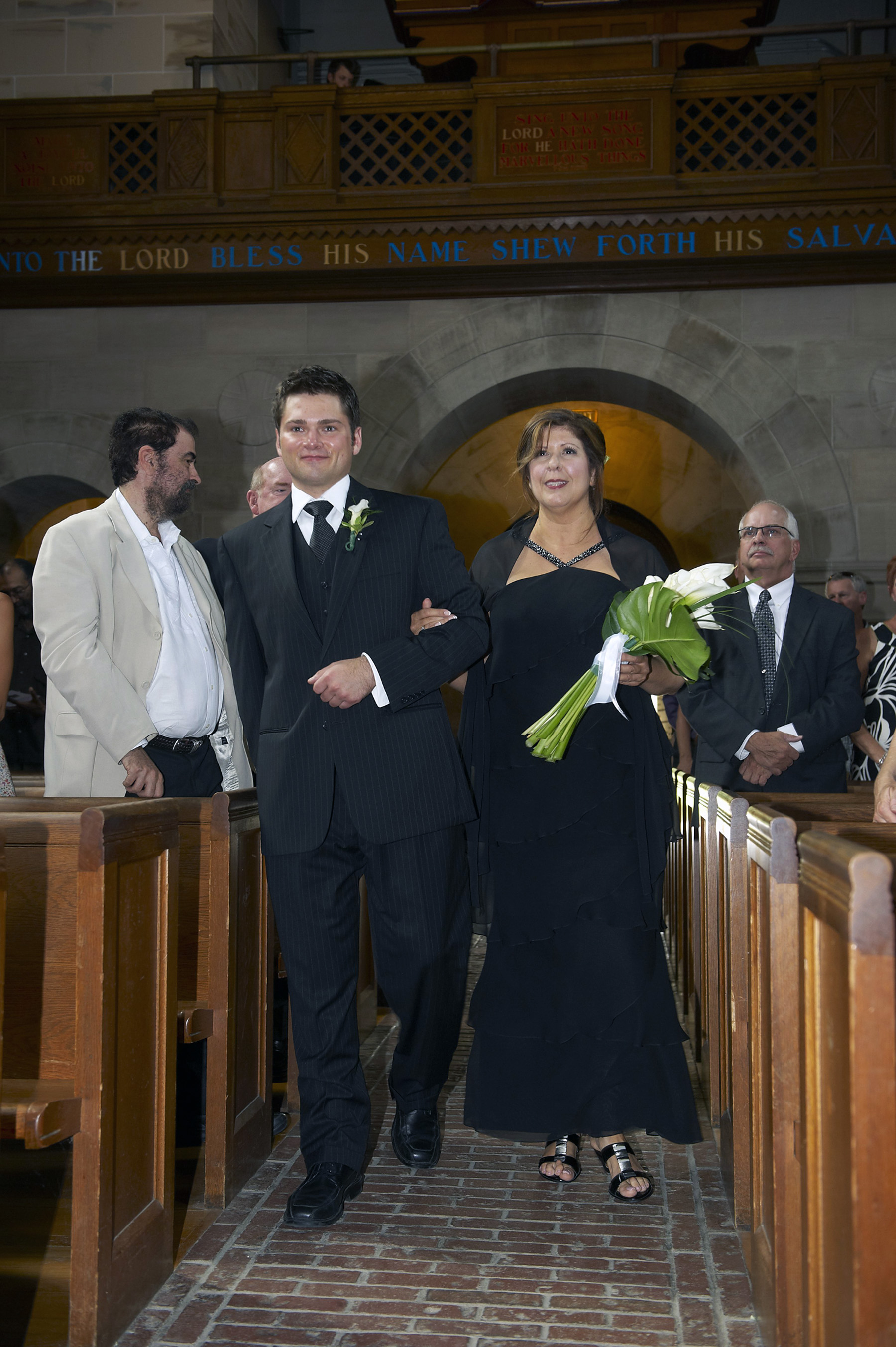
And so it was that the bride wore black.*

If the dress that I selected had anything to say to the world, it would be this:

Here is a new, albeit older, bride. A modern bride. A bride who, on occasion, likes to tweak tradition. A bride who knows what is what in this world. A bride who has lived five decades and four years, and who holds no preconceptions or illusions beneath an illusion veil. (Indeed, I would wear a single, simple calla lily in my hair.)

Yes. The dress suited me. And, winking at superstition myself, I peeked out of the fitting room to find John.

“Well? What do you think?”

“You look beautiful,” he said, smiling. “You’ve found the dress.”

Yes. The groom saw the bride in her gown before the wedding.

And so far, they’re living happily ever after.

*There’s a marvelous François Truffaut film from the late 1960s called The Bride Wore Black, starring the exquisite Jeanne Moreau, the plot of which has nothing whatsoever to do with my own story. Luckily.

Share this:

  • Click to share on Facebook (Opens in new window) Facebook
  • Click to share on X (Opens in new window) X
  • Click to share on Pinterest (Opens in new window) Pinterest
  • Click to share on LinkedIn (Opens in new window) LinkedIn
  • Click to email a link to a friend (Opens in new window) Email
  • Click to print (Opens in new window) Print
  • Click to share on Tumblr (Opens in new window) Tumblr
  • Click to share on Pocket (Opens in new window) Pocket
  • Click to share on Reddit (Opens in new window) Reddit
Like Loading...

What’s Baggage Got To Do With It?

07 Friday Oct 2011

Posted by themidlifesecondwife in Midpoints, Relationships and Family Life

≈ 5 Comments

Tags

baggage, Love, Relationships and Family Life, second marriages, Wendy Swallow

MorgueFile Image

Baggage. It can ruin a spirit just as easily as it can ruin a back. We carry so much of it throughout our lives, but never more so than when we chart a different course, at the intersection where middle age meets true love.

To get remarried at life’s midpoint is to start life as a grown-up all over again. What takes some of the fear and sting out of starting over from scratch is, paradoxically,  some of the baggage that we carry. That which has influenced us, marked us, and wounded us has also taught us. We have a glowing map this time around, whereas the first time some of us might have been driving in the dark, without any headlights on.

We have, in short, been forewarned.

The baggage metaphor springs today from that most pedestrian of pursuits: travel. I am writing this from the middle seat of the mid-section of a United Airlines flight to Orange County, California. I am multitasking, engaging my transversus abdominus the way that Dr. Amanda Miller taught me, so that all the bags I’ve just schlepped while walking down the endless airport corridors won’t wreak havoc on my lower back, and ruin my six sunny days in Southern California.

I’m thinking of baggage because, while I’m in California, I’m going to revisit a book that I read during my engagement to John. If you’ve been following this blog from the beginning, you’ll remember an article I wrote for the Richmond Times-Dispatch about online dating, and how I met John. In the article, I referenced a wonderful memoir of remarriage called The Triumph of Love Over Experience. The woman who wrote the book, Wendy Swallow, shared this stunning insight:

The single most important thing to making a marriage work is the ability of each party to tolerate the neuroses of the other. If you’re going to make it for the long haul, you’re going to have to learn to live with those neuroses. In fact, you’re going to have to learn to embrace them.

John and I like to think that we hug one another’s neuroses at least as often as we hug one another. We each possess a fairly sophisticated baggage-ometer, and can ferret out subtext pretty well, knowing when it’s time to give the other an extra mite of space. Or a strategically-timed hug.

Wendy Swallow will be my guest for an upcoming “Monday Morning Q & A,” so while I’m in California I’ll be doing my homework—re-reading her book with the vantage point of a full year of (re)marriage under my belt, and thinking about what I want to ask her.

One of my readers wrote me the following:

I’m not in midlife (not admittingly) and not a second wife, but I’m having thoughts and fears of a second marriage. I’m 43 (admitting it) and said that I would never remarry, but I have recently found someone who I would consider marrying and I’m scared as hell!

For this reader, I’ll formulate a question for Wendy. Is there anything you’d like me to ask her? If so, please send them to me at:

marci.keyword@gmail.com

Gotta run. The Southern California sunshine is calling me!

Share this:

  • Click to share on Facebook (Opens in new window) Facebook
  • Click to share on X (Opens in new window) X
  • Click to share on Pinterest (Opens in new window) Pinterest
  • Click to share on LinkedIn (Opens in new window) LinkedIn
  • Click to email a link to a friend (Opens in new window) Email
  • Click to print (Opens in new window) Print
  • Click to share on Tumblr (Opens in new window) Tumblr
  • Click to share on Pocket (Opens in new window) Pocket
  • Click to share on Reddit (Opens in new window) Reddit
Like Loading...

The Man Who Wasn’t There: A 9/11 Remembrance

11 Sunday Sep 2011

Posted by themidlifesecondwife in Transitions

≈ 18 Comments

Tags

9/11, Life, Love, Relationships and Family Life, World Trade Center

Sept. 11, 2012—A note to the reader: I published this post last year in honor of the 10th anniversary of 9/11. I would like to share it with you again, today, as we acknowledge another sadly inevitable milestone, and leave you with these words from the poet Edna St. Vincent Millay:

I am not resigned to the shutting away of loving hearts in the hard ground.

So it is, and so it will be, for so it has been, time out of mind:

Into the darkness they go, the wise and the lovely. Crowned

With lilies and with laurel they go; but I am not resigned.

—From “Dirge Without Music”

Dedicated to those who died, and to those whose lives were changed forever.

Like many of you, I sat transfixed in front of the television today, watching the poignant ceremonies and tributes in New York City, in Washington, D.C., and in Shanksville, Penn., honoring the victims and heroes of September 11. Like many of you, I watched with a loved one, grateful that I was not alone with these heartrending images. Like many of you, I remain painfully aware of the thousands of loved ones who saw their lives forever altered during those brief, horrific hours ten years ago.

My heart goes out to these families. I cannot even begin to imagine the magnitude of their loss, the depths of their grief.

My husband and I also watched MSNBC’s playback of NBC’s live coverage of those terrifying moments when the world changed. We held hands tightly. My gaze remained fixed on the gaping hole in the North Tower of the World Trade Center. I could almost see the imprint left by the plane, a jagged, gaping black hole belching smoke.

My husband was to have been there.

At the time, of course, he was not my husband. At the time, I did not even know that he existed. I was still married to my first husband, he to his first wife.

Ten years ago, surrounded by colleagues and students, I watched the catastrophe unfold in real-time; someone had set up a television in the student lounge at the Oberlin Conservatory of Music, where I worked. I had no idea that less than 50 miles from where I stood, a man sat with his own colleagues, watching the same images, shaking his head in wonderment that he was alive.

These are the jolts of time and circumstance that leave me speechless, in awe of the powerful forces that alter our lives.

John has spent the majority of his career in commercial insurance, specifically, environmental insurance. From 1994 through 1998, he worked in the Cleveland office of AIG. It was while John was with AIG that he became friends with a New York-based AIG colleague, Jeffrey Gardner. John left AIG to become vice-president and managing director of Seneca Environmental Management, a division of Seneca Specialty Insurance Company. Jeffrey ultimately left AIG to join Marsh McLennan as an environmental insurance broker. At the time of the attacks on 9/11, Marsh McLennan had offices on eight floors of the North Tower of the World Trade Center.

Because John’s responsibilities at Seneca involved all aspects of national marketing and underwriting, he traveled frequently for work, often to meet with his clients—insurance brokers in cities all across the country. Jeffrey was now a client. At 8:30 on the morning of Tuesday, September 11, 2001, John had a meeting scheduled with Jeffrey in his office at the WTC.

Less than one week before their meeting, John telephoned Jeffrey to postpone. “I looked at my calendar and realized that we would both be at the same conference at San Antonio in a few weeks’ time, so I called Jeffrey and suggested that we put off our meeting until then. It is so vivid—I remember standing next to my desk and looking out the window on a clear Friday afternoon, with my phone in my hand as we spoke for the last time.”

At 8:46 a.m. on Tuesday, September 11, 2001, 16 minutes after the originally scheduled time of John’s meeting with Jeffrey Gardner, American Airlines Flight 11 crashed into the north side of the North Tower, between the 94th and 98th floors.

Jeffrey’s office at Marsh McLennan, where he was to have met with John, was on the 98th floor.

John watched the horror unfold from the safety of a third-floor office in Middleburg Heights, Ohio, with his colleagues. Here is his account:

I didn’t make the connection at first—that I would have been staring at the nose of the aircraft as it split the building.  All I could think of was the terror coursing through the veins of everyone in the building. I knew quite a few people in there and my brother, Brian, lived just across the river, in Brooklyn.  I heard about it on the car radio on my way to work; I lived just a few miles from the office, so I turned around to get a small TV from the house so those of us in the office could follow what was happening.  I returned with the TV and had plugged it in just after the second plane struck the South Tower. 

All seven of us were in the office, riveted to the TV. I turned to see one of my assistants, Elaine, staring at me.  Her face was ashen. She whispered, “You were supposed to be there.” Then, after a measured pause, she repeated the same words in a slightly more audible voice. It was then that I felt my stomach drive itself into my throat.  All of a sudden I could almost feel a part of myself in the office and a part of myself standing hopelessly somewhere among the mass hysteria that was unfolding. 

Just as I was coming to grips with the fact that I was safe, the first tower collapsed.  My own words came slowly this time: “I was supposed to be there. I was supposed to be there.” I could not take my eyes off what I was witnessing, knowing that my fate had placed me safely in a third-floor office in Northeast Ohio instead of in the unspeakable crosshairs of history. I would be able to come home and hug my sons, and they would still have a dad. 

Despite our inability to connect with home office for days, we eventually learned that all of our company people were accounted for. But had I not made that fateful call to change my plans for that day, there would have been one less name on the company roster.

The two beautiful waterfalls designed by Michael Arad and Peter Walker that now soothe the scorched footprints of the Twin Towers at the Memorial site have a most philosophical name: “Reflecting Absence.” John and I plan to pay our respects, to look at the names etched in bronze on the memorial’s perimeters. We will pause when we get to Jeffrey Gardner’s. We will say a prayer for him and for his family. And we will reflect upon John’s absence from the World Trade Center on that fateful day.


 —Originally published on Sept. 11, 2011


Share this:

  • Click to share on Facebook (Opens in new window) Facebook
  • Click to share on X (Opens in new window) X
  • Click to share on Pinterest (Opens in new window) Pinterest
  • Click to share on LinkedIn (Opens in new window) LinkedIn
  • Click to email a link to a friend (Opens in new window) Email
  • Click to print (Opens in new window) Print
  • Click to share on Tumblr (Opens in new window) Tumblr
  • Click to share on Pocket (Opens in new window) Pocket
  • Click to share on Reddit (Opens in new window) Reddit
Like Loading...
← Older posts
Newer posts →

Twitter Updates

Tweets by midlife2wife

Company

  • 183,601 Guests since 8/24/11

Receive notifications of new posts by email.

Join 1,202 other subscribers

Topics

  • Current Events
  • Food for Thought
  • Giveaways
  • House and Garden
  • Humor Me
  • Indulgences
  • Inspiring Women
  • LifeStyles
  • Love
  • Midpoints
  • Monday Morning Q & A
  • Money Matters
  • Nostalgia
  • Portraits of the Artist
  • Product Reviews
  • Relationships and Family Life
  • Remarriage
  • Second Weddings
  • Second Wife Hall of Fame
  • Secrets to a Happy Relationship
  • Special Events
  • Technology
  • The Beautiful Life
  • The Cultured Life
  • The Healthy Life
  • The Life Poetic
  • The Musical Life
  • The Reading Life
  • The Well-Dressed Life
  • The Writing Life
  • Transitions
  • Travel
  • Well-Dressed
  • What's the Buzz?

RSS Feeds

  • RSS - Posts
  • RSS - Comments

Archives

  • July 2019 (1)
  • December 2014 (1)
  • November 2014 (1)
  • October 2014 (2)
  • August 2014 (1)
  • June 2014 (2)
  • May 2014 (2)
  • April 2014 (3)
  • March 2014 (3)
  • February 2014 (3)
  • January 2014 (4)
  • December 2013 (9)
  • November 2013 (2)
  • October 2013 (3)
  • September 2013 (6)
  • August 2013 (5)
  • July 2013 (6)
  • June 2013 (2)
  • May 2013 (3)
  • April 2013 (1)
  • March 2013 (1)
  • January 2013 (3)
  • December 2012 (7)
  • November 2012 (7)
  • October 2012 (12)
  • September 2012 (9)
  • August 2012 (6)
  • July 2012 (4)
  • June 2012 (5)
  • May 2012 (4)
  • April 2012 (1)
  • March 2012 (10)
  • February 2012 (8)
  • January 2012 (9)
  • December 2011 (10)
  • November 2011 (30)
  • October 2011 (18)
  • September 2011 (12)
  • August 2011 (2)

Networks

NetworkedBlogs
Blog:
The Midlife Second Wife ™
Topics:
Relationships, Life, After 50
 
Follow my blog

bloglovin

The Blogs of Others

  • A Baby Boomer Woman's Life After 50
  • A.B. Westrick
  • An Empowered Spirit
  • Apart from my Art
  • Author Meg Medina
  • Better After 50
  • Books is Wonderful
  • Darryle Pollack: I Never Signed Up For This
  • Diana Patient: Photography
  • Empty House, Full Mind
  • GenerationBSquared
  • Grandma's Briefs
  • Grown and Flown
  • Midlife at the Oasis
  • Midlife Boulevard
  • Midlife Mixtape
  • Reason Creek
  • Relocation: The Blog
  • Romancing Reality
  • Second Lives Club
  • The Boomer Rants
  • WHOA Network
  • WordCount

COPYRIGHT © 2011 — 2024  Marci Rich and The Midlife Second Wife™ Keyword Communications, LLC. All Rights Reserved.

Blog at WordPress.com.

  • Subscribe Subscribed
    • The Midlife Second Wife ™
    • Join 450 other subscribers
    • Already have a WordPress.com account? Log in now.
    • The Midlife Second Wife ™
    • Subscribe Subscribed
    • Sign up
    • Log in
    • Report this content
    • View site in Reader
    • Manage subscriptions
    • Collapse this bar
 

Loading Comments...
 

    %d