• An Open Book: TMSW’s Library
  • Copyright
  • Food for Thought Recipes
  • My Right Eye: A Medical Memoir by Marci Rich
  • Praise and Awards
    • Writing Badges
  • The Midlife Second Wives’ Hall of Fame
  • Who is The Midlife Second Wife?
    • Contact
    • FAQ
  • Read Me On The Huffington Post

The Midlife Second Wife ™

~ The Real and True Adventures of Remarriage at Life's Midpoint

The Midlife Second Wife ™

Author Archives: themidlifesecondwife

The Godmother’s Italian Wedding Soup

20 Monday Feb 2012

Posted by themidlifesecondwife in Food for Thought, Nostalgia, Relationships and Family Life

≈ 4 Comments

Tags

Cooking, Food, Italian cooking, Italian Wedding Soup, recipes, Soups

I was not at a wedding the first time I ever tasted Italian Wedding Soup. My recollection is surprisingly sharp, given I could not have been more than eight-years old. My mother, who was of Sicilian descent, had cousins in Warren, Michigan. My father drove the three of us up from Elyria, Ohio—a nearly three-hour trip—for a day visit, the purpose of which eludes me (here my memory is as dense as a cumulonimbus cloud). We gathered for a delicious dinner in the cousins’ formal dining room. I suspect there are two reasons why I remember any of this at all: First, we never traveled anywhere as a family, and second, I had never seen soup with what looked like cooked lettuce in it. It wasn’t lettuce at all, of course, but rather escarole. (I had no idea what that was, so the distinction was lost on me at the time.) All I knew was that the concoction was wonderful, punctuated by the most charming little meatballs I’d ever seen outside of a plate of spaghetti. This sense memory has stayed with me for years.

The name comes from the Italian word for soup, minestra, and the fact that the flavors “marry” well (maritata); hence, wedding soup. This recipe comes from my godmother Fannie, an excellent cook. You’ll remember meeting her in my story “Marlo & Me—Act I.” Aunt Fannie, thank you for sharing this recipe with me, and for allowing me to include it in the blog.

ITALIAN WEDDING SOUP
Serves 4

FOR THE MEATBALLS:
2 pounds ground chuck or round steak
3/4 cup Italian-seasoned bread crumbs
3 eggs, whipped with a whisk
1 Tablespoon parsley flakes
1/4 cup freshly grated Parmigiano-Reggiano cheese
1-1/2 teaspoons Kosher salt
1/2 teaspoon freshly ground pepper
1 teaspoon garlic powder, or 1 minced clove of garlic
2-3 Tablespoons olive oil, for frying

Mix all of the ingredients thoroughly in a large bowl. Cover and let stand at room temperature for one and one-half hours.

Roll the meat into 1/2-inch balls. Brown in olive oil and drain on paper towels. (At this point the meatballs can be frozen for later use.)

THE SOUP:
One-half batch browned meatballs for 2 quarts broth. Freeze the rest of the meatballs for the next time. (If you wish to use the entire batch of meatballs, double the following quantities):

1 bunch escarole (fresh spinach can be substituted)
2 quarts chicken stock (I had homemade stock in my freezer)
Two eggs, beaten
1 cup freshly grated Parmigiano-Reggiano cheese
Kosher salt and freshly ground black pepper, to taste

Wash, trim, and cut the escarole (or spinach) into small pieces. Place in a pot of boiling water for about eight minutes (five minutes if using spinach). Drain well.

Bring chicken broth to a boil, season with salt and pepper to taste, and reduce heat to simmer. Add the meatballs and escarole (or spinach) and return to a boil. Reduce heat, cover, and simmer for about 20 minutes, allowing the flavors of the meatballs to infuse the broth. Add the beaten eggs and cheese. Serve immediately, with extra cheese at the table.

Share this:

  • Click to share on Facebook (Opens in new window) Facebook
  • Click to share on X (Opens in new window) X
  • Click to share on Pinterest (Opens in new window) Pinterest
  • Click to share on LinkedIn (Opens in new window) LinkedIn
  • Click to email a link to a friend (Opens in new window) Email
  • Click to print (Opens in new window) Print
  • Click to share on Tumblr (Opens in new window) Tumblr
  • Click to share on Pocket (Opens in new window) Pocket
  • Click to share on Reddit (Opens in new window) Reddit
Like Loading...

My Blood Donor Valentine

14 Tuesday Feb 2012

Posted by themidlifesecondwife in Love, Relationships and Family Life, The Healthy Life

≈ 8 Comments

Tags

Blood donation, Blood transfusion, Generosity, Health, Life, Love, Valentine's Day, Whole blood

John, hooked up to the apheresis machine at Virginia Blood Services.

Yesterday, to honor John on his birthday, I shared with you the key to his character: his favorite book is Shel Silverstein’s The Giving Tree. Today’s post, I hope, conveys just how much I love and admire my Valentine, and I think this picture tells more of the story.

Every two weeks, John spends a couple of hours hooked up to an apheresis machine at Virginia Blood Services. The device is a type of centrifuge which extracts the blood platelets and some of the plasma from John’s whole blood, returning the red cells and most of the plasma back to him but retaining the life-giving platelets. As I understand it, platelets are an essential part of cancer and organ transplant treatments. John has been donating either whole blood or platelets for most of his adult life; he first gave blood when he lived in Pittsburgh in the late 1980s, after learning about an area child, suffering from leukemia, who needed platelets for treatment.

I’m not afraid of needles or anything, but I’ve never given blood before. My blood pressure has always trended on the low side; I am, unfortunately, one of those people with a lower than usual supply of energy. I suppose I just assumed that giving blood would have an adverse effect on me, depleting my precious stores of vitality.

But on Sunday I accompanied John to Virginia Blood Services and, to my pleasant surprise, I passed the initial screening. I then got myself tethered to a tube and proceeded to have one pint of whole blood siphoned from myself, feeling rather like a pump at a gas station. The whole procedure took about eight minutes. And although John’s method of donating—apheresis—takes about two hours, the process is typically kinder to his system than giving whole blood, because the machine returns the vital red cells to him. Giving whole blood, in which one relinquishes red cells, platelets, plasma and all, can tend to leave a person feeling weaker than giving via apheresis. I’m glad to say, however, that after drinking a can of sugared soda at the advice of the technician (something I never do), I only felt tired, not light-headed or ill in any way.

Here are some facts, courtesy of the Virginia Blood Services website, that are worth learning if you’ve ever considered donating blood but have yet to take the plunge:

  • More than 4.5 million patients need blood transfusions each year in the U.S. and Canada;
  • 43,000 pints of donated blood are used each day in the U.S. and Canada;
  • Someone needs blood every two seconds. Females receive 53 percent of blood transfusions; males receive 47 percent;
  • In the United States, less than 10 percent of the 38 percent eligible to donate blood do so annually;
  • About one in seven people entering a hospital need blood;
  • One pint of blood can save up to three lives.

It’s astonishing to think that the pint of blood I donated on Sunday could save three lives. I’m ashamed that I’ve never been so selfless before this. John’s generous nature has influenced me. And that’s one of the many gifts he’s given me that money can’t buy.

Happy Valentine’s Day, everyone!

Share this:

  • Click to share on Facebook (Opens in new window) Facebook
  • Click to share on X (Opens in new window) X
  • Click to share on Pinterest (Opens in new window) Pinterest
  • Click to share on LinkedIn (Opens in new window) LinkedIn
  • Click to email a link to a friend (Opens in new window) Email
  • Click to print (Opens in new window) Print
  • Click to share on Tumblr (Opens in new window) Tumblr
  • Click to share on Pocket (Opens in new window) Pocket
  • Click to share on Reddit (Opens in new window) Reddit
Like Loading...

Happy Birthentine’s Day to TMSH!

13 Monday Feb 2012

Posted by themidlifesecondwife in Love, Relationships and Family Life, Special Events

≈ 3 Comments

Tags

Birthdays, Generosity, Life, Love, Shel Silverstein, Valentine's Day

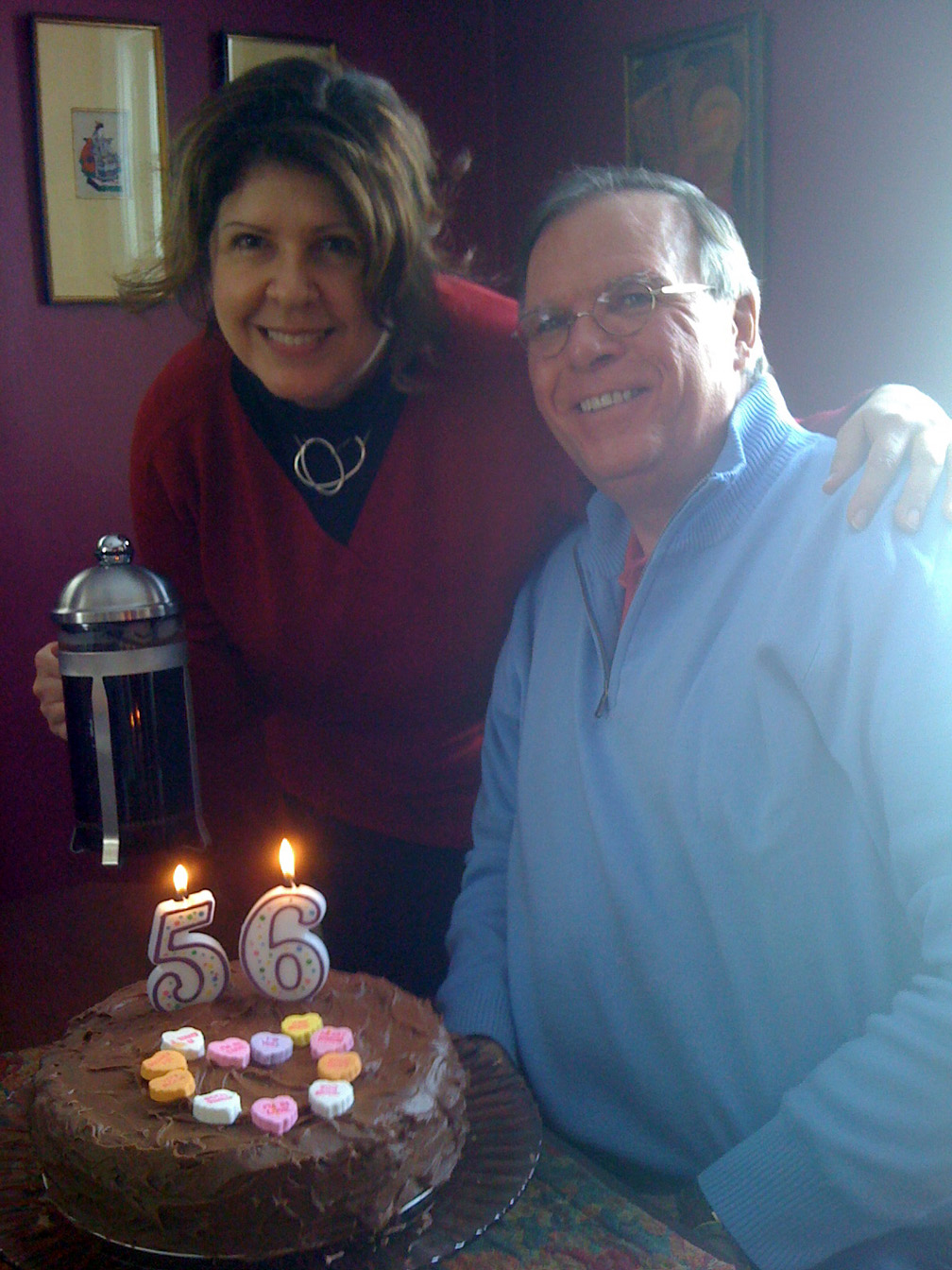
Celebrating John's birthday in 2010. We became engaged the previous month.

Today we celebrate Birthentine’s Day—the eve of Valentine’s Day and John’s birthday. Fifty-eight years ago, in Bronxville, New York, Patricia Cade Rich and John Irving Rich announced to the world the arrival of John Junior, their first-born. I’m awfully glad of this, because if they hadn’t, then where would I be? Probably back in Ohio, freezing while scraping the ice off my car in order to drive to my former job, where I would work long hours, stop at Tooo Chinoise to pick up Chicken Lo Mein, and take it home for dinner. Would I be loveless? Sad to think about this, but yes. Quite possibly I would be, because if the love of my life had not been born, he would not have managed—against all odds of time and space and circumstance—to find me. Certainly I would not be writing this blog, for without The Midlife Second Husband there would be no Midlife Second Wife.

Pat and Jack, I wish you were still alive so I could know you, and thank you, and tell you that I love you for the amazing son you raised.

What do you give a man who has given you the best of everything that money can’t buy? (I can’t tell you here, because then he won’t be surprised when he opens his present tonight at dinner.)

What I can tell you is that when it comes to giving, John has no equal. When we first met, he advised me that if I wanted the key to understanding him, I needed to know that his favorite book was The Giving Tree, by Shel Silverstein.

I needn’t tell you that it is the tree—not the little boy—that John identifies with in the book.

Tomorrow is Valentine’s Day. To mark the occasion, I will be writing a post that I hope will give you some idea of what a giving person my John is. But now I must go. I have a present to wrap.

Share this:

  • Click to share on Facebook (Opens in new window) Facebook
  • Click to share on X (Opens in new window) X
  • Click to share on Pinterest (Opens in new window) Pinterest
  • Click to share on LinkedIn (Opens in new window) LinkedIn
  • Click to email a link to a friend (Opens in new window) Email
  • Click to print (Opens in new window) Print
  • Click to share on Tumblr (Opens in new window) Tumblr
  • Click to share on Pocket (Opens in new window) Pocket
  • Click to share on Reddit (Opens in new window) Reddit
Like Loading...

Simple Poached Salmon

08 Wednesday Feb 2012

Posted by themidlifesecondwife in Food for Thought

≈ 3 Comments

Tags

Cooking, Food, recipes, Salmon, Seafood, Slow cooker

If you got married in the 1970s, chances are one of your shower gifts was a “Crock Pot,” now more commonly known as a slow cooker. The outer shell of mine was in the popular color of the day—avocado. (Don’t you agree that styles and color trends often change for the better?)

That particular Crock-Pot, shaped rather like a pickle barrel without the center bulge, was more upright than roaster-shaped, which is to say you couldn’t fit in all that much. I recall making exactly one dish in it—kielbasa sausage and sauerkraut. I recall not making it very often. Relegated towards the back of a cupboard, the Crock-Pot eventually made some unknown bargain hunter quite happy at a garage sale.

Flash forward to this millenium, and an article that caught my eye in the January 29, 2003 edition of the New York Times. Noted cookbook author Mark Bittman’s “Low and Slow is the Way to Go” made me rethink my antiquated notions of slow cooker cooking. (His recipe for short ribs with Chinese flavors is off-the-hook delicious. I haven’t made it in a while but I should move it up in the rotation. Just re-reading this article made me want it.)

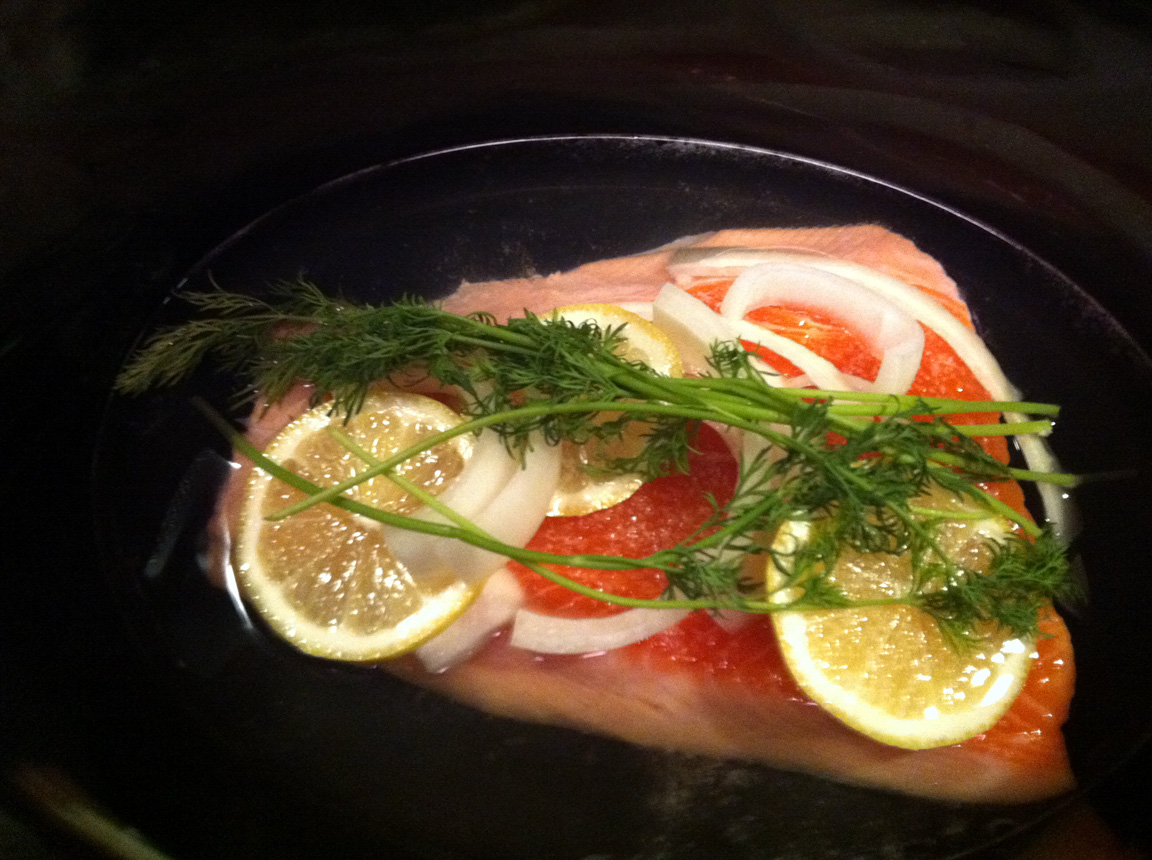
Reading his article for the first time made me covet the kind of slow cooker he was using. Unfortunately, the photo isn’t included in the online version of the story, but you can see it in my mise en place photo for today’s recipe. With its gleaming stainless steel shell and spacious oval shape, it’s one of my favorite pieces of kitchen equipment. I bought it nearly 10 years ago. I’m still using it. I love it. (But not as much as I love John.)

This recipe for poached salmon is delectable. I never prepared fish all that much back in Ohio; even though we lived near Lake Erie, I never made fried perch. I’m just not a huge fan of fried food. I also didn’t live near a good seafood store. I know people who rave about the seafood at Costco, but I prefer a small shop where they truck the fish in fresh daily, and everybody knows your name. Since moving to Richmond, I shop at Yellow Umbrella, where they truck their fish in two or three times a day. (I love Yellow Umbrella as much as I love my slow cooker.)

I bought a one-pound fillet of organically raised, low-density New Zealand salmon for this—it’s one of our favorites. The recipe comes from volume two of Lynn Alley’s wonderful book, The Gourmet Slow Cooker: Regional Comfort-Food Classics, published by Ten Speed Press. My thanks to Lynn for giving me permission to include her recipe in TMSW!

Copyright © 2006 by Lynn Alley. All rights reserved. Used with permission of the author.

Simple Poached Salmon

—Serves 4

1 cup water
1/2 cup dry white wine
1 yellow onion slice (I typically use 2)
1 lemon slice (I typically use about 3 slices)
1 sprig dill (If seasonal and the bunch is large. If using a packaged herb, I use about 4-5 sprigs…and I always buy organic)
1/2 teaspoon salt (I use Kosher)
4 (6-ounch salmon fillets…for two people I buy a one-pound fillet)

Combine the water and wine in the slow cooker and heat on high for 20 to 30 minutes. Add the onion, lemon, dill, salt, and salmon.

Cover and cook on high for about 20 minutes, until the salmon is opaque and cooked through according to taste. (Since I didn’t portion out the fillet, what you see below actually took longer than 20 minutes to cook—closer to 45 minutes.) Serve hot or cold.

From Lynn Alley’s notes to the recipe:

Poaching salmon, or any fish for that matter, in the slow cooker is a no-brainer. Although it isn’t a traditional dish for long, slow cooking, it is one of the things that the low, even temperatures of the slow cooker does well with. Poached salmon, needing no oil to cook, makes a light lunch paired with lemon rice. steamed vegetables, and salad, or a sumptuous dinner with herbed mashed potatoes and grilled vegetables. SUGGESTED BEVERAGE: Salmon, a classic Pacific Northwest ingredient, generally fits like a glove with pinot noir, Oregon’s most beloved grape.

My notes:

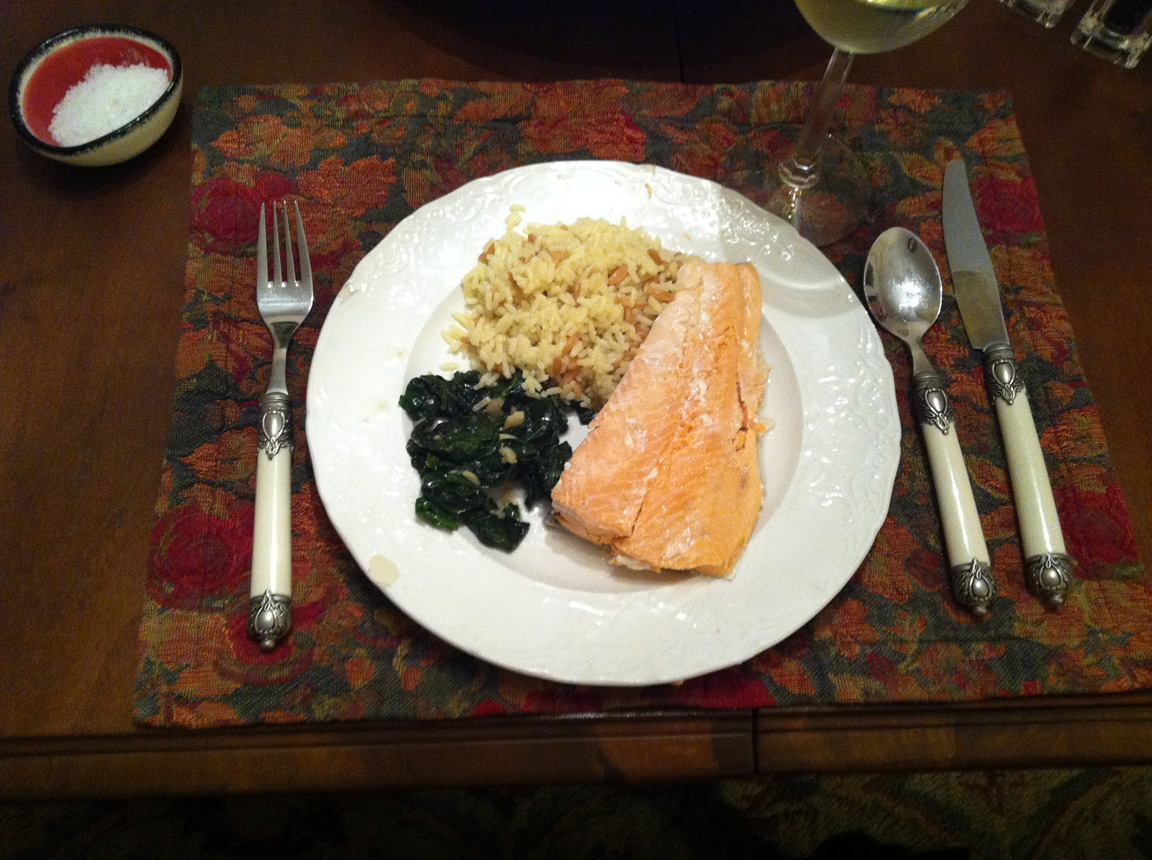
I serve this hot with rice pilaf and either roasted asparagus or sautéed spinach. Our wine that evening was James River Cellars’ Chardonel. 

Share this:

  • Click to share on Facebook (Opens in new window) Facebook
  • Click to share on X (Opens in new window) X
  • Click to share on Pinterest (Opens in new window) Pinterest
  • Click to share on LinkedIn (Opens in new window) LinkedIn
  • Click to email a link to a friend (Opens in new window) Email
  • Click to print (Opens in new window) Print
  • Click to share on Tumblr (Opens in new window) Tumblr
  • Click to share on Pocket (Opens in new window) Pocket
  • Click to share on Reddit (Opens in new window) Reddit
Like Loading...

Why I’m Wearing Red for Women’s Heart Health

03 Friday Feb 2012

Posted by themidlifesecondwife in The Healthy Life, Well-Dressed

≈ 3 Comments

Tags

American Heart Association, Health, Heart disease, List of causes of death by rate, Myocardial infarction, National Wear Red Day

What with this week’s controversy surrounding Susan G. Komen For the Cure’s decision to pull funding for Planned Parenthood (a wrong-headed move, I think), the color pink has been front and center in the news.* This suggests that the darker tone in the palette—red—could be overlooked. That would be a shame, because while the horror that is breast cancer claims far too many lives, it is actually heart disease that kills more than half a million women each year, giving it the dubious distinction of being the leading cause of death among women.

(My thanks to Marlo Thomas and her terrific Huffington Post article for highlighting these surprising statistics.)

Today is National Wear Red Day, and to draw attention to the cause, I’ll be wearing the little number shown above when I leave my laptop to lunch with a few Richmond writers. I’ll also be taking a good, long look at the American Heart Association’s “Go Red for Women” website to educate myself about the topic, and then I’ll make an appointment with my doctor to schedule a heart-health checkup.

Why has this issue commanded my attention—even more than the other distressing health topic in the news this week? Because I have a sneaking suspicion that if any disease is going to nab me, it will have something to do with my heart, and not the flesh covering it. And this from a woman who’s already had cancer.

My father died in 1969, two weeks after suffering a massive heart attack. He was only 48-years old. (I was 13. I have now lived seven years longer than he.) His illness occurred in the days before cardiac care units; he spent the last weeks of his life in an intensive care ward, surrounded by other desperately ill or injured patients—an environment hardly conducive to reducing one’s stress level.

His death was one of the most formative experiences in my life, and there’s much more to say about it in a future post. (More to say about my thyroid cancer, too.) But for now, the point I’m trying to make is that my genetic predisposition for heart disease is pretty strong. And I have what Dr. Oz calls the number one “symptom to watch for [—] shortness of breath.” I’d like to pretend these things don’t exist—going to the doctor for any reason is not my favorite pastime—but I really know better. And I really need to know more.

Please read Marlo’s article. There’s a lot of great information to be found there. She’s interviewed Dr. Oz, as well as Barbra Streisand, whom she calls “a front line soldier in the fight against women’s heart disease.” I was not aware that the number one symptom of heart disease is shortness of breath. I’m ready to take action now.

And I’m ready to make my fashion statement.

Oh, and one more thing: I’ll be sending positive energy to every woman affected by either of these awful diseases. Let’s work to help rid the world of both of ’em. Okay?

*A CNN alert on my iPhone just as I was about to publish this post reports that the Komen Foundation has reversed its decision: “Susan G. Komen for the Cure to restore Planned Parenthood breast cancer screening funds, Sen. Frank Lautenberg says.” Let’s hope so…

Share this:

  • Click to share on Facebook (Opens in new window) Facebook
  • Click to share on X (Opens in new window) X
  • Click to share on Pinterest (Opens in new window) Pinterest
  • Click to share on LinkedIn (Opens in new window) LinkedIn
  • Click to email a link to a friend (Opens in new window) Email
  • Click to print (Opens in new window) Print
  • Click to share on Tumblr (Opens in new window) Tumblr
  • Click to share on Pocket (Opens in new window) Pocket
  • Click to share on Reddit (Opens in new window) Reddit
Like Loading...

The Great Downton Compromise, or Why I’ll Be Watching the Super Bowl

02 Thursday Feb 2012

Posted by themidlifesecondwife in Relationships and Family Life, Special Events, The Cultured Life

≈ 10 Comments

Tags

Downton Abbey, New York Giants, Public Broadcasting Service, Super Bowl

MorgueFile Images

           —VS—

As married couples go, John and I are pretty well matched, but there are a few instances where we orbit different planets. I’m a Mac, for example; he’s a PC. He prefers Diet Coke; I like Diet Pepsi. I drink coffee; he drinks tea. But I love him and he loves me and we both love Downton Abbey. (And that’s quite enough rhyming for one blog post.)

For those not familiar with the Downton phenomenon, it is an hour-long British period drama broadcast on PBS’ estimable Masterpiece Classics series. Why do we love it so? Let me count a few of the ways: There are the carefully drawn, complex characters—many of whom we love to love and a few we love to hate. There’s the scalpel sharp writing—where wit, humor, and humanity emerge effortlessly from the situations at hand. (Maggie Smith’s Dowager Countess gets many of the best lines, but Mrs. Patmore—the dowager of the downstairs kitchen—won my heart when she tossed a crêpes suzette, longed for by an uppity new housemaid, to the estate’s dog). There are the high production values, the elegant Edwardian couture, and the page-turning plot developments. Downton Abbey, which has won a host of awards, is the 21st-century’s answer to another beloved PBS Masterpiece production—Upstairs, Downstairs, which I can remember watching in the 1970s. If you want to know more, you can read a synopsis on PBS’ Masterpiece website.

And so it is that on Sundays at 9, our television set is tuned to PBS. Sandy, our Cavalier King Charles Spaniel, watches the program with us, although she would like to state, formally and for the record, that there are far too few scenes featuring Lord Grantham’s dog Isis.

Sandy is often in charge of the remote

However …
In a plot development as disruptive as the evil Vera Bates, the network executives at PBS have somehow managed to schedule this wildly popular cult hit at the same time that ABC is broadcasting the Super Bowl.

Don’t talk to me about DVRs. Don’t suggest that John watch his beloved New York Giants battle the New England Patriots on a live Internet stream. That’s like asking me to wait to watch Downton the next day online (which, admittedly, I’ll probably do). But blimey—it’s just not the same. Remember, John and I came of age at a time where there were only three networks—five if you count one’s local PBS station and a network affiliate’s weak sister station on UHF. (And you could get those only if you had a round antenna attached to the back of your set.)

No, we’re old school enough, and watch television infrequently enough (we’ve only one set), that we like to catch programs when they actually air. We like the immediacy of it. And so this is why we have agreed to strike a compromise with respect to Downton Abbey.

You might recall that the subject of compromise was addressed quite well during my interview with author Wendy Swallow. “The Great Downton Compromise” is our way of putting our love to the test. John has already made his sacrifice; now it’s my turn.

On January 22, John’s team played the San Francisco 49ers for the NFC championship while Downton Abbey aired on PBS. John insisted on watching Downton with me; I had thought of experiencing the program vicariously through the weekly live Twitter party at #DowntonPBS, but no. John wanted us to watch the program together. (It’s true that he had already watched the Patriots beat the Ravens in the preceding televised game, so he wasn’t exactly football-deprived. But the Giants are his team. He grew up ten minutes outside of New Yawk City. I appreciated the gesture.)

As luck would have it, the game was still going on when Downton concluded, so he was able to watch his team take the NFC championship. In an outcome that would have made O. Henry proud, we both won that evening. But this Sunday, it’s my turn to make the grand gesture. Friends have invited us to watch the big game, and I’ll be trying my hand at making Buffalo Chicken Wings. That night’s episode of Downton Abbey will take place with one less viewer.

Why? Because I love my husband and I want to put his happiness ahead of mine—the way that he put his happiness ahead of mine the other day. It’s what married people do. Are you listening, Vera Bates?

Note to Downton fans: Please keep your tweets at #DowntonPBS as specific as possible—I’ll check in on the feed during halftime. (@PattonOswalt, just keep being funny.)

Related Articles:
“Why Liberals Love Downton Abbey“ (Salon)
Downton Abbey review (The New Yorker)
“Pass the Tea and the Remote and Put on Your Tiaras” (The New York Times)

Share this:

  • Click to share on Facebook (Opens in new window) Facebook
  • Click to share on X (Opens in new window) X
  • Click to share on Pinterest (Opens in new window) Pinterest
  • Click to share on LinkedIn (Opens in new window) LinkedIn
  • Click to email a link to a friend (Opens in new window) Email
  • Click to print (Opens in new window) Print
  • Click to share on Tumblr (Opens in new window) Tumblr
  • Click to share on Pocket (Opens in new window) Pocket
  • Click to share on Reddit (Opens in new window) Reddit
Like Loading...

Baked Kibbee (With a Memory Side Trip to Sittoo’s Kitchen)

01 Wednesday Feb 2012

Posted by themidlifesecondwife in Food for Thought

≈ 12 Comments

Tags

Cooking, Food, Middle Eastern Cooking, recipes

It’s time for equity in ethnic cooking here at The Midlife Second Wife. Regular readers of the blog know that I’m half Sicilian and half Lebanese, and that I’m proud of both aspects of my heritage. But yesterday, when I was compiling an index to the recipes, which you can find at the top of the site, I was struck by an egregious oversight: Italy and Sicily are represented, but Lebanon has nary an olive or a slice of pita bread to acknowledge its treasured place in my lineage. That changes today. I’m proud to share with you two recipes that, when combined, create a whole that is deliciously greater than the sum of its parts. I’m talking about Kibbee Bis-Sayniyyi, or Baked Kibbee.

My Grandmother Abookire prepared kibbee regularly, along with other wonderful dishes such as tabouli, homus, stuffed grape leaves, and kousa. I also have sublime memories of her baking, in her basement summer kitchen, what we now call pita bread, but which she called Syrian bread. The aroma filled the old, American Foursquare house. Sittoo (Arabic for Grandmother) employed an assembly line technique: the small, round discs of dough, having adequately risen, waited beneath kitchen towels on a long folding table for their turn in her antique Magic Chef gas oven. Using a worn, long-handled bread paddle, she pulled the piping hot loaves out of the oven and set them on a separate table. At this point I’d make my move: I’d grab a hot loaf with a spare towel, carry it upstairs to the main kitchen, slather it with butter, and settle on the front porch glider. There, in a carbohydrate-comfort food-stupor, I’d watch the summer traffic roll by on Route 20.

After Sittoo and Jiddu, my grandfather, moved from Ohio to Southern California, she would write to my mother and me regularly n her spidery, upward-slanted hand—often including some of her recipes. Her command of English was remarkable; she and my grandfather had been born and raised in Lebanon, but she was educated at American Christian schools. Nevertheless, I found it difficult to decipher her instructions. To compensate, over the years I’ve acquired substitute recipes that are just as delicious. (In truth, the ingredients and methodology are fairly universal.) I do believe, though, that watching her cook during those impressionable early years left their imprint on the way I squeeze water out of bulgur and use my hands to assemble tabouli. Or maybe all of this is simply embedded in my DNA.

These recipes are from a wonderful cookbook compiled by members of St. Anthony’s Maronite Catholic Church in Glen Allen, Virginia. I purchased the cookbook at their annual Lebanese Food Festival, held each May on the church grounds. In fact, the festival was the first place John took me during my first “official” visit to Richmond. If I  was thrilled to discover that a thriving Lebanese community existed in what would soon be my new hometown, imagine my delight when I tasted the food! If you live in or near Richmond (or plan to visit), mark these dates on your calendar: the 28th Annual Lebanese Food Festival takes place May 18 through 20, 2012. You can visit the church’s website for more information. My thanks to Father George for giving me permission to include these cooking instructions, ever-so-slightly adapted, from Timeless Lebanese Recipes.

Kibbee Bis-Sayniyyi
(Baked Kibbee)
Serves 8-10

To make this recipe, you actually have to make two other recipes first:

1 basic kibbee recipe
1 basic hashwee recipe
Canola oil

Let’s do that now, beginning with

Hashweh
(Meat and Pine Nut Filling)

1/4 cup pine nuts
2 tablespoons butter
1/2 pound ground lamb or beef
1 medium onion, finely chopped
1/4 teaspoon cinnamon
1/4 teaspoon allspice
salt and pepper to taste (I use Kosher salt)

Brown the pine nuts in butter until golden. Then add meat, onion, and spices. Sauté for 10 to 12 minutes. Recipe may be increased if more filling is needed.

After preparing this, I keep it in the refrigerator, in a covered bowl, until I’m ready to use it later that day.

Kibbee
(Basic Recipe)

1 and 1/2 cups bulgur #1 (if you’re using lamb, add an additional 1/2 cup)
1 large onion, pureed in blender
salt to taste
1/4 teaspoon pepper
1/8 teaspoon cinnamon (optional…I’d never dream of omitting this!)
1 teaspoon allspice
2 pounds (4 cups) extra lean lamb or beef (I prefer using lamb)

Cover bulgur (wheat) with cold water. Rinse three times. Drain and press between palms of hands to remove excess water. Work onions and spice together with fingers. Knead meat and spices thoroughly. Add crushed wheat and continue kneading. Dip hands in ice water while kneading in order to soften kibbee. (Ingredients must be kept cold.)

Optional: Run the kneaded mixture through a meat grinder, if available, for a finer consistency. (I don’t own a meat grinder, but I remember my grandmother had one permanently affixed to her kitchen table.)

Now, with both recipes prepared, it’s time to make the baked kibbee:

Cover the bottom of a 9 x 12 cape pan or glass Pyrex dish with canola oil. Spread a half-inch layer of kibbee on the bottom of the pan. (It is easier to take several large balls, pat them flat, and place them in the pan, piecing the kibbee to form an even layer on the bottom of the pan.) Then, go over the kibbee with your hand and smooth it evenly.* Spread the hashwee stuffing evenly over the kibbee layer. Place the remaining kibbee over the hashwee, using the same method. (The top layer should be thicker than the bottom.)

With a sharp knife, score the top layer 1/2 inch deep in a diamond-shaped design 1 inch apart. Pour a bit of canola oil across the top. Bake in a 400-degree oven for 25 minutes. Lower the heat to 300-degrees and bake for 20-30 minutes more. The baked kibbee should be golden brown. When serving, cut along the diamond-shaped wedges.

*Important: When smoothing the layers of kibbee by hand, keep dipping your hands in cold water so the kibbee will not stick to your hands. Smooth well.

I like to serve this with rice pilaf and tabouli. (I’ll share my recipe for tabouli with you at a future date.) Don’t forget the pita bread. Sadly, I’ve never tried to bake my own. I should; there’s a recipe for it in the church’s Timeless Lebanese Recipes! If I do, you can be certain I’ll let you know.

Bil-hanā’ wa ash-shifā’!*

*Bon appétit!

Share this:

  • Click to share on Facebook (Opens in new window) Facebook
  • Click to share on X (Opens in new window) X
  • Click to share on Pinterest (Opens in new window) Pinterest
  • Click to share on LinkedIn (Opens in new window) LinkedIn
  • Click to email a link to a friend (Opens in new window) Email
  • Click to print (Opens in new window) Print
  • Click to share on Tumblr (Opens in new window) Tumblr
  • Click to share on Pocket (Opens in new window) Pocket
  • Click to share on Reddit (Opens in new window) Reddit
Like Loading...

Boomers and Retirement: Preparing for the ‘New Normal’

30 Monday Jan 2012

Posted by themidlifesecondwife in Midpoints, Monday Morning Q & A, Money Matters

≈ 3 Comments

Tags

Baby boomer, Finances, Financial planner, Individual Retirement Account, Money, Pension, Retirement, Roth IRA, Savings account

A Talk with Financial Professional Michelle Mast

Last year, on 1/1/11, the very first baby boomers turned 65; the world welcomes the second wave this year. Happy Birthday, Boomers! If you’re keeping count, between 2011 and 2029, all baby boomers—the cohort born between 1946 and 1964—will have reached the age of 65. In seasons past, that was the age that marked the traditional start of retirement. But it’s a new dawn, a new day, and as Bob Dylan wrote, the times they are a-changin’.

Have you changed with them? If so, and one of your resolutions for the New Year is to save money for your retirement, congratulations! If not, and you are a boomer, then all you have is company to go with your misery, and a future that could be blowin’ in the wind.

Retirement

Image by 401K via Flickr

Michelle Mast is a professional CERTIFIED FINANCIAL PLANNER™ with AXA Advisors, LLC. She says that in 2011, 60 percent of baby boomers saved less than $100,000 toward their retirement1. Mast received a Certificate in Retirement Planning from the Wharton School of the University of Pennsylvania for completing the AXA Equitable at Retirement program. But you don’t need a certificate from Wharton to know that this statistic does not paint a pretty picture. Mast recalls that the rule of thumb used for projecting a person’s retirement plan once called for them to set aside 75 percent of what it cost to live in the manner to which they are accustomed. (We’ll talk in a moment about that.) Today, she says three factors have conspired to drive that projection from 75 percent up to 100 percent: mortality (people are living longer), inflation (‘nuff said), and health care expenses (ditto).

This is enough to send a person diving underneath the sofa cushions—if not to look for loose change, then to hide from the wolf at the door.

I recently spoke with Mast about strategies that might help those who haven’t saved enough for retirement.

TMSW: Michelle, the statistic about the number of boomers who don’t seem ready for retirement is pretty sobering.

MM: I know. And that’s the upside. Research also shows that during the same year, 36 percent of boomers saved less than $25,000 towards retirement, and 29 percent saved less than $10,0002.

What accounts for these low numbers?

There just aren’t as many pension plans today as there were in our parents’ generation. And market volatility may also be playing a role in many cases. But studies show that 14% percent of individuals have no retirement vehicle at all—not even an IRA account3.

This suggests to me that the retirement my generation envisioned may not be the norm.

That’s right. There may be what some people consider to be a “new normal.” A good number of people will be working during their retirement. This is significant: 50 percent of current retirees are finding that their actual retirement spending is equal to or higher than their spending prior to retirement4. Now in some cases, this is because people are doing things they weren’t able to do while they were working—traveling, for example. But people are generally living longer—into their 70s, 80s, and even 90s—especially women. Women have many financial concerns and are an extremely important part of what I’m saying now.

Well, what can be done to turn the tide?

People really just have to focus on savings; there is no such thing as a “retirement loan!” The only way to create the money for retirement is to save the money for retirement. Going backwards, analyze your current cash flow. Are there expenses you don’t have to incur? Can you set aside $10 a month? If so, put this toward an emergency reserve or a retirement account.

Really? Will $10 a month make a difference? I mean, I sometimes think that my nickel-and dime-approach to savings is like rearranging the deck chairs on the Titanic; at the end of each month, I take whatever is left in my wallet, add it to the change I’ve dumped in my little tin can, and put it in a savings account.

There’s no silly way to save. What is important is saving.

Can you talk a bit about that “emergency reserve”? We’ve all been taught how important it is to save for a rainy day. How much should a person plan on setting aside for the deluge?

In the past, the rule of thumb was to have six months of your living expenses in an emergency reserve; that is, in a savings vehicle that’s liquid, where you can access the funds easily if you need to. But in light of all the volatility of the past four years, the conventional wisdom now is that your emergency reserve should be closer to a year’s worth of living expenses. So if you have $3,000 in expenses each month—mortgage, utilities, groceries, etc.—you should have almost $36,000 in your emergency reserve.

I’m going to need more dimes and quarters…You mention a vehicle that’s liquid. You mean like a savings account?

The formula is going to be different for everybody, but yes, a savings account, but also other places where you could house a portion of this money, for example: a money-market deposit account or a certificate of deposit. The idea is to have the money work as hard for you as it can while still maintaining liquidity.

Going back to my measly little $10 a month, if I want to use it to begin saving toward retirement, which investment strategy makes the most sense?

IRAs, or Individual Retirement Accounts, are savings vehicles you can consider for retirement, depending on your particular situation. There are two different kinds of IRAs—a Traditional IRA and a Roth IRA. Here are the key differences:

  • A Traditional IRA will give you a tax deduction at the time you make a contribution. The money will grow, tax-deferred, but when you take it out during retirement, it will be considered taxable income. One thing to bear in mind with a Traditional IRA is that when you reach the age of 70-and-a-half, you have to distribute the Required Minimum Distribution.
  • A Roth IRA is different in that respect; you actually don’t ever have to take money out of it, which makes it a nice legacy to pass on. But if you do take out a withdrawal, the good news is that the money you take out is not taxable income, because Roth IRAs are funded with after-tax dollars. There are, however, no tax deductions for the money you contribute to a Roth IRA; nevertheless, that money will grow tax-deferred, just like the Traditional IRA. This is important to bear in mind: studies have shown that any tax-free benefits during retirement are generally good features. In fact, increasingly 401(k)s are including a Roth feature. Keep in mind that your choice of retirement planning strategies should be based entirely on your individual needs, goals, risk tolerance, and particular situation.

You can also combine distributions when you reach 70; take some funds out of each type of IRA account to minimize your taxable cost.

I’ve heard the term “dollar cost averaging,” but I’m not sure I understand what it means. Can you shed some light on the subject?

Market volatility might cause investors to shift their investment strategy away from equities (stocks). But history suggests that a down market may be a good time to consider investing—and dollar cost averaging (or systematic investing) can be effective because it essentially provides the opportunity to purchase more shares less expensively. With dollar cost averaging, the amount you invest on a regular basis is always the same, meaning that you buy more shares when the price is low and fewer shares when the price is high. This spreads out your cost basis over several years, which helps provide insulation against short-term changes in market price; a lower average cost can ultimately equal a higher return when the market goes back up. First, you’d decide exactly how much money you feel comfortable investing each month, but be sure that you’re financially capable of keeping that amount consistent. You’d next select a long-term investment in which you would like to invest your money. Then, at regular intervals (weekly, monthly, or quarterly), you would invest that money into the investment you’ve chosen. Of course, generally speaking, all investments in equities are subject to fluctuation in value and market risk, including loss of principal—and it’s very important to understand that while dollar cost averaging has the potential to reduce the average cost of a share of stock, it does not guarantee a profit or protect against loss in declining markets. To be effective, there must be a continuous investment regardless of price fluctuations, and you must consider your financial ability to continue making purchases through periods of low price levels.

Some people might be fearful of meeting with a financial professional because they think they cannot afford it. Does a person pay a fee, the way one would pay a doctor or a lawyer, to obtain financial advice?

I experience this question often. Generally speaking, there are three ways that financial professionals get paid: fee-based, commission based, or a combination of both. All are fine; it just depends on the client’s objective and needs. For example, if a person only wants financial advice and doesn’t necessarily want to purchase investments, then he or she would consider a fee-based adviser.

At the end of the day, you want a financial professional who will be unbiased. I’m not going to recommend one account or fund or investment institution over another because of how it might affect my commission. I’ll suggest an account or a provider to you because I believe it’s the best for you.

Michelle, thank you so much for taking time away from your busy schedule to speak with me about these important money matters.

You’re welcome, Marci! It was my pleasure.

1Source: 2011 Retirement Confidence Survey conducted by The Employee Benefit Research Institute (EBRI).

2Source:2011 Retirement Confidence Survey (EBRI)

3Source: Bankers Life and Casualty Company Center for a Secure Retirement, Middle Income Boomers, Financial Security and the New Retirement, 2011.

4Source: 2010 Retirement Confidence Survey, March 2010, Employee Benefit Research Institute, 2010.

Michelle Mast, CFP® , CLU, MBA

Michelle Mast is a CERTIFIED FINANCIAL PLANNER™ professional and holds the Chartered Life Underwriter designation. She has been associated with AXA Advisors for more than 24 years. She works with individuals as well as corporations on both a personal and corporate basis in developing and implementing financial strategies to help them work toward their financial objectives and goals. Mast works in individual financial planning, retirement planning, risk management, college education funding, and strategies for estate planning. She has received the title of Qualified Plan Specialist based on her successful completion of an internal AXA Advisors training program and a written assessment, as well as the title of Retirement Planning Specialist by AXA Advisors, based upon the successful receipt of a Certificate in Retirement Planning from the Wharton School of the University of Pennsylvania for completing the AXA Equitable at Retirement program. Previous work experience includes positions in the accounting and banking field. During her tenure with AXA Advisors she has received numerous awards, including being named to the company’s Hall of Fame and being named a Centurion Leader, and earning the National Growth award and Hallmark honors. Mast was one of 30 select women to participate in the AXA Women’s Council to further women in financial planning and management. She also focuses on assisting women in financial planning and works to incorporate women’s financial concerns with regard to divorce and widowhood. She conducts workshops on financial matters. Mast is a member of the Financial Planning Association and has earned a Bachelor of Science Degree in Accounting from New York University and a Master of Business Administration degree in Finance from Hofstra University.

Michelle Mast CFP®, CLU, offer securities through AXA Advisors, LLC (NY, NY 212-314-4600) member FINRA, SIPC. Investment advisory services are offered through AXA Advisors, LLC, an investment advisor registered with the SEC. Annuity and insurance products offered through AXA Network, LLC.  Individual Financial Professionals may transact business and/or respond to inquiries only in states(s) in which they are properly registered and/or licensed. AXA Advisors, AXA Network, and AXA Equitable Life Insurance Company (NY, NY) are affiliated companies and  do not provide tax or legal advice. Be sure to consult your own tax and legal advisors regarding your particular circumstances.

Share this:

  • Click to share on Facebook (Opens in new window) Facebook
  • Click to share on X (Opens in new window) X
  • Click to share on Pinterest (Opens in new window) Pinterest
  • Click to share on LinkedIn (Opens in new window) LinkedIn
  • Click to email a link to a friend (Opens in new window) Email
  • Click to print (Opens in new window) Print
  • Click to share on Tumblr (Opens in new window) Tumblr
  • Click to share on Pocket (Opens in new window) Pocket
  • Click to share on Reddit (Opens in new window) Reddit
Like Loading...

Greek Penne Pasta

27 Friday Jan 2012

Posted by themidlifesecondwife in Food for Thought

≈ 4 Comments

Tags

Cooking, Feta, Food, Pasta, Pine nuts, recipes

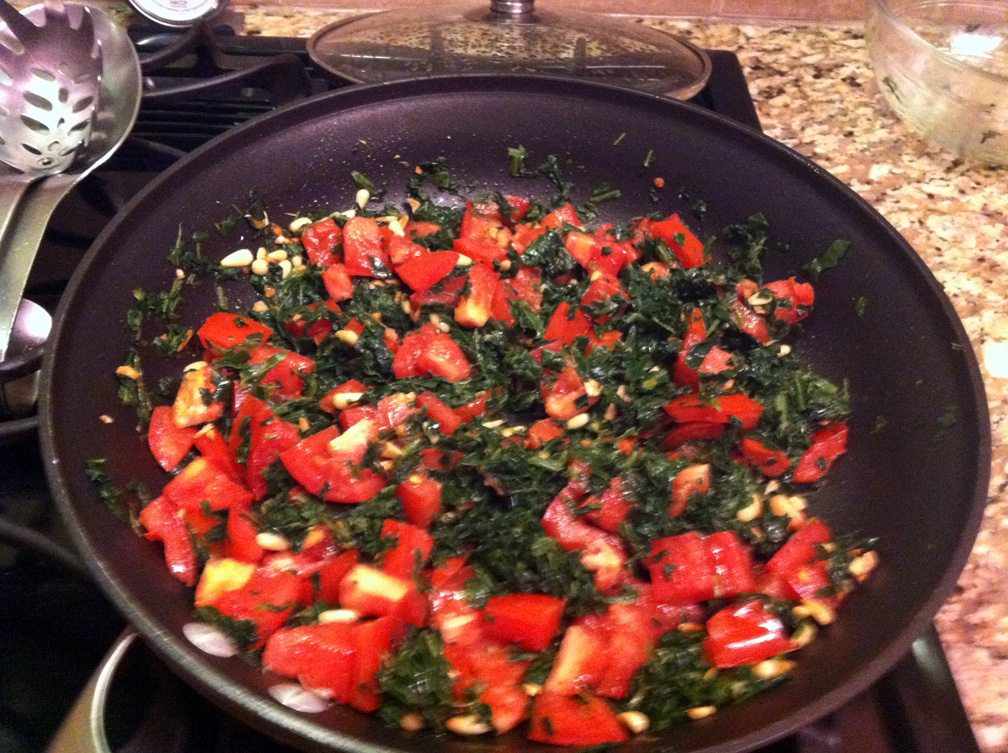
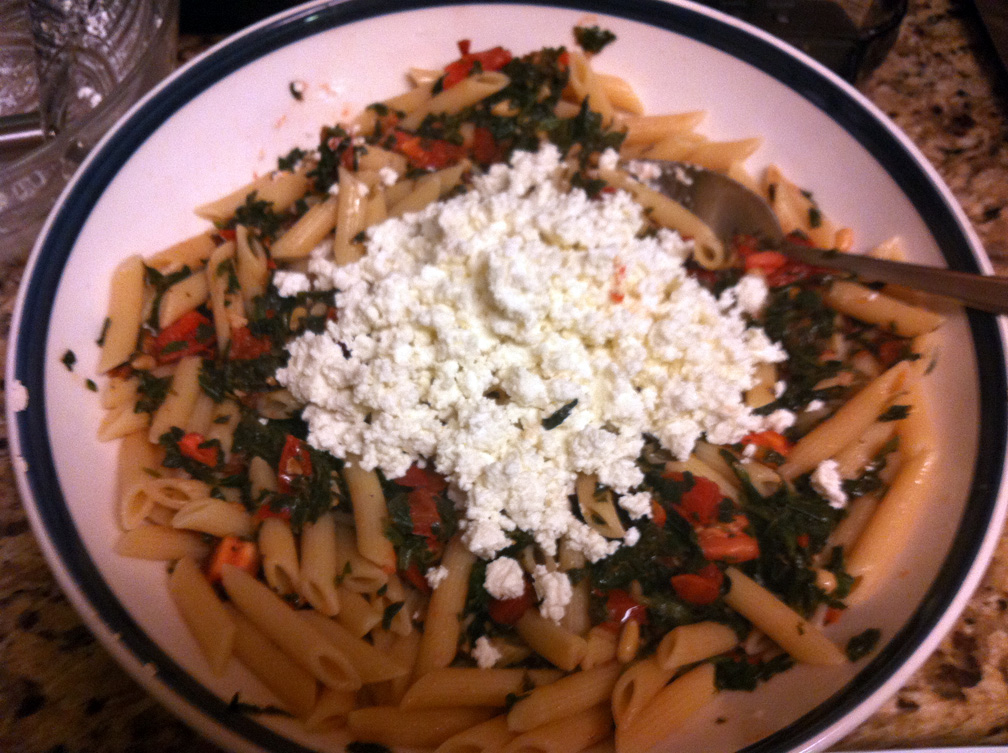
Do I love pasta? Of course I do—I’m half Sicilian! But this recipe, with its decidedly Greek flavors, is one of my favorite ways to prepare it. It’s quite simple to make, with only nine ingredients. (Remember the block of frozen spinach I disparaged in one recent recipe? It makes an important appearance here. Sometimes frozen works just fine.)

Because this dish has so few ingredients, each is essential to its success; this is not the time to skimp. Pine nuts are expensive right now, but you’ll only need two tablespoons’ worth for this—buy a small package, keep them in an air-tight container in the refrigerator, and they’ll last you for months. The feta cheese should be the best you can find; Ellwood Thompson’s, in Richmond, has a Bulgarian feta made from sheep’s milk. It lends just the right bite. Don’t substitute canned tomatoes for fresh; if tomatoes aren’t in season—or you can’t find good quality plum tomatoes in the produce section—wait until summer to make this. Serve it warm, as soon as it’s ready, but know that it keeps beautifully for several days in the refrigerator, and also tastes delicious cold.

Greek Penne Pasta

—Serves 6

12 ounces penne
5-1/2 teaspoons good olive oil
2 tablespoons pine nuts
5 cloves garlic, minced
1 (10-ounce) package frozen chopped spinach, thawed and well-drained
4 large plum tomatoes, chopped (about 8 ounces)
8 ounces feta cheese
1/2 teaspoon Kosher salt
1/8 teaspoon freshly ground black pepper

Cook the pasta according to the directions on the package. Drain and set aside. If necessary, cover to keep warm.

Heat a large non-stick skillet with 1/2 teaspoon olive oil, then add 3 teaspoons more to the skillet; heat the oil over medium heat. Add the pine nuts and garlic. Cook and stir about 5 minutes, or until the pine nuts are lightly golden. Then stir in the spinach (be sure it’s well-drained—I squeeze it in my hands to get rid of any excess moisture) and tomatoes. Cook about 3 minutes or until heated through, stirring occasionally. Season lightly with salt and pepper.


Meanwhile, using a pastry blender, crumble the feta in a medium-size bowl and set aside.

To serve, place half of the hot pasta in a large bowl and drizzle with 1 teaspoon of the remaining olive oil. Gently toss until coated. Add the remaining pasta, drizzle with the remaining 1 teaspoon olive oil and gently toss. Then add the spinach mixture and toss. Finally add the feta cheese, additional salt and pepper to taste, and toss until well combined.

Adapted from Healthy Homestyle Cooking by Evelyn Tribole (Rodale Press 1994)

Share this:

  • Click to share on Facebook (Opens in new window) Facebook
  • Click to share on X (Opens in new window) X
  • Click to share on Pinterest (Opens in new window) Pinterest
  • Click to share on LinkedIn (Opens in new window) LinkedIn
  • Click to email a link to a friend (Opens in new window) Email
  • Click to print (Opens in new window) Print
  • Click to share on Tumblr (Opens in new window) Tumblr
  • Click to share on Pocket (Opens in new window) Pocket
  • Click to share on Reddit (Opens in new window) Reddit
Like Loading...

TMSW is Five-Months Old Today!

24 Tuesday Jan 2012

Posted by themidlifesecondwife in What's the Buzz?

≈ Leave a comment

Tags

Blog, BlogHer, Bloglovin, Facebook, NaBloPoMo, Twitter, WordPress, writing

MorgueFile Image

(Want to help me celebrate? Read through to the end of this post to find out how!)

Five months ago today, I hit “publish” on the very first post for The Midlife Second Wife. What a long way we’ve come in such a short time! I thought you might like to hear about some of these developments, and a few new offerings planned for the coming months.

Last night, the blog welcomed its 12,001st visitor to the site. I have to say that this number has me a bit flabbergasted—I had hoped to reach 10,000 visitors after my first year of blogging. If the trend continues, 20,000 readers will have passed through these pages by our one-year anniversary.

Your fellow subscribers now number 273: 133 are following by email or readers, 25 are following the comments, and 115 join us by way of Twitter.

I’m going to add another opportunity today for readers to climb aboard: a site based in Sweden, Bloglovin.com, acts as a sort of storage locker for people who follow a lot of different blogs, organizing them all in one place. I’ll be adding a widget to my site so that Bloglovin’ lovers can share the TMSW love.

TMSW has won two awards from bloggers: the Liebster and the Versatile Blogger Award. In November, TMSW was featured on WordPress’ “Freshly Pressed,” an event that brought more than 5,000 visitors to the site in less than two days. Also in November, the highly respected publishing network BlogHer syndicated one of my posts. Fifty-five of you like me, you really like me, on Facebook, too.

So what’s next? Well, I’ll continue posting two to three times each week. (I also hope to pick a quiet month when my freelance work subsides and do another NaBloPoMo with BlogHer). You’ll see the recipe files getting thicker, and you’ll have more interviews with experts to enjoy. I’ll even begin sprucing the place up a bit. I’ll be asking for your opinion in a few readers’ polls, too.

We now have our 110 charter members of the Midlife Second Wives’ club, and they can expect to hear from me in the weeks ahead. I need to think of an idea for the second-tier membership group, too; if you have any ideas for that, please let me know! I’ll also get to work on our Midlife Second Wives’ Hall of Fame.

And by all means, please send me your ideas for articles, post your comments, and share the articles you like on Facebook.

While we’re on the subject….I have a favor to ask you. It’ll help us all celebrate this five-month milestone!

Close your eyes, think back, and pick out your favorite post from the last five months. Got one? Good. Now, email a link to that post to three of your friends, letting them know about the blog, and invite them to sign up. (This is important: send me a blind copy of your email so that I’ll know where the new subscribers are coming from.) I’ll enter your email in a drawing for a special prize for each new subscriber that comes my way through your efforts.

(I promise it will be useful and tasteful, not like the Leg Lamp “Major Award” that the Old Man received in A Christmas Story.)

Thanks for reading, and thanks for sharing!

—XOXOTMSW

Share this:

  • Click to share on Facebook (Opens in new window) Facebook
  • Click to share on X (Opens in new window) X
  • Click to share on Pinterest (Opens in new window) Pinterest
  • Click to share on LinkedIn (Opens in new window) LinkedIn
  • Click to email a link to a friend (Opens in new window) Email
  • Click to print (Opens in new window) Print
  • Click to share on Tumblr (Opens in new window) Tumblr
  • Click to share on Pocket (Opens in new window) Pocket
  • Click to share on Reddit (Opens in new window) Reddit
Like Loading...
← Older posts
Newer posts →

Twitter Updates

Tweets by midlife2wife

Company

  • 183,383 Guests since 8/24/11

Receive notifications of new posts by email.

Join 1,202 other subscribers

Topics

  • Current Events
  • Food for Thought
  • Giveaways
  • House and Garden
  • Humor Me
  • Indulgences
  • Inspiring Women
  • LifeStyles
  • Love
  • Midpoints
  • Monday Morning Q & A
  • Money Matters
  • Nostalgia
  • Portraits of the Artist
  • Product Reviews
  • Relationships and Family Life
  • Remarriage
  • Second Weddings
  • Second Wife Hall of Fame
  • Secrets to a Happy Relationship
  • Special Events
  • Technology
  • The Beautiful Life
  • The Cultured Life
  • The Healthy Life
  • The Life Poetic
  • The Musical Life
  • The Reading Life
  • The Well-Dressed Life
  • The Writing Life
  • Transitions
  • Travel
  • Well-Dressed
  • What's the Buzz?

RSS Feeds

  • RSS - Posts
  • RSS - Comments

Archives

  • July 2019 (1)
  • December 2014 (1)
  • November 2014 (1)
  • October 2014 (2)
  • August 2014 (1)
  • June 2014 (2)
  • May 2014 (2)
  • April 2014 (3)
  • March 2014 (3)
  • February 2014 (3)
  • January 2014 (4)
  • December 2013 (9)
  • November 2013 (2)
  • October 2013 (3)
  • September 2013 (6)
  • August 2013 (5)
  • July 2013 (6)
  • June 2013 (2)
  • May 2013 (3)
  • April 2013 (1)
  • March 2013 (1)
  • January 2013 (3)
  • December 2012 (7)
  • November 2012 (7)
  • October 2012 (12)
  • September 2012 (9)
  • August 2012 (6)
  • July 2012 (4)
  • June 2012 (5)
  • May 2012 (4)
  • April 2012 (1)
  • March 2012 (10)
  • February 2012 (8)
  • January 2012 (9)
  • December 2011 (10)
  • November 2011 (30)
  • October 2011 (18)
  • September 2011 (12)
  • August 2011 (2)

Networks

NetworkedBlogs
Blog:
The Midlife Second Wife ™
Topics:
Relationships, Life, After 50
 
Follow my blog

bloglovin

The Blogs of Others

  • A Baby Boomer Woman's Life After 50
  • A.B. Westrick
  • An Empowered Spirit
  • Apart from my Art
  • Author Meg Medina
  • Better After 50
  • Books is Wonderful
  • Darryle Pollack: I Never Signed Up For This
  • Diana Patient: Photography
  • Empty House, Full Mind
  • GenerationBSquared
  • Grandma's Briefs
  • Grown and Flown
  • Midlife at the Oasis
  • Midlife Boulevard
  • Midlife Mixtape
  • Reason Creek
  • Relocation: The Blog
  • Romancing Reality
  • Second Lives Club
  • The Boomer Rants
  • WHOA Network
  • WordCount

COPYRIGHT © 2011 — 2024  Marci Rich and The Midlife Second Wife™ Keyword Communications, LLC. All Rights Reserved.

Blog at WordPress.com.

  • Subscribe Subscribed
    • The Midlife Second Wife ™
    • Join 450 other subscribers
    • Already have a WordPress.com account? Log in now.
    • The Midlife Second Wife ™
    • Subscribe Subscribed
    • Sign up
    • Log in
    • Report this content
    • View site in Reader
    • Manage subscriptions
    • Collapse this bar
 

Loading Comments...
 

    %d