• An Open Book: TMSW’s Library
  • Copyright
  • Food for Thought Recipes
  • My Right Eye: A Medical Memoir by Marci Rich
  • Praise and Awards
    • Writing Badges
  • The Midlife Second Wives’ Hall of Fame
  • Who is The Midlife Second Wife?
    • Contact
    • FAQ
  • Read Me On The Huffington Post

The Midlife Second Wife ™

~ The Real and True Adventures of Remarriage at Life's Midpoint

The Midlife Second Wife ™

Category Archives: Food for Thought

Cook, Eat, Think

The Casserole Queens’ Chicken Pot Pie

19 Monday Dec 2011

Posted by themidlifesecondwife in Food for Thought

≈ 1 Comment

Tags

Casseroles, chicken, Chicken Pot Pie, Comfort Food, Food, recipes

Not your mother's chicken pot pie. Not frozen, either.

Except for the rare occasions when I would order it in a restaurant, the only chicken pot pie I’ve ever known was my mother’s. It was of the variety found in the freezer case at the supermarket. Mom was an excellent cook and a wonderful baker, but she rarely attempted pastry pie crusts, which is why, I suspect, she never made a chicken pot pie from scratch.

I inherited my mother’s cooking and baking genes. Unfortunately, another dominant trait is the trepidation gene, the one that kicks in when faced with the prospect of a pastry crust. Now look: I can whip up a graham cracker crust that’ll knock your socks off. (Someday I’ll share my recipe for peanut butter pie.) But I’ve always found the act of rolling out pastry dough and trying to fit it neatly in a pie pan as intimidating as trying to drive a stick shift. I’ve determined that I have a sort of spatial dyslexia. I also invariably cut off way too much gift paper when I’m wrapping presents. So… to make me feel better about myself when I think about these shortcomings, I resort to comfort food. Ironically, the one comfort food I’ve craved the most and haven’t been able to satisfy has been chicken pot pie. Until, that is, I met the Casserole Queens at an author signing at Richmond’s Fountain Books.
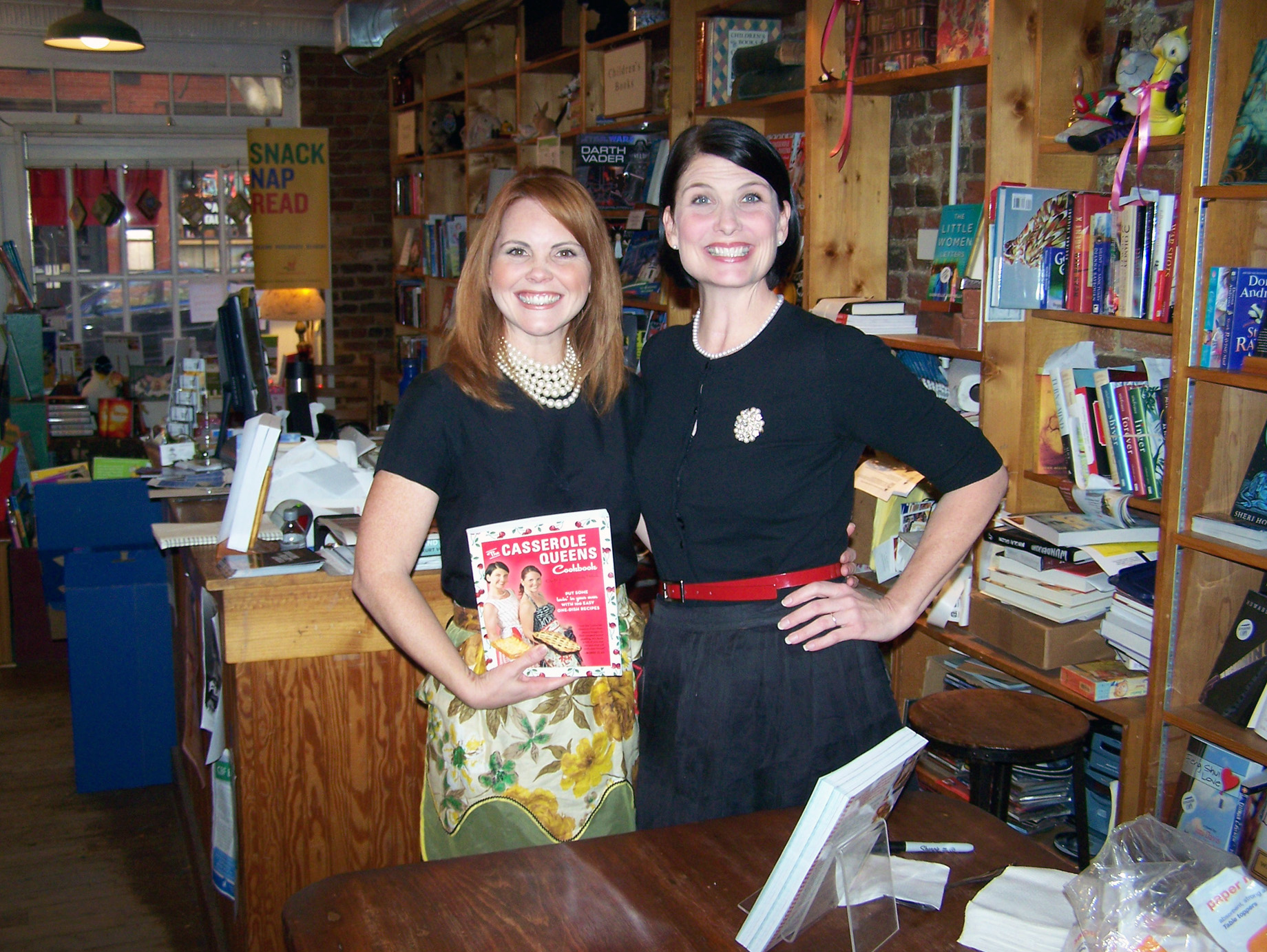
Crystal Cook, left, and Sandy Pollock: The Casserole Queens

You’ll recall that I shared their recipe for sweet potato casserole at Thanksgiving. And I promised to return with their chicken pot pie recipe. Luckily, I roasted two chickens the other week, so I just happened to have the main ingredient for this on hand.

I was also ready to face my fears.

I needn’t have worried. This recipe replaces homemade crust with a sheet of frozen puff pastry. (One and one-half or so sheets, if the brand you’re using is too small for a 9×13 dish. And of course you’ll thaw them first.) While it could be said that I’m still repeating a pattern begun in my mother’s kitchen, I justify this cheat by reminding myself of all the other from-scratch aspects of this recipe. I then feel positively awash in culinary nobility.

This recipe, incidentally, is the one that caught the eye of Bobby Flay; he featured  Crystal and Sandy on Throwdown! with Bobby Flay, his Food Network show. Surprisingly, they didn’t win.

They did as far as John and I are concerned. We loved every morsel. The recipe made enough for us to enjoy leftovers for several days and still share a serving with our neighbor. If you have a crowd coming over for the holidays, this ought to keep them satisfied.

World’s Greatest Chicken Pot Pie

—Makes 8 servings

2 tablespoons unsalted butter
1 (3-pound) roasted chicken, boned and shredded
1/4 cup chopped red bell pepper
2 medium shallots, thinly sliced
3 tablespoons all-purpose flour
2 teaspoons salt
1 teaspoon dried tarragon, crushed
1 teaspoon freshly ground black pepper
2 cups whole milk
1 cup heavy cream
1/3 cup dry white wine
1-1/2 cups fresh peas, blanched*
1-1/2 cups carrots, diced and blanched
2 russet potatoes, diced and blanched
1 sheet frozen puff pastry, thawed**
Egg wash (lightly whisk together 1 whole egg and 1 teaspoon water)

* I used frozen peas and they were perfectly wonderful. I did take the time, however, to blanch the carrots and the potatoes (separately). Took some extra time, but it was worth it to preserve their distinct flavors.
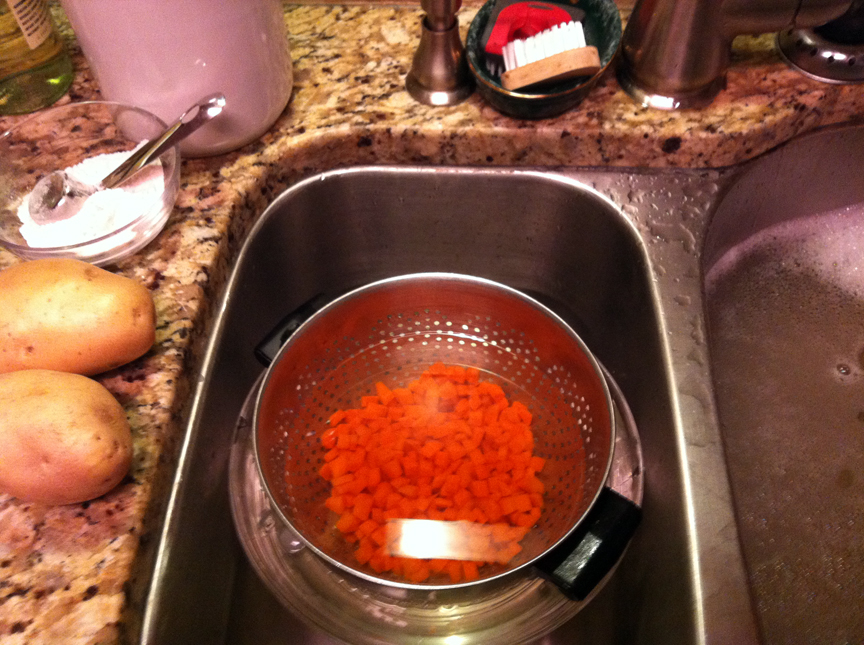

**Depending on the brand you use, you might need more than 1 sheet. I did.

1. Preheat the oven to 425oF.

2. In a large skillet set over medium-high heat, melt the butter. Add the chicken, bell pepper, and shallots, and cook, stirring constantly, for 5 minutes. Stir in the flour, salt,
tarragon, and black pepper. Add the milk and cream, and cook, stirring frequently, until the mixture is thick and bubbly, about 10 minutes. Add the wine, peas, carrots, and potatoes and stir until heated thoroughly, about 5 minutes.

3. Transfer the hot chicken mixture to a 9 x 13-inch casserole dish. Place the puff pastry over the top of the casserole dish. Brush the edges of the puff pastry with the egg wash and press against the side of the casserole dish, then cut slits in the pastry to allow steam to escape. Brush the top of the puff pastry with egg wash—this will help the puff pastry brown evenly. Bake for about 35 minutes or until the top is golden brown. Serve immediately.

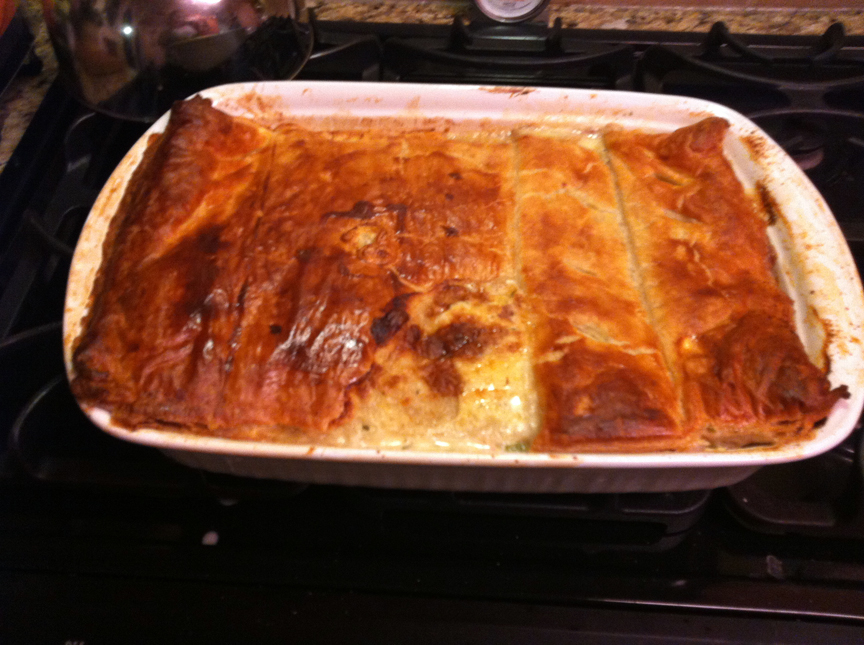
Copyright © 2011 by Crystal Cook and Sandy Pollock. All rights reserved. Used with permission.

— Photos by Marci Rich for The Midlife Second Wife

Share this:

  • Click to share on Facebook (Opens in new window) Facebook
  • Click to share on X (Opens in new window) X
  • Click to share on Pinterest (Opens in new window) Pinterest
  • Click to share on LinkedIn (Opens in new window) LinkedIn
  • Click to email a link to a friend (Opens in new window) Email
  • Click to print (Opens in new window) Print
  • Click to share on Tumblr (Opens in new window) Tumblr
  • Click to share on Pocket (Opens in new window) Pocket
  • Click to share on Reddit (Opens in new window) Reddit
Like Loading...

Barbara Kafka’s Basic Chicken Stock

14 Wednesday Dec 2011

Posted by themidlifesecondwife in Food for Thought

≈ 4 Comments

Tags

Broth, chicken, Cooking, Food, Roasting, Simmering, Soup, Stock (food)

The lovely bones go into the pot. The chicken is reserved for another use.

Barbara Kafka calls chicken stock “the universal solvent of the kitchen.” I wholeheartedly agree. So many recipes that I love call for chicken stock, and it’s essential that I have it on hand. As one reader pointed out last week, store-bought stock—even the organic versions—are laden with salt. This recipe is not. This is what you’ll want to use. Besides being embarrassingly easy to make, it’s economical, and it will fill your home with the aroma of simmering goodness—a perfect antidote to a cold autumn or winter day.

Last week I featured Kafka’s recipe for roasted chicken. Please bear that in mind as you consider this post; to state the obvious, roast chicken is the first step in making homemade stock. Again, my thanks to Barbara Kafka for giving me permission to share these recipes from her wonderful book Roasting: A Simple Art.

The finished stock, ready for measuring and freezing

Basic Chicken Stock
This makes about 3 quarts

Carcass and bones from a 5- to 6-pound roasted chicken, plus uncooked neck and giblets (I also add the wing tips I’ve trimmed before roasting the chicken); or 6 pounds chicken bones, necks and wings

3 quarts water or stock, or to cover by 2 inches
(I’ve never added stock and don’t recommend it doing so. See BK’s notes below.)

If using a whole chicken carcass, cut it up. Place the chicken parts or bones and parts in a stockpot with water to cover by 2-3 inches. Cover the pot and bring to a boil. Skim off the fat and scum that rise to the top. Lower the heat so liquid is just barely boiling. Cover if desired. Cook 8 to 16 hours, skimming occasionally, adding more cold water as needed. The more skimming, the clearer the stock.

Pour the stock through a sieve and let cool at room temperature as time permits; then refrigerate. Remove the art from the surface and any sediment from the bottom.

Use as is, refrigerate for 1 week, or freeze for 6 to 9 months.

Some notes from Barbara Kafka, adapted from her introduction to this recipe:

  • Make the stock without vegetables; they can always be added later. Vegetables cloud the stock and can cause it to turn and sour. (Kafka points out that she also doesn’t know until she uses the stock what she wants the flavorings to be.)
  • Stock made from the bones saved from plates and the carcass of a roasted bird, with its giblets added, will be richer than stock made from unroasted parts.
  • Tie up the gizzards and hearts in a piece of cheesecloth to fish them out easily after an hour’s cooking time. (I have to admit I never seem to have cheesecloth on hand, and I always forget to remove the giblets from the pot after an hour. Never harmed my stock, as far as I can tell!)
  • Before using the bones of a roast chicken for stock, remove all the good meat and save it for another use. (You can see from the picture that’s exactly what I did; the following day I made chicken pot pie, and will share that recipe with you next week.)
  • Note that the pieces of tendon and all parts that look and feel unattractive are good for the flavor of the stock.
  • Once a chicken is roasted, it is easy to pull the carcass apart—cut it if you are fastidious. (I’m not fastidious. I just rip the thing to pieces.) But having the bones in smaller pieces means that less liquid is needed to cover them (and that yields a richer stock).
  • Use a stockpot that is tall in proportion to its diameter; this minimizes the amount of liquid required and constantly rotates the liquid over the bones, which should be covered by liquid by several inches. (When Kafka doesn’t have time to let the stock simmer for many hours, she cheats by adding canned stock to the water for a base. I’ve never done this and I suspect she doesn’t do it often herself. I should ask her!)
  • The key to the success of this stock is long simmering. Don’t be alarmed, but if I start my pot going after an evening meal, I’ll keep it simmering all through the night and into the next day. Just keep the flame on at its lowest—after the initial boiling, all you really want to do is keep it lightly percolating—one or two “burps” at a time. I keep the lid on, but slightly askew to let some of the heat escape.
  • Why don’t you want it to boil the entire time? Because, according to Kafka, boiling risks binding the fat and dissolving solids into the gelatinous liquid. And long simmering dissolves all the gelatinous bits, which is what you want. The bones fall apart, as she says, “having given their all.” It takes about eight hours minimum; she likes to keep it going up to sixteen hours, if possible, and so do I.

Share this:

  • Click to share on Facebook (Opens in new window) Facebook
  • Click to share on X (Opens in new window) X
  • Click to share on Pinterest (Opens in new window) Pinterest
  • Click to share on LinkedIn (Opens in new window) LinkedIn
  • Click to email a link to a friend (Opens in new window) Email
  • Click to print (Opens in new window) Print
  • Click to share on Tumblr (Opens in new window) Tumblr
  • Click to share on Pocket (Opens in new window) Pocket
  • Click to share on Reddit (Opens in new window) Reddit
Like Loading...

Two Chickens, Many Meals (Thanks to Barbara Kafka)

07 Wednesday Dec 2011

Posted by themidlifesecondwife in Food for Thought

≈ 4 Comments

Tags

Barbara Kafka, chicken, Cooking, Food, Roasting

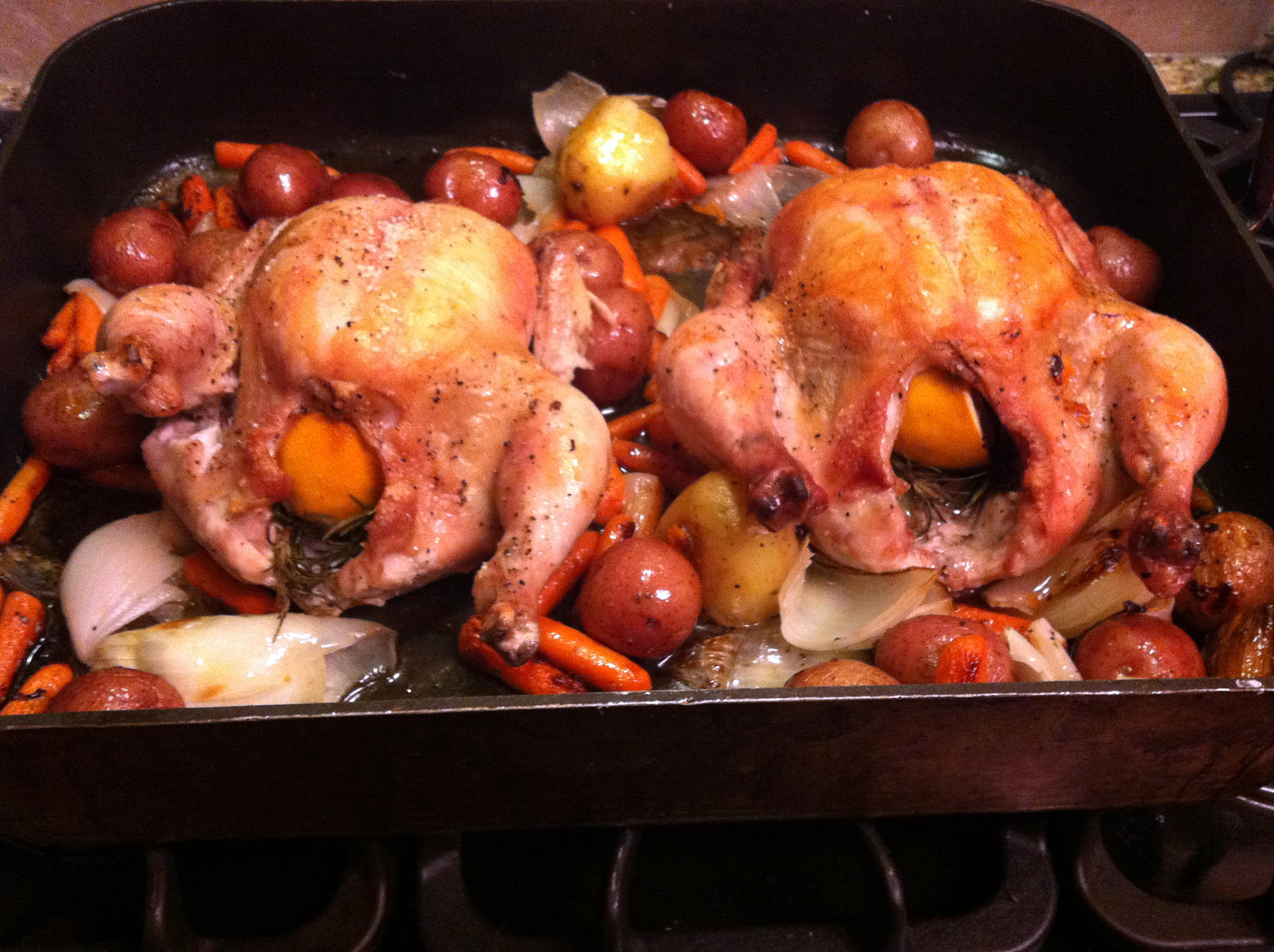
You know the old saying: “Give people roasted chicken, they’ll eat for a day. Teach them how to roast a chicken, they’ll eat forever.” What? That’s not how it goes? Well, it does now. Barbara Kafka is the person who taught me how to roast a chicken, although she wasn’t aware of that when I called her this morning, at her home in Manhattan, to ask for permission to publish two of her recipes on The Midlife Second Wife. As far as I’m concerned her beautiful book, Roasting, A Simple Art, is the last word on that most fundamental kitchen skill. And her “continuous kitchen” philosophy is smart and economical, especially if you’re on a budget. I’m always amazed by the number of meals I can eke out of one or two roast chickens.

Kafka’s premise, that fish, fowl, meat—even vegetables and some fruits—are best roasted at extremely high oven temperatures (500-degrees Fahrenheit), has proved infallible in my kitchen. I have roasted chicken, standing rib roast, turkey, asparagus, cherry tomatoes, leeks, and more using this principle. The results are always wonderful: the high-heat method seals in flavor, yielding a crispy, succulent exterior and an interior that is moist and delicious. You’ll never serve a dry turkey again.

Another Kafka principle to which I adhere is the “continuous kitchen.” Let’s use chicken as an example. I typically roast two at the same time. After we’ve dined on one, I reserve all of the bones and trim the carcass of all meat, which I reserve for leftovers (another roast chicken dinner, sandwiches, chicken salad, or a casserole). I do the same with the extra bird that has not been served. All of the bones, the wing tips (which I’ve removed before roasting), and the neck and giblets (saved before roasting) get tossed into my stockpot and filled with water. Do you see where I’m going with this? Homemade chicken stock—lots of it—to keep in your freezer. You’ll be able to read Kafka’s recipe for basic chicken stock in my next cooking post—or her book, if it’s not too late to add something to your holiday wish list.

Copyright © 1995 by Barbara Kafka. All rights reserved. Used with permission.

Today I’ll be sharing her famous recipe for roasted chicken. My thanks to Barbara Kafka for giving me permission to do so.

A few words of warning, though: The only aspect of her method that could rightly be called Kafkaesque—having a touch of danger—is the method itself. Roasting at 500-degrees Fahrenheit is perfectly safe to do, provided you have taken a few advance precautions:

  1. Make sure that your oven is clean, as in spotless. If you don’t have time to clean your oven before trying this, don’t do it. Self-cleaning ovens are best (so much easier on the back), but I’ve successfully used the high-heat method in an ordinary oven.
  2. Make sure the rack is placed at the lowest section of your oven. I actually remove the top rack and rest my roasting pan on the bottom rack. Kafka might disagree with this; her instructions invariably say to place the rack in the center or bottom third of the oven. But when I’ve tried that I’ve found my food browned too quickly, so I’d lower the temperature slightly (or cover the top with foil) to avoid burning. (Every oven varies in temperature; mine have always seemed to be on the high end.) I’m also a worrier when it comes to high heat, and prefer the extra cushion of space at the top, especially if grease is popping energetically.
  3. Don’t leave the kitchen unattended while you’re doing this. That shouldn’t be an imposition; it’s a quick method, and you’re sure to have other related tasks to perform. Just stay nearby.
  4. Keep your oven fan on, and open a door or window if it gets too smoky. (Didn’t clean the oven first, did you?)
  5. Take care when opening your oven door to remove or check on what you’re roasting. Avert your head (especially if you wear glasses…trust me) and wait a few seconds before proceeding.
  6. Practice safe kitchen. Have a fire extinguisher nearby, and keep pets and children away from the oven area while you’re cooking.

Now, let’s begin.

Simplest Roast Chicken

Serves 2 to 4
Total roasting time: 50 to 60 minutes


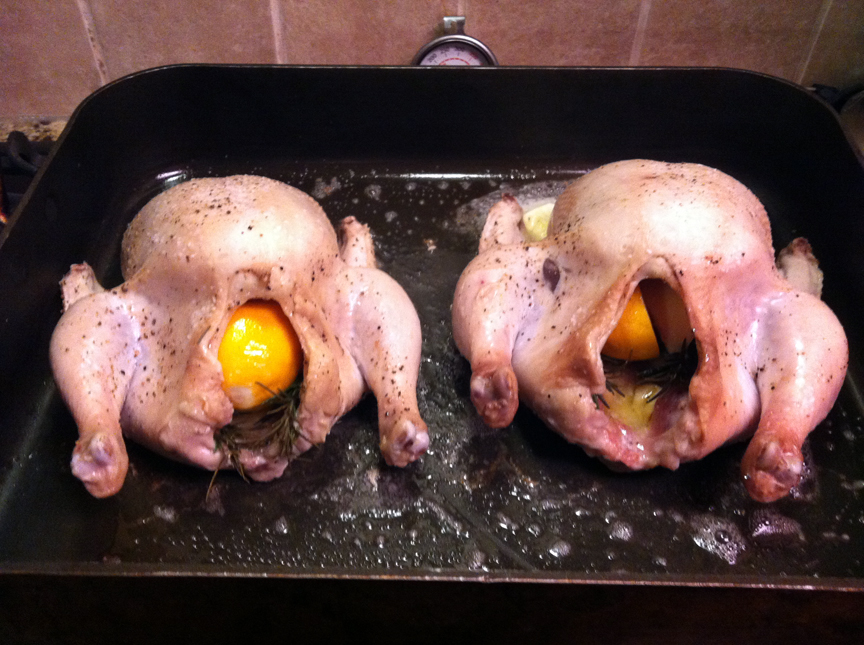
5- to 6-pound chicken, wing tips removed (the chickens shown in the photograph were about 3 pounds each)

1 lemon, halved (I used two, for two chickens)
4 whole garlic cloves (again, doubled for two birds)
Kosher salt, to taste
Freshly ground black pepper, to taste
1 cup Basic Chicken Stock (page 42 of her book) or canned, water, fruit juice, or wine, for deglazing

Place rack on second level from bottom of oven. (See my note above.) Heat oven to 500 o F.

Remove the fat from the tail and crop end of the chicken. Freeze the neck and giblets for Basic Chicken Stock. [Or refrigerate them in a sealed plastic bag if making stock the same day or the next.] Reserve chicken livers for another use.

Stuff the cavity of the chicken with the lemon, garlic, and butter, if using. Season the cavity and skin with salt and pepper. [I also added some sprigs of fresh rosemary.]

The stuffed chickens after 10 minutes of roasting

Place the chicken in a 12x8x1½-inch roasting pan [slightly larger if adding vegetables] breast side up. Put in the oven legs first and roast 50 to 60 minutes, or until the juices run clear. After the first 10 minutes, move the chicken with a wooden spatula to keep it from sticking.**

**At this stage, I incorporate elements from Kafka’s recipe for Roast Chicken with Crispy Potatoes:

2 pounds small red new potatoes, peeled or not and quartered (I did not quarter them when I made this, and rather wish I had done.)
1-2 medium onions, peeled, left whole, optional, or 6 cloves garlic, unpeeled, optional (I only used onions)
My addition: a package of baby carrots

Sprinkle vegetables with salt and pepper and add to the roasting pan after the first 10 minutes of roasting. At 15-minute intervals, until the end of roasting time, stir the vegetables around with a wooden spoon so that they don’t stick to the pan.
Back to the standard recipe:

Remove the chicken to a platter by placing a large wooden spoon into the tail end and balancing the chicken with a kitchen spoon pressed against the crop end. As you lift the chicken, tilt it over the roasting pan so that all the juices run out and into the pan.

Pour off or spoon out excess fat from the roasting pan and put the roasting pan on top of the stove. Add the stock or other liquid and bring the contents of the pan to a boil, while scraping the bottom vigorously with a wooden spoon. Let reduce by half. Serve the sauce over the chicken, or, for crisp skin, in a sauceboat.

If you’ve added potatoes, onion, carrots, etc., remove them to a serving platter as well. Season with salt and pepper to taste, and then deglaze the pan.

Next week, I’ll share Barbara Kafka’s method for making Basic Chicken Stock. And, for the holiday week, my food gift to you will be the Casserole Queens’ recipe for Chicken Pot Pie—just the thing to have on hand when company begins to fill your home!

Share this:

  • Click to share on Facebook (Opens in new window) Facebook
  • Click to share on X (Opens in new window) X
  • Click to share on Pinterest (Opens in new window) Pinterest
  • Click to share on LinkedIn (Opens in new window) LinkedIn
  • Click to email a link to a friend (Opens in new window) Email
  • Click to print (Opens in new window) Print
  • Click to share on Tumblr (Opens in new window) Tumblr
  • Click to share on Pocket (Opens in new window) Pocket
  • Click to share on Reddit (Opens in new window) Reddit
Like Loading...

Mimi’s Marinara Sauce With Meatballs and Sausage

29 Tuesday Nov 2011

Posted by themidlifesecondwife in Food for Thought

≈ 6 Comments

Tags

Cooking, Food, Marinara sauce, Pasta, recipes, Sauces

This recipe for marinara sauce with meatballs and sausage, a family favorite, has been in my cooking repertoire since the Carter Administration, which is to say a very long time. I’ve made a number of adjustments and refinements to the original recipe over the years, chief among them the addition of dry red wine. I love cooking with wine—it’s such a generous thing to do for your dinner guests! The Clemenza cooking scene in The Godfather provided the inspiration for this enhancement—after the movie was released on video I had a chance to study his method—so I suppose we ought to thank Francis Ford Coppola. (He produces his own wine, too.) You’ll notice, however, that I don’t precook the meatballs or the sausage before adding them to the pot; they get cooked along with everything else, since the sauce simmers at least four hours on the stove. I tried precooking the meat only once, and found that the sauce took on an entirely different flavor. I prefer my method, since it retains the tenderness of the meat and prevents it from drying out, but by all means, adjust this recipe to your own tastes. You might also wish to substitute turkey sausage and turkey meatballs for the red meats shown here. As my Grandma Monia used to say: Mangia!

MIMI’S MARINARA SAUCE WITH MEATBALLS AND SAUSAGE*

1 large (28-ounce) can whole tomatoes (I prefer San Marzano Italian plum tomatoes)
3 12-ounce cans tomato paste
water
salt, freshly-ground pepper, and garlic salt to taste
one-quarter cup sugar
one-half to 1 cup dry red wine, such as Chianti or Cabernet Sauvignon
one-half cup grated Parmesan cheese, or to taste**
1 and one-half pounds hot Italian sausage, cut into 4-inch sections
1 and one-half pounds sweet Italian sausage, cut into 4-inch sections
2 pounds ground chuck
4 cloves garlic, minced
¼ cup chopped Italian parsley
6 eggs
4 cups (approximate) seasoned Italian bread crumbs
1 cup (approximate) grated Parmesan cheese**
salt and freshly-ground pepper

I begin by making the meatballs so that they’re ready to add to the simmering sauce.

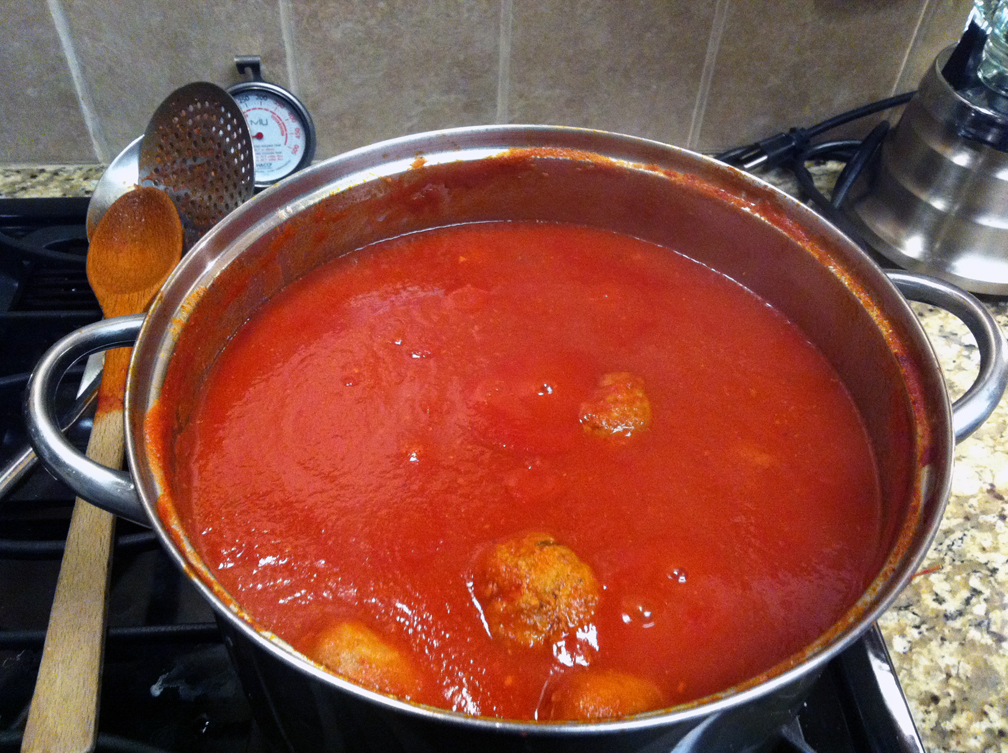
In increments, so that everything is blended well, combine ground chuck, garlic, chopped parsley, eggs, breadcrumbs, Parmesan cheese, and salt and pepper. (If you prefer, substitute garlic salt for the garlic in the meatballs.) Keeping a small bowl of water nearby, wet your hands and break off the meat into about 2-inch pieces, rolling into meatballs. Continue the process, wetting your hands as you go. (Take a look at the picture above; the meatball simmering in the pot is the size you’re going for. And take care not to overdo it with the breadcrumbs; you want the meatballs to adhere, but you don’t want them to be dry.) When all of the meatballs have been made, set aside in the refrigerator in a covered bowl.

Chop the canned tomatoes and put them in a large pot, adding one can of water and three cans of tomato paste. Stir well to combine, then add water to the pot until you’ve filled the pot slightly halfway. (Too much water and your sauce will be thin and, well, watery. Plus, when you add your meat and the sauce begins to boil and then simmer, too much water will make the sauce boil over. Trust me: you don’t want that.)

Over medium heat, begin bringing this mixture to the boil, adding salt, pepper, garlic salt to taste along with the sugar before it gets to the boiling point. (Let your taste preferences be your guide in terms of how much seasoning to use. I sprinkle everything fairly liberally to begin with, stir and simmer, and then check my seasonings a couple of times throughout the cooking process.) Add the wine and the Parmesan cheese to the sauce, and stir well, bringing to a boil.

Add the sausage to the sauce.

Add the meatballs to the sauce.

Return everything to a boil, then reduce the heat to low and simmer slowly for four hours. Continue to stir the pot, using a wooden spoon, and scrape up from the bottom in case you’ve let the heat get too high and the sauce starts to burn. The secret here is a SLOW, STEADY SIMMER. If your dinner is delayed for some reason, one of the beautiful aspects of this recipe is that you can keep this pot of sauce simmering for an extra hour. Make sure that you cook it for the full four hours, though, because you want to make sure that your meat is done. Check the sausage before serving; if it’s pink inside, keep simmering it, and the sauce, until done.

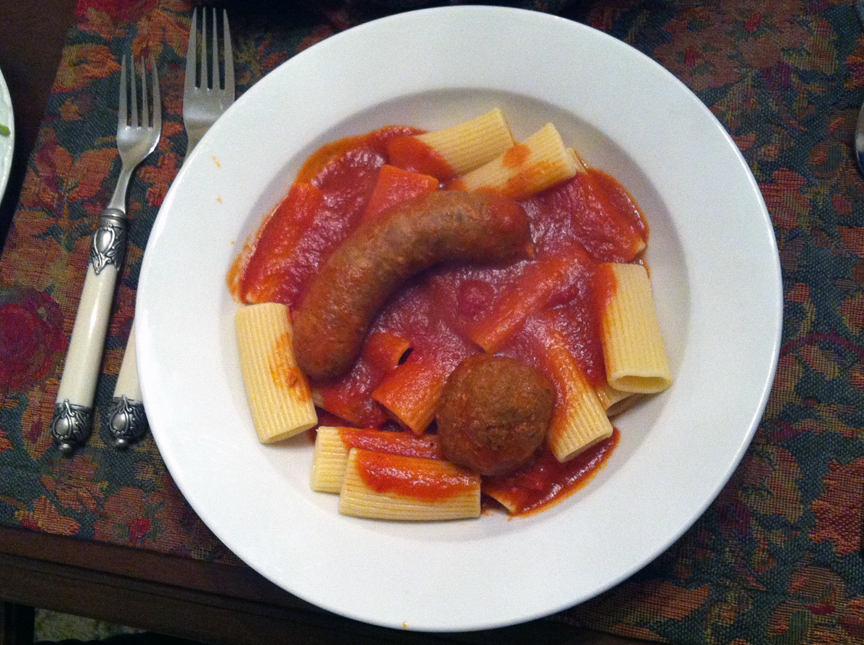
This is a hearty sauce, so serve it over a substantial pasta like rigatoni, rather than a delicate angel hair pasta. Toss together a green salad, add a loaf of crusty Italian bread, and mangia!

*Mimi is John’s nickname for me.

** A word about the Parmesan cheese. If I’m economizing (and aren’t nearly all of us economizing?) I’ll use Kraft grated Parm. But on the rare occasions when we’re splurging, I’ll grate fresh Parmigiano-Reggianno cheese for this recipe; I firmly believe in using the freshest, best ingredients that one can afford, and there’s nothing like the real thing.

P.S. Your entire house will smell amazing while you’re cooking this sauce!

Share this:

  • Click to share on Facebook (Opens in new window) Facebook
  • Click to share on X (Opens in new window) X
  • Click to share on Pinterest (Opens in new window) Pinterest
  • Click to share on LinkedIn (Opens in new window) LinkedIn
  • Click to email a link to a friend (Opens in new window) Email
  • Click to print (Opens in new window) Print
  • Click to share on Tumblr (Opens in new window) Tumblr
  • Click to share on Pocket (Opens in new window) Pocket
  • Click to share on Reddit (Opens in new window) Reddit
Like Loading...

Where’s Home for the Holidays When You’re Divorced?

21 Monday Nov 2011

Posted by themidlifesecondwife in Food for Thought, Relationships and Family Life

≈ 102 Comments

Tags

Christmas, Divorce, Family, Holidays, Home, Life, Remarriage, Thanksgiving

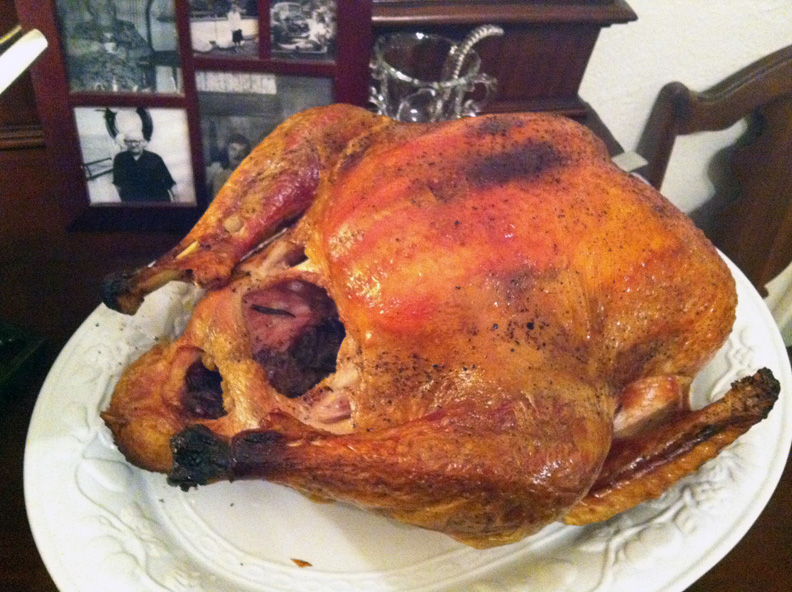
The turkey I prepared in 2010, when my stepsons celebrated an early Christmas with us.

When my first marriage ended, the day before Thanksgiving in 2003, I took a deep breath upon returning from court and began meal preparations for my first major holiday on my own. I set myself (and my raw nerves) to the comforting task of marinating pears for a compote, then started on the bread-sage stuffing. Why? Because for as long as I can recall, I’ve cooked elaborate dinners for the holidays.

During my first marriage, our family shared hosting duties for the holidays, but the times when it wasn’t my turn didn’t mean I was off the hook. I contributed side dishes and desserts to the groaning board so the burden of cooking an entire meal wasn’t borne by the host. That, however, was all in the past. My son would join me, and my cousin, for my first post-divorce Thanksgiving. That was it. Taking the smallest turkey I’d ever roasted out of the oven, I marveled at its lightness. And cried.

One month later, at Christmas, I said goodbye to all that and performed a variation on the theme. My cousin brought her nephew, my son came with his girlfriend at the time, and I rounded out the rest of the table with a young violinist from the Ukraine, who was studying at the conservatory where I worked. She brought her mother along. And, for the first time in my entire life, turkey was not featured on the table. Instead I prepared a standing rib roast from one of Ina Garten‘s Barefoot Contessa cookbooks.

This was my new family dynamic, and the start of a new tradition.

It can’t have been easy for my son, who at the time was in his early 20s. He was now required to divide all of his holidays in two; the first half of the day was spent with his father, the latter half with me. Those mornings and early afternoons dragged on so! It seemed strange to be alone in the house on a holiday. I probably hugged him far too long and far too tightly when he arrived. But so it went, each year, until the year I remarried.

My new husband had taken a job in Virginia, and I was now living nearly 500 miles from where I grew up and lived my entire life—and 500 miles from my son. Whereas holidays had presented a mere logistical inconvenience, now the geographical stakes were raised to challenging heights. Would I be able to spend at least one holiday with him? And what of my husband’s sons? How and when would we see them? The oldest is in graduate school in Illinois; the youngest had just started college in Ohio.

As it turned out, I wasn’t able to see my son at all that first year after our move. His work schedule simply didn’t allow him enough time off to make the trip. I cannot tell you how that rocked me. Things fared a bit better with the other boys; they drove to Virginia the second week of December to have an early Christmas with us. But again, what orbits they had to navigate! The eldest and his girlfriend drove from Illinois to Ohio to spend time with his mother and brother. Then, with his brother in tow, he drove from Ohio to Virginia. Then it was back around and up to Ohio to drop his brother off, and westward to St. Louis, so his girlfriend could see her family. And back to Illinois. It was like a 1930s movie, where a map of the United States with moving, dotted arrows illustrated a character’s travel progression from Point A to Point Whatever. The mind reels.

Last year, John and I decided that it was our turn to give the kids a break and do the driving. We left for Ohio early in the morning the day before Thanksgiving. Once there, we stayed with my son and his girlfriend. John’s sons joined us the next day, and we all enjoyed Thanksgiving dinner together in a suburb of Cleveland. In a restaurant. For Thanksgiving.

That took some getting used to. Never in my life had I set foot in a restaurant on a major holiday; it went against every cooking and baking gene in my body. I had always felt nothing but sadness for Ralphie and his family in A Christmas Story, forced to eat Christmas dinner at a Chinese restaurant after the Bumpus hounds devoured their turkey.

The meal was traditional enough and tasty enough, I suppose. But that was hardly the point. The goal was to be together: one scattered family gathered for a few brief hours around a table laden with food that might (or might not) allow us (allow me?) to pretend we were in the old homestead, however new that homestead might be.

It was more than enough that we were together and healthy.

It’s true, as the old song says, that there’s no place like home for the holidays. But when you create a new family, and circumstances toss your family hither and yon with no viable base of operations, it helps to remember another song—one that can serve to brighten your thoughts with a clarity that allows comfort and joy to shine through:

Home is where the heart is.

Share this:

  • Click to share on Facebook (Opens in new window) Facebook
  • Click to share on X (Opens in new window) X
  • Click to share on Pinterest (Opens in new window) Pinterest
  • Click to share on LinkedIn (Opens in new window) LinkedIn
  • Click to email a link to a friend (Opens in new window) Email
  • Click to print (Opens in new window) Print
  • Click to share on Tumblr (Opens in new window) Tumblr
  • Click to share on Pocket (Opens in new window) Pocket
  • Click to share on Reddit (Opens in new window) Reddit
Like Loading...

The Casserole Queens’ Sweet Potato Casserole

20 Sunday Nov 2011

Posted by themidlifesecondwife in Food for Thought

≈ 2 Comments

Tags

Casseroles, Cooking, recipes, The Casserole Queens

Ordinarily I only share recipes that I’ve kitchen-tested, but with Thanksgiving a few days away, you might be in desperate need of a side dish, and I’m not cooking this year’s holiday meal. (More on that in a separate post.) But if I were laying out my usual spread, believe me, I’d make room on my menu for this casserole—oven unseen—courtesy of the Casserole Queens.

(Actually, if you ask any of my previous guests over the years, they’ll tell you that many’s the time I’ve experimented with new recipes when having them over for dinner. I’m just a gal with a Santoku knife and a sense of adventure.)

John and I met Crystal Cook and Sandy Pollock a few weeks ago, when they came to Richmond for an author signing at Fountain Bookstore. Even if you didn’t know they hail from Austin, Texas, where they run a food-delivery service, you’d guess it right off: their down-home, friendly hospitality gives it away. You want to bask in the light of their warmth. You want them to invite you to dinner.

Crystal Cook, left, and Sandy Pollock: The Casserole Queens

Crystal and Sandy came to culinary prominence with their recipe for Chicken Pot Pie, which caught the eye of Bobby Flay. He featured them, and their recipe, in an episode of the Food Network’s Throwdown! with Bobby Flay. The Casserole Queens Cookbook, published this year by Clarkson Potter, made the New York Times’ best-seller list. Their book tour included a stop in New York City, where they cooked with Al Roker on the Today Show.

Casseroles represent the ultimate in comfort food, especially for us baby-boomers, who cut our teeth on macaroni and cheese and tuna noodle casserole. A patron at the bookstore called this type of cooking “emotionally significant,” and the phrase is perfect. Mid-lifers, I’m talking to you now. Weren’t casseroles some of your favorite meals from childhood? Don’t you feel a flush of warm memories just thinking about them? Now imagine those meals crafted with a 21st-century point-of-view. Sandy trained at the French Culinary Institute; together with Crystal she has given these time-honored recipes a sophisticated twist. The staff at Fountain Books had prepared Chicken Pot Pie, Mandarin Meatloaf, and Lemon Bars for us to sample. Delicious. Toothsome. May I please wrap some up in a napkin to take home with me? And yes, emotionally significant. As soon as I get my writing deadlines under control, I intend to cook my way through their entire book.

In honor of Thanksgiving, here is a recipe for sweet potatoes that puts a spin on that old chestnut. If you make it, by all means—please leave a note in the comment section and tell us how it was! When I get back into the kitchen, I’ll report on my own attempt at Chicken Pot Pie.

My thanks to Crystal and Sandy for giving me permission to share this recipe with you!

Sweet Potato Casserole

—Makes 6 to 8 servings

8 large sweet potatoes
2/3 cup packed light brown sugar
2/3 cup pecans, toasted
1/2 cup all-purpose flour
5 tablespoons unsalted butter, plus more for greasing the casserole dish
3/4 cup heavy cream
1/2 cup pure maple syrup
1 large egg, beaten
2 teaspoons vanilla extract
1 teaspoon salt

1. Preheat the oven to 400-degrees Fahrenheit.

2. Wash the sweet potatoes, dry well, and put on a baking sheet. Bake for about 1 hour or until soft. Remove the potatoes from the oven.

3. Reduce the oven temperature to 375-degrees.

4. Put the brown sugar, pecans, flour, and 5 tablespoons butter in the bowl of a food processor. Pulse until crumbly. Transfer the mixture to a bowl and put in the refrigerator until ready to use.

5. In the bowl of a stand mixer, fitted with the paddle attachment, add the cream, maple syrup, egg, vanilla, and salt. Peel the baked sweet potatoes, and add the flesh to the bowl. Beat the sweet potato mixture on medium-high speed until smooth.

6. Grease a 9 x 13-casserole dish with some butter. Pour the sweet potato mixture into the dish and smooth the top with the back of a spoon. Sprinkle the pecan topping evenly over the dish. Bake for 40 minutes or until heated through and the top has browned.

Copyright © 2011 by Crystal Cook and Sandy Pollock. All rights reserved. Used with permission.

Share this:

  • Click to share on Facebook (Opens in new window) Facebook
  • Click to share on X (Opens in new window) X
  • Click to share on Pinterest (Opens in new window) Pinterest
  • Click to share on LinkedIn (Opens in new window) LinkedIn
  • Click to email a link to a friend (Opens in new window) Email
  • Click to print (Opens in new window) Print
  • Click to share on Tumblr (Opens in new window) Tumblr
  • Click to share on Pocket (Opens in new window) Pocket
  • Click to share on Reddit (Opens in new window) Reddit
Like Loading...

Marinated Flank Steak

17 Thursday Nov 2011

Posted by themidlifesecondwife in Food for Thought

≈ 2 Comments

Tags

Cooking, Food, Grilling, recipes, Steak Marinades

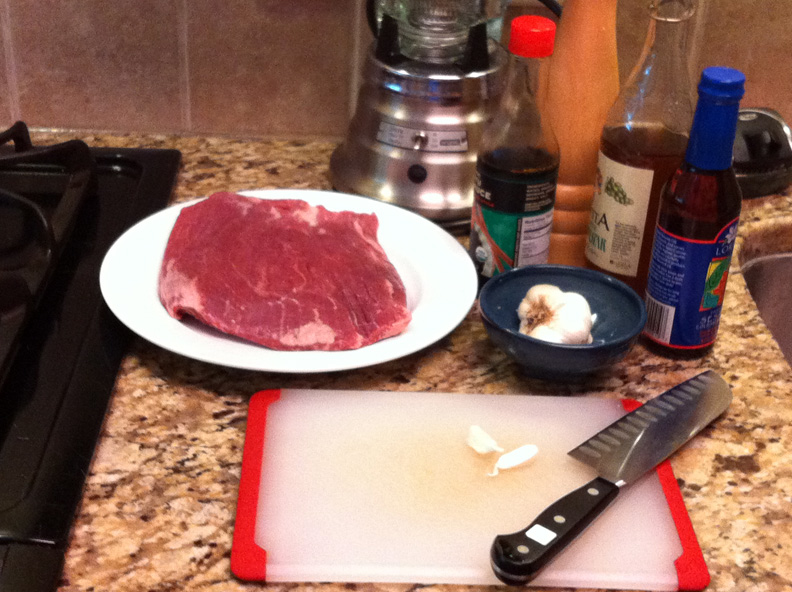
Mise en place for this recipe

Be honest. Are you growing just a bit weary of the holiday recipes that are flooding your inbox? Are you tired of seeing glossy, garnished turkeys gleaming out at you from the covers of the food magazines in the grocery check-out line? Or is your Thanksgiving menu all set, but you’re at a loss for what to cook tomorrow night?

I thought so.

Grilling season might be over in many parts of the U.S., but for those of us who like some char with our meat, there’s no time like the present.

This recipe is so easy that I almost hesitate to share it, lest you think I’m coasting. It yields such a delicious meal, however, that it seems a shame to keep it from you. You can serve this with any number of sides; I like to kick it old-school, with baked potatoes and a salad or green vegetable. My thanks to an old friend, Anne Morse of Hudson, Ohio, for giving me this recipe back in the 1970s.

For great tips on grilling the perfect flank steak, I’ve included a link. And meat should be at room temperature before throwing it on the flames, so remember to take your marinated steak out of the refrigerator at least an hour before you’re ready to grill.

Enjoy!

Marinade for Flank Steak

—From the kitchen of Anne Morse

One-half cup soy sauce
One-half cup sesame oil
3 tablespoons red wine vinegar
Freshly-ground pepper
2 medium cloves garlic, crushed

Mix together the first four ingredients. Add the garlic. Pour over flank steak and marinate for 24 hours, turning occasionally.

Share this:

  • Click to share on Facebook (Opens in new window) Facebook
  • Click to share on X (Opens in new window) X
  • Click to share on Pinterest (Opens in new window) Pinterest
  • Click to share on LinkedIn (Opens in new window) LinkedIn
  • Click to email a link to a friend (Opens in new window) Email
  • Click to print (Opens in new window) Print
  • Click to share on Tumblr (Opens in new window) Tumblr
  • Click to share on Pocket (Opens in new window) Pocket
  • Click to share on Reddit (Opens in new window) Reddit
Like Loading...

Holiday Candied Pecans

09 Wednesday Nov 2011

Posted by themidlifesecondwife in Food for Thought

≈ 2 Comments

Tags

Cooking, Food, Holiday Baking, Pecans, recipes

Bah, humbug. The news isn’t good for those of us beginning to plan our holiday menus. The Associated Press reported today that due to drought in parts of the South and high demand from China, the price of pecans is going up. In 2008, the retail price for a pound of pecans was $7; last year it rose to $9, and this year experts are predicting that consumers can expect to pay around $11 per pound. It’s a good thing I still have a stash stored in the freezer, because in our house, a holiday without candied pecans is like a Yuletide without It’s a Wonderful Life.

I typically make candied pecans around Thanksgiving, and this is one of my favorite cooking traditions. They are easy to prepare, they keep beautifully throughout the season if stored in an airtight tin, and they make wonderful hostess gifts if you’ve a round of parties to attend. And while we’re talking about storage, the pecans in my freezer will be just fine. According to New Mexico State University’s Cooperative Extension Service (College of Agriculture and Home Economics), shelled pecan halves will keep from 12 to 24 months if stored below freezing (20- to 30-degrees Fahrenheit).

HOLIDAY CANDIED PECANS

—Makes 6 cups. You can also divide this recipe in half.

6 cups pecan halves
4 tablespoons unsalted butter
1 cup light corn syrup
1 cup sugar, divided*

1. Preheat oven to 250-degrees. Divide pecans in two batches and spread out evenly on two 13 x 9 x 2-inch baking pans.

2. In a 4-quart saucepan, melt the butter over medium heat. With a wooden spoon or a silicone spatula, stir in the corn syrup and one-half cup of sugar. Stirring constantly, bring to boil over medium heat. Once the candied syrup has reached the boiling point, allow it to boil—without stirring—for five minutes.

3. Pour the hot syrup over the nuts, taking care to stir the batches constantly (and quickly) in order to coat them evenly. (Be careful—the syrup will be hot.) At this point, I find that using a silicone spatula works better than a wooden spoon; the candied syrup doesn’t stick to it as much.

4. Bake in a preheated 250-degree oven for one hour, stirring several times. I stir the trays of pecans at four 15-minute intervals, using my kitchen timer as a reminder.

5. After removing the pans from the oven, sprinkle the pecans with the remaining one-half cup of sugar and toss to coat evenly.

6. Spread the pecans onto sheets of freezer paper (shiny side up) that you’ve set out on your work surface, and add additional amounts of sugar until you’ve nicely separated them into their individual halves and coated them with sugar. You can also perform this step on greased cookie sheets, but I find that the freezer paper eliminates the need for additional butter and works just as well. It also gives you a wider surface area in which to work.

7. Allow the pecan halves to cool, then store them in tightly covered containers.

* Plus additional sugar for coating

Share this:

  • Click to share on Facebook (Opens in new window) Facebook
  • Click to share on X (Opens in new window) X
  • Click to share on Pinterest (Opens in new window) Pinterest
  • Click to share on LinkedIn (Opens in new window) LinkedIn
  • Click to email a link to a friend (Opens in new window) Email
  • Click to print (Opens in new window) Print
  • Click to share on Tumblr (Opens in new window) Tumblr
  • Click to share on Pocket (Opens in new window) Pocket
  • Click to share on Reddit (Opens in new window) Reddit
Like Loading...

Sally Field of Greens

02 Wednesday Nov 2011

Posted by themidlifesecondwife in Food for Thought

≈ Leave a comment

Tags

Cooking, Daniel Day-Lewis, Doris Kearns Goodwin, Food, Joseph Gordon-Levitt, recipes, Salads, Sally Field, Steven Spielberg

The stars are out here in Richmond, Virginia, where filming got underway last month for Lincoln, directed and co-produced by Academy Award-winning filmmaker Steven Spielberg. The film, based on Doris Kearns Goodwin’s book Team of Rivals, stars Academy Award winners Daniel Day-Lewis as Abraham Lincoln and Sally Field as Mary Todd Lincoln. And although I haven’t seen any bold-face names yet, John and I did have a bite to eat last Sunday at Lift Coffee Shop & Café, which features such charming additions to its menu as a HAM-iel Day Lewis sandwich (grilled on sourdough bread with ham, pineapple, and provolone, and topped with honey and barbecue sauce); a delicious BLT—the Joseph Gordon Lettuce—named in honor of actor Joseph Gordon-Levitt, who portrays Robert Todd Lincoln; and a tasty-looking salad, the Sally Field of Greens. Lift also serves up a wonderful cup of coffee.

My thanks to Stephanie Garnett, manager of Lift, for her generosity in sharing this recipe with The Midlife Second Wife!

For more information about film production in Virginia, please visit the website for the Virginia Film Office.

Sally Field of Greens
Serves 2

1 package field greens or spring mix, washed and dried
3 ounces diced ripe pear (peeled)
2 ounces Craisins
1-1/2 ounces crumbled Gorgonzola cheese
Balsamic vinaigrette
Crumbled Gorgonzola

Fill a salad bowl with the greens. Toss with pear, Craisins, and 1-1/2 ounces of crumbled Gorgonzola. Drizzle with Balsamic vinaigrette and top with additional crumbled Gorgonzola.


Share this:

  • Click to share on Facebook (Opens in new window) Facebook
  • Click to share on X (Opens in new window) X
  • Click to share on Pinterest (Opens in new window) Pinterest
  • Click to share on LinkedIn (Opens in new window) LinkedIn
  • Click to email a link to a friend (Opens in new window) Email
  • Click to print (Opens in new window) Print
  • Click to share on Tumblr (Opens in new window) Tumblr
  • Click to share on Pocket (Opens in new window) Pocket
  • Click to share on Reddit (Opens in new window) Reddit
Like Loading...

For Those Having Trouble With the Soup Link …

26 Wednesday Oct 2011

Posted by themidlifesecondwife in Food for Thought

≈ Leave a comment

Tags

Food, Recipe, Soups

Dear friends,

Some of you might be having trouble linking to the post for Chef Tom Valenti’s Ham Hock and Split Pea Soup recipe. My apologies. I’ve been having trouble with my Flickr account, which is my current repository for gallery photos.

Clicking on the embedded link should take you directly to it. And here’s a short link if you’d like to kick it old-school by pasting this into your browser:

Tom Valenti’s Ham Hock and Split Pea Soup

Sorry for any inconvenience.

Love,

The Midlife Second Wife

p.s. to Flickr: As soon as I can afford it, I’m leaving you for Aperture.

Share this:

  • Click to share on Facebook (Opens in new window) Facebook
  • Click to share on X (Opens in new window) X
  • Click to share on Pinterest (Opens in new window) Pinterest
  • Click to share on LinkedIn (Opens in new window) LinkedIn
  • Click to email a link to a friend (Opens in new window) Email
  • Click to print (Opens in new window) Print
  • Click to share on Tumblr (Opens in new window) Tumblr
  • Click to share on Pocket (Opens in new window) Pocket
  • Click to share on Reddit (Opens in new window) Reddit
Like Loading...
← Older posts
Newer posts →

Twitter Updates

Tweets by midlife2wife

Company

  • 183,646 Guests since 8/24/11

Receive notifications of new posts by email.

Join 1,202 other subscribers

Topics

  • Current Events
  • Food for Thought
  • Giveaways
  • House and Garden
  • Humor Me
  • Indulgences
  • Inspiring Women
  • LifeStyles
  • Love
  • Midpoints
  • Monday Morning Q & A
  • Money Matters
  • Nostalgia
  • Portraits of the Artist
  • Product Reviews
  • Relationships and Family Life
  • Remarriage
  • Second Weddings
  • Second Wife Hall of Fame
  • Secrets to a Happy Relationship
  • Special Events
  • Technology
  • The Beautiful Life
  • The Cultured Life
  • The Healthy Life
  • The Life Poetic
  • The Musical Life
  • The Reading Life
  • The Well-Dressed Life
  • The Writing Life
  • Transitions
  • Travel
  • Well-Dressed
  • What's the Buzz?

RSS Feeds

  • RSS - Posts
  • RSS - Comments

Archives

  • July 2019 (1)
  • December 2014 (1)
  • November 2014 (1)
  • October 2014 (2)
  • August 2014 (1)
  • June 2014 (2)
  • May 2014 (2)
  • April 2014 (3)
  • March 2014 (3)
  • February 2014 (3)
  • January 2014 (4)
  • December 2013 (9)
  • November 2013 (2)
  • October 2013 (3)
  • September 2013 (6)
  • August 2013 (5)
  • July 2013 (6)
  • June 2013 (2)
  • May 2013 (3)
  • April 2013 (1)
  • March 2013 (1)
  • January 2013 (3)
  • December 2012 (7)
  • November 2012 (7)
  • October 2012 (12)
  • September 2012 (9)
  • August 2012 (6)
  • July 2012 (4)
  • June 2012 (5)
  • May 2012 (4)
  • April 2012 (1)
  • March 2012 (10)
  • February 2012 (8)
  • January 2012 (9)
  • December 2011 (10)
  • November 2011 (30)
  • October 2011 (18)
  • September 2011 (12)
  • August 2011 (2)

Networks

NetworkedBlogs
Blog:
The Midlife Second Wife ™
Topics:
Relationships, Life, After 50
 
Follow my blog

bloglovin

The Blogs of Others

  • A Baby Boomer Woman's Life After 50
  • A.B. Westrick
  • An Empowered Spirit
  • Apart from my Art
  • Author Meg Medina
  • Better After 50
  • Books is Wonderful
  • Darryle Pollack: I Never Signed Up For This
  • Diana Patient: Photography
  • Empty House, Full Mind
  • GenerationBSquared
  • Grandma's Briefs
  • Grown and Flown
  • Midlife at the Oasis
  • Midlife Boulevard
  • Midlife Mixtape
  • Reason Creek
  • Relocation: The Blog
  • Romancing Reality
  • Second Lives Club
  • The Boomer Rants
  • WHOA Network
  • WordCount

COPYRIGHT © 2011 — 2024  Marci Rich and The Midlife Second Wife™ Keyword Communications, LLC. All Rights Reserved.

Blog at WordPress.com.

  • Subscribe Subscribed
    • The Midlife Second Wife ™
    • Join 450 other subscribers
    • Already have a WordPress.com account? Log in now.
    • The Midlife Second Wife ™
    • Subscribe Subscribed
    • Sign up
    • Log in
    • Report this content
    • View site in Reader
    • Manage subscriptions
    • Collapse this bar
 

Loading Comments...
 

    %d