• An Open Book: TMSW’s Library
  • Copyright
  • Food for Thought Recipes
  • My Right Eye: A Medical Memoir by Marci Rich
  • Praise and Awards
    • Writing Badges
  • The Midlife Second Wives’ Hall of Fame
  • Who is The Midlife Second Wife?
    • Contact
    • FAQ
  • Read Me On The Huffington Post

The Midlife Second Wife ™

~ The Real and True Adventures of Remarriage at Life's Midpoint

The Midlife Second Wife ™

Author Archives: themidlifesecondwife

The Casserole Queens’ Chicken Pot Pie

19 Monday Dec 2011

Posted by themidlifesecondwife in Food for Thought

≈ 1 Comment

Tags

Casseroles, chicken, Chicken Pot Pie, Comfort Food, Food, recipes

Not your mother's chicken pot pie. Not frozen, either.

Except for the rare occasions when I would order it in a restaurant, the only chicken pot pie I’ve ever known was my mother’s. It was of the variety found in the freezer case at the supermarket. Mom was an excellent cook and a wonderful baker, but she rarely attempted pastry pie crusts, which is why, I suspect, she never made a chicken pot pie from scratch.

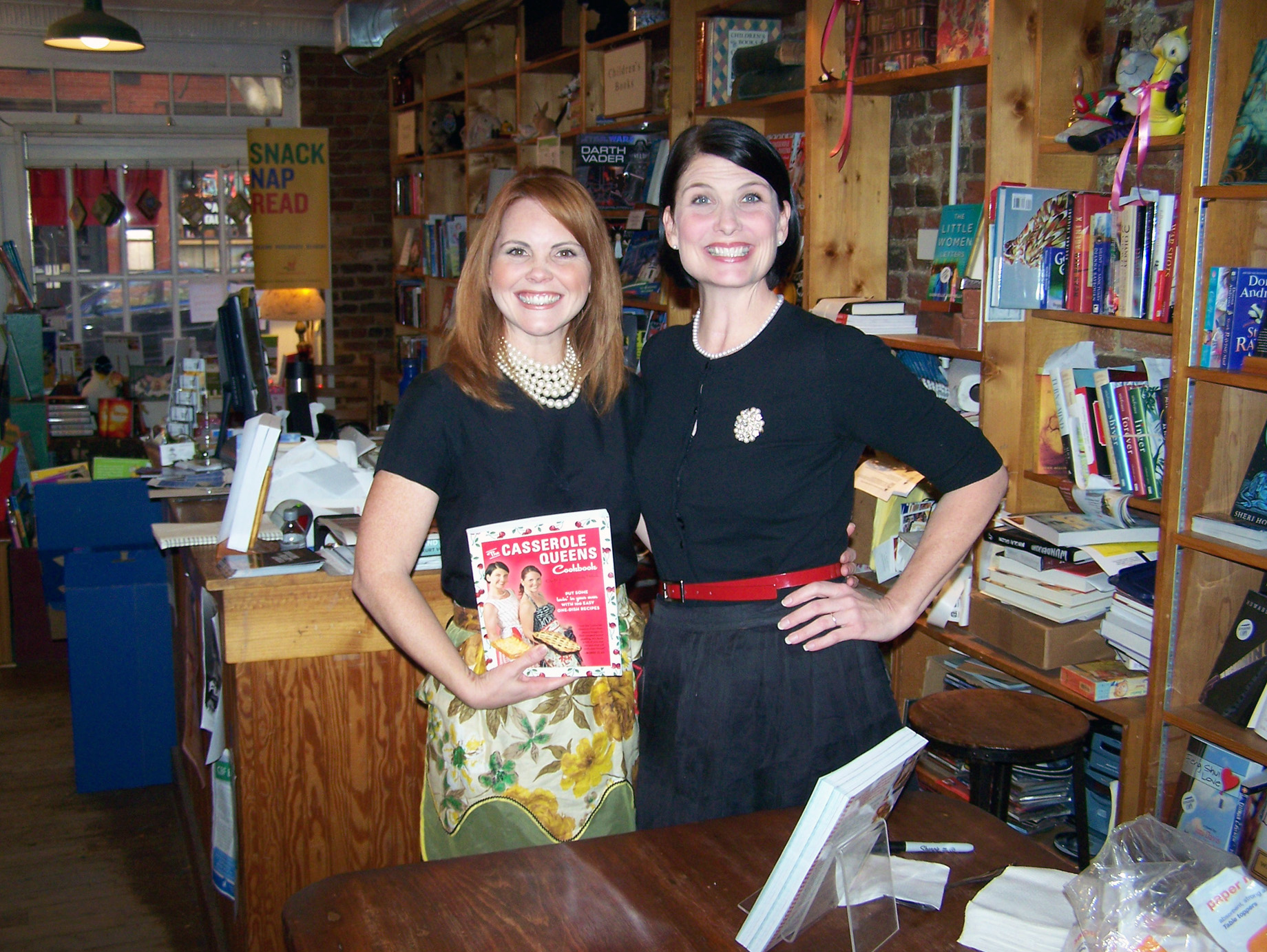
I inherited my mother’s cooking and baking genes. Unfortunately, another dominant trait is the trepidation gene, the one that kicks in when faced with the prospect of a pastry crust. Now look: I can whip up a graham cracker crust that’ll knock your socks off. (Someday I’ll share my recipe for peanut butter pie.) But I’ve always found the act of rolling out pastry dough and trying to fit it neatly in a pie pan as intimidating as trying to drive a stick shift. I’ve determined that I have a sort of spatial dyslexia. I also invariably cut off way too much gift paper when I’m wrapping presents. So… to make me feel better about myself when I think about these shortcomings, I resort to comfort food. Ironically, the one comfort food I’ve craved the most and haven’t been able to satisfy has been chicken pot pie. Until, that is, I met the Casserole Queens at an author signing at Richmond’s Fountain Books.

Crystal Cook, left, and Sandy Pollock: The Casserole Queens

You’ll recall that I shared their recipe for sweet potato casserole at Thanksgiving. And I promised to return with their chicken pot pie recipe. Luckily, I roasted two chickens the other week, so I just happened to have the main ingredient for this on hand.

I was also ready to face my fears.

I needn’t have worried. This recipe replaces homemade crust with a sheet of frozen puff pastry. (One and one-half or so sheets, if the brand you’re using is too small for a 9×13 dish. And of course you’ll thaw them first.) While it could be said that I’m still repeating a pattern begun in my mother’s kitchen, I justify this cheat by reminding myself of all the other from-scratch aspects of this recipe. I then feel positively awash in culinary nobility.

This recipe, incidentally, is the one that caught the eye of Bobby Flay; he featured  Crystal and Sandy on Throwdown! with Bobby Flay, his Food Network show. Surprisingly, they didn’t win.

They did as far as John and I are concerned. We loved every morsel. The recipe made enough for us to enjoy leftovers for several days and still share a serving with our neighbor. If you have a crowd coming over for the holidays, this ought to keep them satisfied.

World’s Greatest Chicken Pot Pie

—Makes 8 servings

2 tablespoons unsalted butter
1 (3-pound) roasted chicken, boned and shredded
1/4 cup chopped red bell pepper
2 medium shallots, thinly sliced
3 tablespoons all-purpose flour
2 teaspoons salt
1 teaspoon dried tarragon, crushed
1 teaspoon freshly ground black pepper
2 cups whole milk
1 cup heavy cream
1/3 cup dry white wine
1-1/2 cups fresh peas, blanched*
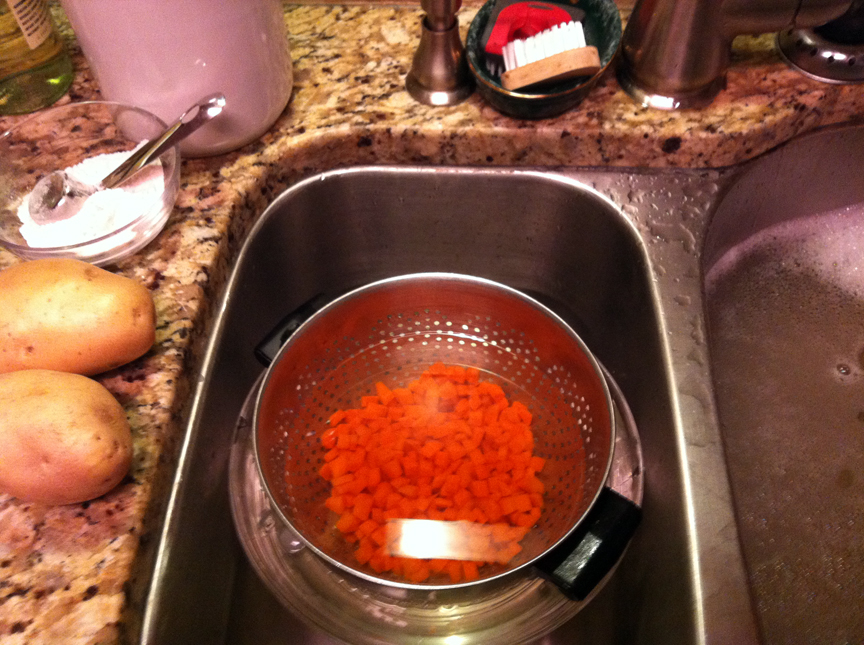
1-1/2 cups carrots, diced and blanched
2 russet potatoes, diced and blanched
1 sheet frozen puff pastry, thawed**
Egg wash (lightly whisk together 1 whole egg and 1 teaspoon water)

* I used frozen peas and they were perfectly wonderful. I did take the time, however, to blanch the carrots and the potatoes (separately). Took some extra time, but it was worth it to preserve their distinct flavors.


**Depending on the brand you use, you might need more than 1 sheet. I did.

1. Preheat the oven to 425oF.

2. In a large skillet set over medium-high heat, melt the butter. Add the chicken, bell pepper, and shallots, and cook, stirring constantly, for 5 minutes. Stir in the flour, salt,
tarragon, and black pepper. Add the milk and cream, and cook, stirring frequently, until the mixture is thick and bubbly, about 10 minutes. Add the wine, peas, carrots, and potatoes and stir until heated thoroughly, about 5 minutes.

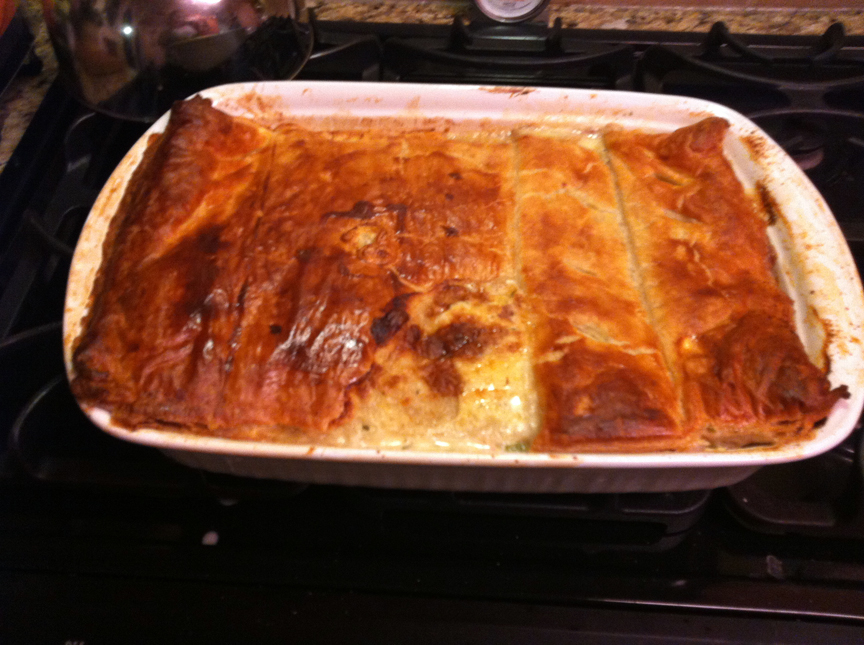
3. Transfer the hot chicken mixture to a 9 x 13-inch casserole dish. Place the puff pastry over the top of the casserole dish. Brush the edges of the puff pastry with the egg wash and press against the side of the casserole dish, then cut slits in the pastry to allow steam to escape. Brush the top of the puff pastry with egg wash—this will help the puff pastry brown evenly. Bake for about 35 minutes or until the top is golden brown. Serve immediately.

Copyright © 2011 by Crystal Cook and Sandy Pollock. All rights reserved. Used with permission.

— Photos by Marci Rich for The Midlife Second Wife

Share this:

  • Click to share on Facebook (Opens in new window) Facebook
  • Click to share on X (Opens in new window) X
  • Click to share on Pinterest (Opens in new window) Pinterest
  • Click to share on LinkedIn (Opens in new window) LinkedIn
  • Click to email a link to a friend (Opens in new window) Email
  • Click to print (Opens in new window) Print
  • Click to share on Tumblr (Opens in new window) Tumblr
  • Click to share on Pocket (Opens in new window) Pocket
  • Click to share on Reddit (Opens in new window) Reddit
Like Loading...

Barbara Kafka’s Basic Chicken Stock

14 Wednesday Dec 2011

Posted by themidlifesecondwife in Food for Thought

≈ 4 Comments

Tags

Broth, chicken, Cooking, Food, Roasting, Simmering, Soup, Stock (food)

The lovely bones go into the pot. The chicken is reserved for another use.

Barbara Kafka calls chicken stock “the universal solvent of the kitchen.” I wholeheartedly agree. So many recipes that I love call for chicken stock, and it’s essential that I have it on hand. As one reader pointed out last week, store-bought stock—even the organic versions—are laden with salt. This recipe is not. This is what you’ll want to use. Besides being embarrassingly easy to make, it’s economical, and it will fill your home with the aroma of simmering goodness—a perfect antidote to a cold autumn or winter day.

Last week I featured Kafka’s recipe for roasted chicken. Please bear that in mind as you consider this post; to state the obvious, roast chicken is the first step in making homemade stock. Again, my thanks to Barbara Kafka for giving me permission to share these recipes from her wonderful book Roasting: A Simple Art.

The finished stock, ready for measuring and freezing

Basic Chicken Stock
This makes about 3 quarts

Carcass and bones from a 5- to 6-pound roasted chicken, plus uncooked neck and giblets (I also add the wing tips I’ve trimmed before roasting the chicken); or 6 pounds chicken bones, necks and wings

3 quarts water or stock, or to cover by 2 inches
(I’ve never added stock and don’t recommend it doing so. See BK’s notes below.)

If using a whole chicken carcass, cut it up. Place the chicken parts or bones and parts in a stockpot with water to cover by 2-3 inches. Cover the pot and bring to a boil. Skim off the fat and scum that rise to the top. Lower the heat so liquid is just barely boiling. Cover if desired. Cook 8 to 16 hours, skimming occasionally, adding more cold water as needed. The more skimming, the clearer the stock.

Pour the stock through a sieve and let cool at room temperature as time permits; then refrigerate. Remove the art from the surface and any sediment from the bottom.

Use as is, refrigerate for 1 week, or freeze for 6 to 9 months.

Some notes from Barbara Kafka, adapted from her introduction to this recipe:

  • Make the stock without vegetables; they can always be added later. Vegetables cloud the stock and can cause it to turn and sour. (Kafka points out that she also doesn’t know until she uses the stock what she wants the flavorings to be.)
  • Stock made from the bones saved from plates and the carcass of a roasted bird, with its giblets added, will be richer than stock made from unroasted parts.
  • Tie up the gizzards and hearts in a piece of cheesecloth to fish them out easily after an hour’s cooking time. (I have to admit I never seem to have cheesecloth on hand, and I always forget to remove the giblets from the pot after an hour. Never harmed my stock, as far as I can tell!)
  • Before using the bones of a roast chicken for stock, remove all the good meat and save it for another use. (You can see from the picture that’s exactly what I did; the following day I made chicken pot pie, and will share that recipe with you next week.)
  • Note that the pieces of tendon and all parts that look and feel unattractive are good for the flavor of the stock.
  • Once a chicken is roasted, it is easy to pull the carcass apart—cut it if you are fastidious. (I’m not fastidious. I just rip the thing to pieces.) But having the bones in smaller pieces means that less liquid is needed to cover them (and that yields a richer stock).
  • Use a stockpot that is tall in proportion to its diameter; this minimizes the amount of liquid required and constantly rotates the liquid over the bones, which should be covered by liquid by several inches. (When Kafka doesn’t have time to let the stock simmer for many hours, she cheats by adding canned stock to the water for a base. I’ve never done this and I suspect she doesn’t do it often herself. I should ask her!)
  • The key to the success of this stock is long simmering. Don’t be alarmed, but if I start my pot going after an evening meal, I’ll keep it simmering all through the night and into the next day. Just keep the flame on at its lowest—after the initial boiling, all you really want to do is keep it lightly percolating—one or two “burps” at a time. I keep the lid on, but slightly askew to let some of the heat escape.
  • Why don’t you want it to boil the entire time? Because, according to Kafka, boiling risks binding the fat and dissolving solids into the gelatinous liquid. And long simmering dissolves all the gelatinous bits, which is what you want. The bones fall apart, as she says, “having given their all.” It takes about eight hours minimum; she likes to keep it going up to sixteen hours, if possible, and so do I.

Share this:

  • Click to share on Facebook (Opens in new window) Facebook
  • Click to share on X (Opens in new window) X
  • Click to share on Pinterest (Opens in new window) Pinterest
  • Click to share on LinkedIn (Opens in new window) LinkedIn
  • Click to email a link to a friend (Opens in new window) Email
  • Click to print (Opens in new window) Print
  • Click to share on Tumblr (Opens in new window) Tumblr
  • Click to share on Pocket (Opens in new window) Pocket
  • Click to share on Reddit (Opens in new window) Reddit
Like Loading...

The Triumph of Love: A Talk With Author Wendy Swallow

12 Monday Dec 2011

Posted by themidlifesecondwife in Love, Monday Morning Q & A, Relationships and Family Life, Remarriage, Second Weddings

≈ 2 Comments

Tags

Life, Love, Marriage, Premarital Counseling, Relationships, Remarriage, second marriages

Several months after John and I became engaged, I was assisting a journalist at the New York Times with a story—part of my regular duties as director of communications for the music conservatory where I worked. During our e-mail exchange, I mentioned that I was getting remarried, relocating to Virginia, and would soon be leaving my job. She wrote back to wish me luck and tell me about a book that crossed her desk when she was an editor at the Times Book Review. She found it “extremely interesting and well written,” she wrote, and sent me a link that led me to Wendy Swallow’s The Triumph of Love Over Experience: A Memoir of Remarriage. Something told me to read it—most likely the voice inside my head suggesting that after a quarter century of marriage and seven post-divorce years on my own, advice from a person who had been in the trenches might be useful. Deeply in love, John and I share a common sense of how to be in the world and of the world—with the same values, faith, and politics—and we operate from the same zone of trust and honesty. We’ve always been able to communicate easily and openly about our relationship. Still, advice from an expert is always welcome, and I was curious to see how someone else navigated the waters we were about to enter. I should mention that Wendy and her second husband each had two sons when they remarried—all of them teenagers.


THE TRIUMPH OF LOVE OVER EXPERIENCE: A Memoir of Remarriage

By Wendy Swallow
296 pp. Hyperion.

Her book was a comfort to me, a survival guide, user’s manual, and road map all in one. I have recommended it countless times—and not just to second couples—anyone in a relationship will benefit from reading it. Regular followers of this blog already know that I’ve cited Wendy’s wisdom before. One of my favorite quotes appears on the “Secrets to a Happy Relationship” page, which you can find at the top of the blog. When I began formulating the editorial objectives for The Midlife Second Wife, I determined that mine would not be the only voice you would hear; a section devoted to interviews with experts was therefore essential. Wendy Swallow is the first person to whom I reached out. I’m pleased and honored that she agreed to do this interview. Here is an edited transcript of our conversation, which took place on Thursday, December 1, 2011:

Wendy, thanks so much for participating in this interview. I’ve been looking forward to our conversation for some time. So have some of my readers. One of them sent me this e-mail:

I’m not in midlife … and not a second wife, but I’m having thoughts and fears of a second marriage. I’m 43 and said that I would never remarry, but I have recently found someone who I would consider marrying and I’m scared as hell!

Based on the research you did for your memoir of remarriage—and based on your own happy experience—what do you say to people who are genuinely frightened by the prospect of “stepping off the cliff and hoping to be able to fly?”

Those fears need to be taken seriously. That doesn’t mean you give in to them, but you listen to them and examine them. You have to trust your gut on this stuff, but you also have to really believe strongly—and the research bears this out—that the people who do best in a remarriage are those who have really worked to process what happened in their first marriage and their divorce, and who have grown from those experiences. That means perhaps going into counseling, accepting your role in what did not go well in your former relationship and where those problems lay, and in your ongoing relationship with your ex—even if the person that you left seems mostly to blame for the marriage’s failure from your perspective. Everybody has to look at how they contributed to the marriage not working out—even going so far as to ask why you married that person in the first place. This is especially true if you have children. I believe strongly in this. I don’t think it’s an easy process to go through. But if you want to grow and be able to marry again, this is an important piece of the puzzle. You have to keep those lessons in front of you. Researchers find that people who do not do well in remarriage never really learned the lessons of their first failed marriage. The statistics for second marriages succeeding are not great. And for those who remarry a third time, the odds that that marriage won’t work increase, and they go up for each subsequent remarriage.

I know. The numbers are pretty grim. Your reminder that we learn the lessons from our past experiences is critically important. What other conscious decisions must a couple make, and what actions must they take, for their second marriage to have a shot at success?

One of the things Charlie and I told each other early on was this: “I just want to be clear: I’m not rescuing you.” We were mostly talking to ourselves. We married our first spouses because we wanted to help them be more stable in the world. After my marriage ended, it ultimately became more important to me that I be really stable and happy in my single, divorced life. I knew this for myself, but I wasn’t sure that Charlie saw that.

There’s a moment in the book where I write about how we went to counseling with a minister. At the very first session, she managed to surface the whole issue of money, because we had a wealth disparity in our relationship. It wasn’t a bad thing—we didn’t think that money was something we’d have to spend a lot of time worrying about. But we had slightly different attitudes to this disparity in our relationship—we had two alien cultures coming together—and we recognized that it could create challenges in the future. It took—it always takes—compromise and communication to work those things out, so having these counseling sessions helped us; even if you think you know what you’re doing, a little premarital counseling can go a long way.

I want to return to the topic of compromise, but first I have to say something about premarital counseling. In our case, that train had left the station; that’s why I was so glad to read your book. How risky is it to take on a second marriage without going through couples’ therapy first? What advice do you have for those who are leaving it to their own devices?

I do think there’s a lot of good literature out there, and many excellent books that deal with stepfamilies, so there are a lot of resources. You can get counseling in various ways. A wise, good friend can be helpful. Definitely you have to talk to each other.

Before I left my first husband, I remember talking to a friend who remarried. I asked him what worked in his second marriage that didn’t work in his first. He said that when he married his second wife, he told her, “If you have a problem with something I’m doing, tell me right away. Don’t let it snowball.” That was their mantra.

I really thought about that. If you establish that you can talk about the difficult issues together early, then that’s good.

Very early on, our kids got into this habit that we worried about at first: drinking milkshakes at 10 at night and watching South Park in the kitchen. At first Charlie and I hung around, but then we realized they had more fun without us there. So we started taking our dog out for a long walk while they had their time together. It was perfectly natural; we didn’t like South Park. We’d leave the house with the dog for those long walks, and that was when we could talk without people hearing us or wondering why we were huddled together and whispering. We were both working full-time and running all over D.C. with these kids to play practice, SAT prep—we had very little downtime with each other—so those walks were very helpful in giving us a chance to download. His boys would bring their issues to him, mine to me; kids communicate with their own parents, mostly. Sometimes there were things I needed to know, and I wanted to anticipate what level of support was required of me.

That’s a great example of using every opportunity to keep the lines of dialogue open. Let’s get back to the subject of compromise. It’s undoubtedly important, but is there such a thing as too much compromise?

I think you have to trust your gut. You might agree to compromise on something but it doesn’t sit right with you. Trusting your gut has two actions:

1. Listening to your inner feelings, and assessing those feelings. How fair are they?

2. Acknowledging that there may be something you either need to bring back or learn to deal with. Which is it?

It’s not enough to listen to your gut—you must assess your feelings. Let your rational, less emotional brain think about it. Once you’ve done that, ask yourself what you really think will be different after your compromise—what outcome are you looking for?

There’s a famous moment in our family when we all learned a lot about compromise. My youngest stepson, Sam (the second-youngest of the boys) was advocating for a cell phone; he went to a school that was farther from home than the others. We worried about the cost of four cell phones, thinking that if we got one for Sam, we’d have to get phones for all four boys, as they were close in age. It begged the question: Who is ready for something, and who isn’t?

Each boy got his own computer when they started high school; before that, they had to share. And they would be taking their computers to college. We thought we were being fair and equitable. But after much discussion about the cell phone, Sam turned to us and said, “Can no one be special anymore?”

The truth is, each boy was different and had different needs, but we were trying to homogenize everyone. Benjamin called it “the kindergarten effect.” When we all moved in together, I had a cubby for each boy, color-coded toothbrushes and towels. The boys saw it as infantilizing. The house would have run more smoothly if the Wendy-scheme had worked, but the boys weren’t in that place.

Sometimes you set out with a plan that you think is fair and equitable, but life is a lot messier than that. The boys picked up on the fact that we wanted to be fair and equitable—and they appreciated it—but we were also able to articulate that within the family, some had specific needs.

The lesson is, compromise is a double-edged sword. Sometimes an imposition of the will of one person over the other has to be negotiated.

Here’s another compromise-related question, and a timely one, with Christmas only two weeks away: How do you handle the holidays?

In the early days we had a little trouble, because although Charlie and I tried to organize things well in advance, not all parties involved were planners—they would do things at the last minute, or not consult with us, so the matter of who was even going to be with us was often up in the air.

We did okay, though. One of the things we decided early on was that because our kids were teenagers, we were not going to pretend to make a happy family out of the six of us just because we were cohabitating. Both our sets of boys spent time with their other parents. Both of us had joint custody, which was nice. Sometimes we just had his kids, sometimes just mine, sometimes all four, sometimes nobody. We’d have four different alternatives in a two-week period. My older sister, who is a minister, says, when something is stressful:

“I’m trying to hold this lightly.”

This Christmas we’re expecting to have all four boys together for the first time in four years; all four of them without other people. We’re still waiting for word on the fourth and hope we get him. But we’re “trying to hold it lightly.” If it doesn’t work, it’s not the end of the world.

I learned from my first marriage that the good moments in life are not necessarily going to happen on a designated day. Many wonderful moments take place on completely average days.

The other thing is, we really didn’t want the kids to feel the stress of two families on the holidays, so we would accept that the kids were happy with the parent they were with. We’d have a night two weeks into December where we did something special together, like decorate the tree. We learned to get very flexible.

People get into trouble when they have a preset romantic notion of how something should look, whether it’s marriage, or what a holiday is supposed to look like. Life is way more variable. What is precious in life is not a perfectly decorated tree with all people in their seats at the table. Life can be messy.We’ve had holidays where we didn’t even put lights on the tree. It just has to be good enough as it is.

Whatever it is, Charlie will always say, “Let’s make this fun.”

Our first Thanksgiving in a restaurant was kind of sad for me; it wasn’t with my big family. Charlie found this cool restaurant and we were seated way up high. It was a lovely experience, but partly it was because he said “Let’s just make this a really cool event they’ll always remember.

One day we were trying to choose a movie to rent, deciding which one would be the most fun. The boys said, “Let’s do several movies!” It wasn’t what I had in mind, but I took Charlie’s line and asked myself: “Is there some way to have fun here?

Compromise again, which takes negotiating. Pro and Con lists are great tools for that—especially for working through big decisions. For a couple about to get remarried, what in your view are the top three things that should appear on the Pro side of their ledger? And what top three items on the Con side of the list suggest trouble ahead?

On the Pro side, I think that these must be at the top of the list:

1. Both parties need to be tolerant, patient, mature, and capable of self-examination.

In my first marriage, I didn’t understand how mature I had to be in the world. In my second marriage, I learned, partly from working for many years, that there’s something about the business world that enables most people to deal with people even if they don’t like them. A lot of the attributes about how we behave outside of the family can help us be better members of our own family. I don’t think I should give voice to all of my angry moments. I do a lot of waiting, so I don’t feel so strongly about the issue and can then address it with my more mature self.

2. Each person needs to be truly loving. They have to really love each other—love all of each other—the whole ball of wax.

None of us are perfect. We will all disappoint each other at times. But who is really there for me? And who am I really there for? Charlie and I didn’t get married for three years; we didn’t make any rash movements. I had worked so hard to recover from my first marriage that it took my brain time to catch up with my heart in order to accept him with all of his baggage. I knew that it was going to take time. Research bears this out: Rapid remarriage is dicier statistically than thoughtful, careful remarriage.

I knew that there was a whole process that Charlie had to go through—that he and his ex had to go through—without me coming in.

3. Your kids have to be in a place where they will be able to cope with your remarriage.

Charlie and I did not move in together before we married—not for moral or religious reasons, but because I was not going to ask my children to be at the kitchen table with a stranger every morning unless I was sure that this was a permanent thing. And his kids were really not ready; it was a little harder for them when it did happen because their parents’ divorce was more recent.

Not all kids are going to be ready for their parents to remarry. I know marriages that have sort of gone forward without everyone at the table. It’s not that they won’t be successful; it’s just that things will be tougher. It can be painful. I’ve watched a couple of families whose kids went into battle mode. Our own kids did not need to make us unhappy; they were very relieved that their parents were happier once they remarried.

Now, for the Con side …

1. Any impulsive behaviors

One example of an impulsive behavior would be getting together when it is motivated by something other than “this is the smart thing to do.” One thing I found in my research is that women are more likely to remarry partly to solve financial problems. Many women come out of a divorce living a more reduced life, and they struggle significantly. Women are somewhat motivated by financial concerns; who can blame them? But if that is the main motivation, that’s a problem.

Another impulsive behavior is getting married in the first blush of love before you know who somebody is—acting impulsively towards remarriage rather than thinking it out carefully and taking the time to know who you’re marrying. When you remarry, it’s not just the person you’re marrying; it’s their larger family. It’s their baggage. It’s their divorce.

2. Wrangling over property and money from early on in the relationship

We’ve all heard stories of someone who married a person who dictated everything, including where they will live, because the person they are marrying is very established in their lives and their career. If one party is having to give up everything and the other is not giving up anything, that’s destabilizing. It makes you wonder why they’re not compromising. One area where this comes up in a big way, even subconsciously, is property.

When the kids and I moved into Charlie’s house (partly for financial reasons) there were advantages. It was closer to my job. We would be only two blocks from my ex, which was a huge boon for my kids. But it was their house. When we moved my stuff in, I put it all in the living room, then I asked for a shelf or two. We worked it all out, negotiating so that decisions weren’t made automatically and arbitrarily. If one person in a proposed remarriage is unwilling to compromise on some of this stuff, that’s a problem.

The issue of property is interesting. When I was interviewing people for my book, I met one couple that fought because the husband needed a home office and he took away his young step-daughter’s playroom. By the time I’d met them, she was a grown woman who no longer lived at home, but she still hadn’t forgiven him. It’s all about territoriality. People identify certain things, rooms, and buildings with different stages in their lives.

3. The person you remarry doesn’t share your basic values and integrity

Here’s another thing I learned from my divorce. My ex and I had less trouble deciding about how to deal with our kids afterward because he’s trustworthy. He had issues, but trust was never one of them. He never once missed a support payment. He never stood the boys up. We shared the same values on education and on who the boys would become. We shared the same religious life. We shared the basic values.

If either party lacks integrity, then there’s going to be a lot more distrust in a marriage, and trust is the most important thing. You have to really know a person to know if they’ve got a spotty trust history.

Wendy, you’ve written a book about divorce and a book about remarriage. Do you have any plans for a third book about relationships?  

I never really meant to write a memoir to begin with, and then I wrote two even though I thought I shouldn’t write one until I was 80 and my parents were gone. I don’t think I’ll write another book about relationships; I’m not really sure I have anything more to add to the literature at this point. I’ve just spent four years writing my first novel. I’m working with my agent, and hoping it will be published in the next year or so. Part of me wants to do more non-fiction. We now live in Nevada half of the year, and I’ve become very interested in climate change, especially as it relates to the West. When my kids were young, I had all sorts of story ideas in my head about families and kids with issues. Maybe if I ever have grandkids …

You’ve now been remarried for ten years. What would you tell your younger self if you could travel back in time to the eve of your wedding?

It would be to have confidence. I’d say, “Trust yourself and trust Charlie, because it’s all gonna be fine. You’ve made an excellent choice. Trust it and rejoice in it.” 

Wendy Swallow is an author and journalist who recently retired as an emeritus professor of journalism after nearly 20 years of teaching at American University in Washington, D.C.  She started her career as a reporter and editor on the financial desk of the Washington Post, covering the savings and loan crisis, local business, and regional environmental issues.  In academia, she researched and wrote about advertiser pressure on newspaper coverage and the influence of new technology on journalism.  More recently, she has turned to writing about family issues.  She has published two books with Hyperion, Breaking Apart: A Memoir of Divorce (2001) and The Triumph of Love Over Experience:  A Memoir of Remarriage (2005).  In addition to many newspapers, her work has appeared in MORE, Washingtonian, Ladies’ Home Journal, Readers’ Digest, Parenting, The National Journal, Washington Journalism Review, Journalism Quarterly, Journalism Educator, Newspaper Research Journal, and Extra!  She is currently working on an historical novel and divides her time between homes in Reno, Nevada, and Washington, D.C.  She and her husband Charles Shepard have four grown sons.

Share this:

  • Click to share on Facebook (Opens in new window) Facebook
  • Click to share on X (Opens in new window) X
  • Click to share on Pinterest (Opens in new window) Pinterest
  • Click to share on LinkedIn (Opens in new window) LinkedIn
  • Click to email a link to a friend (Opens in new window) Email
  • Click to print (Opens in new window) Print
  • Click to share on Tumblr (Opens in new window) Tumblr
  • Click to share on Pocket (Opens in new window) Pocket
  • Click to share on Reddit (Opens in new window) Reddit
Like Loading...

Two Chickens, Many Meals (Thanks to Barbara Kafka)

07 Wednesday Dec 2011

Posted by themidlifesecondwife in Food for Thought

≈ 4 Comments

Tags

Barbara Kafka, chicken, Cooking, Food, Roasting

You know the old saying: “Give people roasted chicken, they’ll eat for a day. Teach them how to roast a chicken, they’ll eat forever.” What? That’s not how it goes? Well, it does now. Barbara Kafka is the person who taught me how to roast a chicken, although she wasn’t aware of that when I called her this morning, at her home in Manhattan, to ask for permission to publish two of her recipes on The Midlife Second Wife. As far as I’m concerned her beautiful book, Roasting, A Simple Art, is the last word on that most fundamental kitchen skill. And her “continuous kitchen” philosophy is smart and economical, especially if you’re on a budget. I’m always amazed by the number of meals I can eke out of one or two roast chickens.

Kafka’s premise, that fish, fowl, meat—even vegetables and some fruits—are best roasted at extremely high oven temperatures (500-degrees Fahrenheit), has proved infallible in my kitchen. I have roasted chicken, standing rib roast, turkey, asparagus, cherry tomatoes, leeks, and more using this principle. The results are always wonderful: the high-heat method seals in flavor, yielding a crispy, succulent exterior and an interior that is moist and delicious. You’ll never serve a dry turkey again.

Another Kafka principle to which I adhere is the “continuous kitchen.” Let’s use chicken as an example. I typically roast two at the same time. After we’ve dined on one, I reserve all of the bones and trim the carcass of all meat, which I reserve for leftovers (another roast chicken dinner, sandwiches, chicken salad, or a casserole). I do the same with the extra bird that has not been served. All of the bones, the wing tips (which I’ve removed before roasting), and the neck and giblets (saved before roasting) get tossed into my stockpot and filled with water. Do you see where I’m going with this? Homemade chicken stock—lots of it—to keep in your freezer. You’ll be able to read Kafka’s recipe for basic chicken stock in my next cooking post—or her book, if it’s not too late to add something to your holiday wish list.

Copyright © 1995 by Barbara Kafka. All rights reserved. Used with permission.

Today I’ll be sharing her famous recipe for roasted chicken. My thanks to Barbara Kafka for giving me permission to do so.

A few words of warning, though: The only aspect of her method that could rightly be called Kafkaesque—having a touch of danger—is the method itself. Roasting at 500-degrees Fahrenheit is perfectly safe to do, provided you have taken a few advance precautions:

  1. Make sure that your oven is clean, as in spotless. If you don’t have time to clean your oven before trying this, don’t do it. Self-cleaning ovens are best (so much easier on the back), but I’ve successfully used the high-heat method in an ordinary oven.
  2. Make sure the rack is placed at the lowest section of your oven. I actually remove the top rack and rest my roasting pan on the bottom rack. Kafka might disagree with this; her instructions invariably say to place the rack in the center or bottom third of the oven. But when I’ve tried that I’ve found my food browned too quickly, so I’d lower the temperature slightly (or cover the top with foil) to avoid burning. (Every oven varies in temperature; mine have always seemed to be on the high end.) I’m also a worrier when it comes to high heat, and prefer the extra cushion of space at the top, especially if grease is popping energetically.
  3. Don’t leave the kitchen unattended while you’re doing this. That shouldn’t be an imposition; it’s a quick method, and you’re sure to have other related tasks to perform. Just stay nearby.
  4. Keep your oven fan on, and open a door or window if it gets too smoky. (Didn’t clean the oven first, did you?)
  5. Take care when opening your oven door to remove or check on what you’re roasting. Avert your head (especially if you wear glasses…trust me) and wait a few seconds before proceeding.
  6. Practice safe kitchen. Have a fire extinguisher nearby, and keep pets and children away from the oven area while you’re cooking.

Now, let’s begin.

Simplest Roast Chicken

Serves 2 to 4
Total roasting time: 50 to 60 minutes


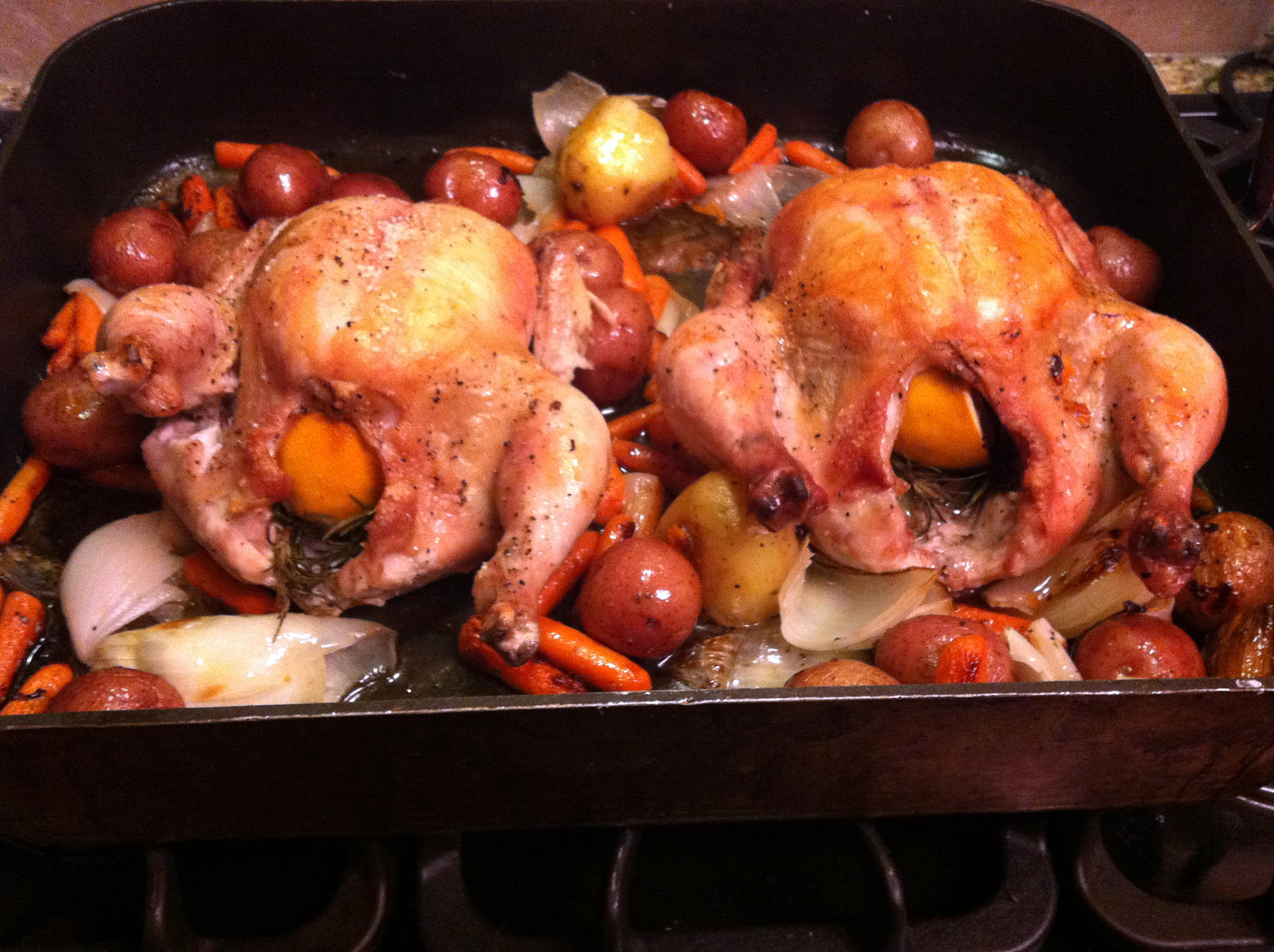
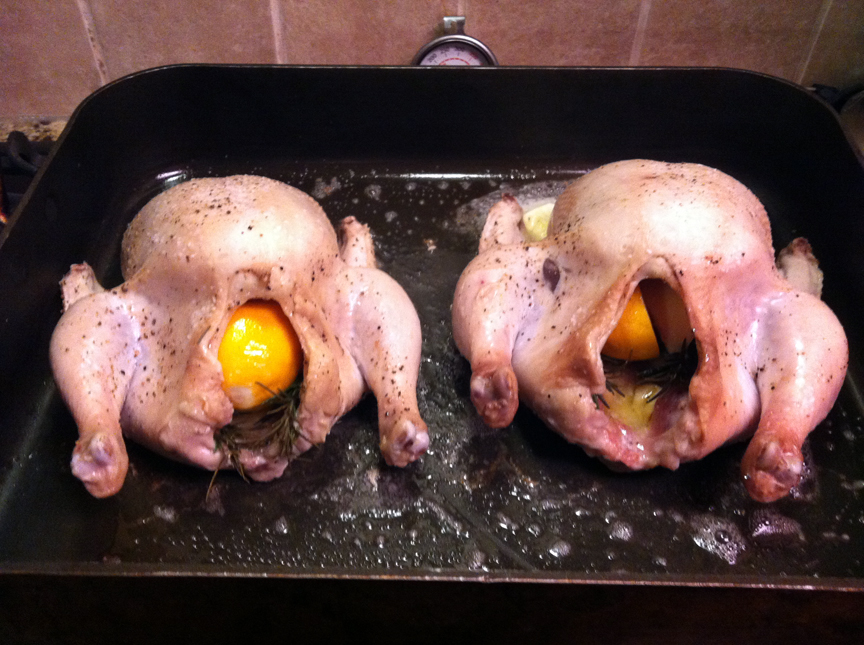
5- to 6-pound chicken, wing tips removed (the chickens shown in the photograph were about 3 pounds each)

1 lemon, halved (I used two, for two chickens)
4 whole garlic cloves (again, doubled for two birds)
Kosher salt, to taste
Freshly ground black pepper, to taste
1 cup Basic Chicken Stock (page 42 of her book) or canned, water, fruit juice, or wine, for deglazing

Place rack on second level from bottom of oven. (See my note above.) Heat oven to 500 o F.

Remove the fat from the tail and crop end of the chicken. Freeze the neck and giblets for Basic Chicken Stock. [Or refrigerate them in a sealed plastic bag if making stock the same day or the next.] Reserve chicken livers for another use.

Stuff the cavity of the chicken with the lemon, garlic, and butter, if using. Season the cavity and skin with salt and pepper. [I also added some sprigs of fresh rosemary.]

The stuffed chickens after 10 minutes of roasting

Place the chicken in a 12x8x1½-inch roasting pan [slightly larger if adding vegetables] breast side up. Put in the oven legs first and roast 50 to 60 minutes, or until the juices run clear. After the first 10 minutes, move the chicken with a wooden spatula to keep it from sticking.**

**At this stage, I incorporate elements from Kafka’s recipe for Roast Chicken with Crispy Potatoes:

2 pounds small red new potatoes, peeled or not and quartered (I did not quarter them when I made this, and rather wish I had done.)
1-2 medium onions, peeled, left whole, optional, or 6 cloves garlic, unpeeled, optional (I only used onions)
My addition: a package of baby carrots

Sprinkle vegetables with salt and pepper and add to the roasting pan after the first 10 minutes of roasting. At 15-minute intervals, until the end of roasting time, stir the vegetables around with a wooden spoon so that they don’t stick to the pan.
Back to the standard recipe:

Remove the chicken to a platter by placing a large wooden spoon into the tail end and balancing the chicken with a kitchen spoon pressed against the crop end. As you lift the chicken, tilt it over the roasting pan so that all the juices run out and into the pan.

Pour off or spoon out excess fat from the roasting pan and put the roasting pan on top of the stove. Add the stock or other liquid and bring the contents of the pan to a boil, while scraping the bottom vigorously with a wooden spoon. Let reduce by half. Serve the sauce over the chicken, or, for crisp skin, in a sauceboat.

If you’ve added potatoes, onion, carrots, etc., remove them to a serving platter as well. Season with salt and pepper to taste, and then deglaze the pan.

Next week, I’ll share Barbara Kafka’s method for making Basic Chicken Stock. And, for the holiday week, my food gift to you will be the Casserole Queens’ recipe for Chicken Pot Pie—just the thing to have on hand when company begins to fill your home!

Share this:

  • Click to share on Facebook (Opens in new window) Facebook
  • Click to share on X (Opens in new window) X
  • Click to share on Pinterest (Opens in new window) Pinterest
  • Click to share on LinkedIn (Opens in new window) LinkedIn
  • Click to email a link to a friend (Opens in new window) Email
  • Click to print (Opens in new window) Print
  • Click to share on Tumblr (Opens in new window) Tumblr
  • Click to share on Pocket (Opens in new window) Pocket
  • Click to share on Reddit (Opens in new window) Reddit
Like Loading...

The Liebster Award

03 Saturday Dec 2011

Posted by themidlifesecondwife in The Writing Life, What's the Buzz?

≈ 12 Comments

Tags

blogs, Liebster, writing

This past week I learned that Ree of ReeknittingwordswithGod chose The Midlife Second Wife as one of five blogs to receive the Liebster Award. The name derives from the German—Liebling means favorite, Liebe means love, Liebste means dearest—hence Liebster, because the award is given to blogs that the recipient loves. The circle of Liebster Blogs is ever-widening, and could very well exist in perpetuity as long as there’s an Internet and bloggers who blog. It’s important to note that bloggers give the award only to blogs with fewer than 200 followers. (It pleases me to report that also this week, the The Midlife Second Wife reached a circulation of 120 e-mail and WordPress subscribers.)

Because the Liebster Award is given by bloggers to bloggers, I consider it a singular honor—we write not only to gain perspective and understanding, but also so that others will read. The award, therefore, strikes me as a real validation of what we do. It’s also a wonderful way for the blogging community to connect, and to share blogs that they themselves love.

There are a few requirements that come with the Liebster Award. Here they are:

I. Show your thanks to the blogger who gave you the award by linking back to them. (Ree, thank you. I’m glad to count you among my readers, and am happy to send people your way.) You can find Ree’s reflections on spirituality and—yes!—knitting, at ReeknittingwordswithGod.

II. Reveal your top five selections for the award and let those bloggers know by leaving a comment on their blog (see below).

III. Post the award on your blog.

Here are my award winners—I hope you’ll enjoy discovering their work:

1. Linda Grashoff – The true name of Linda’s blog is Romancing Reality, and that’s precisely what this painterly photographer does. In the click of a shutter, she finds art in everyday places and captures extraordinary nature scenes that mesmerize.

2. A.B. Westrick – It almost goes without saying that bloggers are writers. But when you find a writer who is a blogger, well, that’s a bonus. If you care at all about the craft of writing, then you owe it to yourself to visit this blog. A.B.’s first book, for young adult readers, is forthcoming from Viking Children’s Books.

3. Radical Amazement – I discovered this blog when it was featured on WordPress’ “Freshly Pressed.” I was, well, impressed. I love the sensibilities here, this is a deeply spiritual blog—but it is the spirituality of a person who is not afraid to state: “I am agnostic with a great deal of faith.” A photographer and a writer, this is a talent I’m glad to have stumbled upon.

4. Author Meg Medina – Another great blog by a writer. Meg is a Latina author, as she says, “of libros for kids of all ages.” Not only will you find humor and insight here, you’ll snag some terrific recipes, too.

5. Aphaeresis – Anne’s blog is about everything under the sun—food, daily life, books, classical music—the quotidian quirkily observed. A true diarist, she writes lyrically, sardonically, intelligently. I love it.

Ree, thanks again for the honor.

Share this:

  • Click to share on Facebook (Opens in new window) Facebook
  • Click to share on X (Opens in new window) X
  • Click to share on Pinterest (Opens in new window) Pinterest
  • Click to share on LinkedIn (Opens in new window) LinkedIn
  • Click to email a link to a friend (Opens in new window) Email
  • Click to print (Opens in new window) Print
  • Click to share on Tumblr (Opens in new window) Tumblr
  • Click to share on Pocket (Opens in new window) Pocket
  • Click to share on Reddit (Opens in new window) Reddit
Like Loading...

How Do I Spell Relief? S-T-A-B-L-E

02 Friday Dec 2011

Posted by themidlifesecondwife in The Healthy Life

≈ 7 Comments

Tags

Breast cancer, Breast cancer screening, Health, mammograms

MorgueFile Image

On Wednesday I posted an essay on the blog about the importance of having an annual mammogram—prompted by the fact that I had to go in for a screening mammogram that afternoon. Before another moment passes, I want to let you know that I’m fine. The results were the same as the screening mammogram I had to take last year at the Cleveland Clinic; in short, stable. Many of you sent me personal e-mails, some of you left comments here, a few of you phoned. Thank you from the bottom of my relieved heart for your concern and support.

It was a long, stressful afternoon, despite the soothing atmosphere of the imaging center to which my gynecologist referred me. The staff could not have been kinder, and they were especially helpful when a mix-up occurred with my Cleveland films. Still, as experiences go, I could have done without this one. I needed all of yesterday to recover my equipoise.

These screenings are sobering affairs; you know that for a few of the women sharing space with you in the waiting room, the news is not going to be good. Last year, at the Cleveland Clinic, a woman wept in the anteroom. There but for the grace of God …

The thing is, my wonky breasts are likely to lead me down this path again. And again and again. As I wrote earlier this week, I was diagnosed with fibrocystic disease when I was in my twenties. (The condition goes by other names: mammary dysplasia, benign breast disease, or this euphemism—new to me—which apparently was coined to diminish worry: “fibrocystic change.”) Last year was the first time my annual mammogram raised a red flag with the radiologist. In my case—and here I’m quoting last year’s test result—”there is a moderate amount of fibroglandular density noted within the right breast … Underlying fibroglandular pattern is stable.”

Stable is a good word. I’m all for stable. It means that for one more year, I don’t have to think about these wonky breasts anymore. (And you won’t have to read about them.)

Thanks again for your concern. But tell me: did you schedule your annual exam?

Share this:

  • Click to share on Facebook (Opens in new window) Facebook
  • Click to share on X (Opens in new window) X
  • Click to share on Pinterest (Opens in new window) Pinterest
  • Click to share on LinkedIn (Opens in new window) LinkedIn
  • Click to email a link to a friend (Opens in new window) Email
  • Click to print (Opens in new window) Print
  • Click to share on Tumblr (Opens in new window) Tumblr
  • Click to share on Pocket (Opens in new window) Pocket
  • Click to share on Reddit (Opens in new window) Reddit
Like Loading...

Every Picture Tells a Story: Please Schedule Your Mammogram

30 Wednesday Nov 2011

Posted by themidlifesecondwife in The Healthy Life

≈ 16 Comments

Tags

Breast, Breast cancer, Breast cancer screening, Cancer, Health, Mammography, National Cancer Institute, National Institutes of Health

morgeFile Image

I had every intention of writing something lighthearted for this, my last daily post as part of BlogHer’s NaBloPoMo challenge. But my heart isn’t feeling all that light right now, and if there’s one thing I’ve learned about living daily life and writing, it’s this: I can’t fake it. This afternoon, a friend is accompanying me while I undergo a screening mammogram.

For those unfamiliar with the term, a screening mammogram is like needing to have your senior pictures retaken because they turned out so awful the first time. Earlier this month, I had my routine annual mammogram. And for the second year in a row, I received a call several days later informing me that the radiologist wanted a “do-over.” Something on the film of my right breast looked—what was the word I heard when the technician called me?—suspicious? Unusual? I can’t remember. I stopped listening clearly shortly after she identified herself on the phone. Panic, I suppose.

My adventures in good health and otherwise are long and complicated—far too complicated for a single post—so for now I’ll focus only on this new development. Last year, I was relieved when the films came back negative. This year, I’m hoping for the same result. I had no symptoms then, and I have none now, other than the usual annoyance of fibrocystic disease, which was diagnosed when I was in my twenties.

Regardless of today’s outcome, I’ve decided that I will share the experience on my blog. Why? Two reasons, mostly. First, because breast cancer is probably the top rung of the worry ladder for millions of women. Estimates for 2011 from the National Cancer Institute at the National Institutes of Health predict that there will be 230,480 new cases of breast cancer among women; 2,140 among men. (Yes, men can get breast cancer, too.) Deaths this year are estimated at 39,520 for women, and 450 for men.

Second, I believe that it’s in your best interest to have useful and important information, so I’ll be telling more of my story in future posts. If telling my story prompts someone to get to the doctor for a long overdue visit, or to begin to take seriously the reminders to perform self-examinations each month, then that’s a good thing.

My own history is such that it necessitated regular mammograms at an age earlier than what is considered the norm, despite the fact that neither my mother nor her sister ever developed the disease. (I’m an only child, so as canaries in the mine go, I’m it.)

You would think I’d be used to all this rigmarole by now, but I’m not. I’m a bit apprehensive today, and that’s normal.

Here’s hoping my films will be normal, too.

And you out there. Yes, you. The one reading this and thinking, “You know, I guess I should call and schedule my appointment, but I’m just so busy right now…”

Guess what? You’ll always be busy. Don’t panic, but please make time for this; it’s important.

This has been a public service announcement from The Midlife Second Wife.

Share this:

  • Click to share on Facebook (Opens in new window) Facebook
  • Click to share on X (Opens in new window) X
  • Click to share on Pinterest (Opens in new window) Pinterest
  • Click to share on LinkedIn (Opens in new window) LinkedIn
  • Click to email a link to a friend (Opens in new window) Email
  • Click to print (Opens in new window) Print
  • Click to share on Tumblr (Opens in new window) Tumblr
  • Click to share on Pocket (Opens in new window) Pocket
  • Click to share on Reddit (Opens in new window) Reddit
Like Loading...

Mimi’s Marinara Sauce With Meatballs and Sausage

29 Tuesday Nov 2011

Posted by themidlifesecondwife in Food for Thought

≈ 6 Comments

Tags

Cooking, Food, Marinara sauce, Pasta, recipes, Sauces

This recipe for marinara sauce with meatballs and sausage, a family favorite, has been in my cooking repertoire since the Carter Administration, which is to say a very long time. I’ve made a number of adjustments and refinements to the original recipe over the years, chief among them the addition of dry red wine. I love cooking with wine—it’s such a generous thing to do for your dinner guests! The Clemenza cooking scene in The Godfather provided the inspiration for this enhancement—after the movie was released on video I had a chance to study his method—so I suppose we ought to thank Francis Ford Coppola. (He produces his own wine, too.) You’ll notice, however, that I don’t precook the meatballs or the sausage before adding them to the pot; they get cooked along with everything else, since the sauce simmers at least four hours on the stove. I tried precooking the meat only once, and found that the sauce took on an entirely different flavor. I prefer my method, since it retains the tenderness of the meat and prevents it from drying out, but by all means, adjust this recipe to your own tastes. You might also wish to substitute turkey sausage and turkey meatballs for the red meats shown here. As my Grandma Monia used to say: Mangia!

MIMI’S MARINARA SAUCE WITH MEATBALLS AND SAUSAGE*

1 large (28-ounce) can whole tomatoes (I prefer San Marzano Italian plum tomatoes)
3 12-ounce cans tomato paste
water
salt, freshly-ground pepper, and garlic salt to taste
one-quarter cup sugar
one-half to 1 cup dry red wine, such as Chianti or Cabernet Sauvignon
one-half cup grated Parmesan cheese, or to taste**
1 and one-half pounds hot Italian sausage, cut into 4-inch sections
1 and one-half pounds sweet Italian sausage, cut into 4-inch sections
2 pounds ground chuck
4 cloves garlic, minced
¼ cup chopped Italian parsley
6 eggs
4 cups (approximate) seasoned Italian bread crumbs
1 cup (approximate) grated Parmesan cheese**
salt and freshly-ground pepper

I begin by making the meatballs so that they’re ready to add to the simmering sauce.

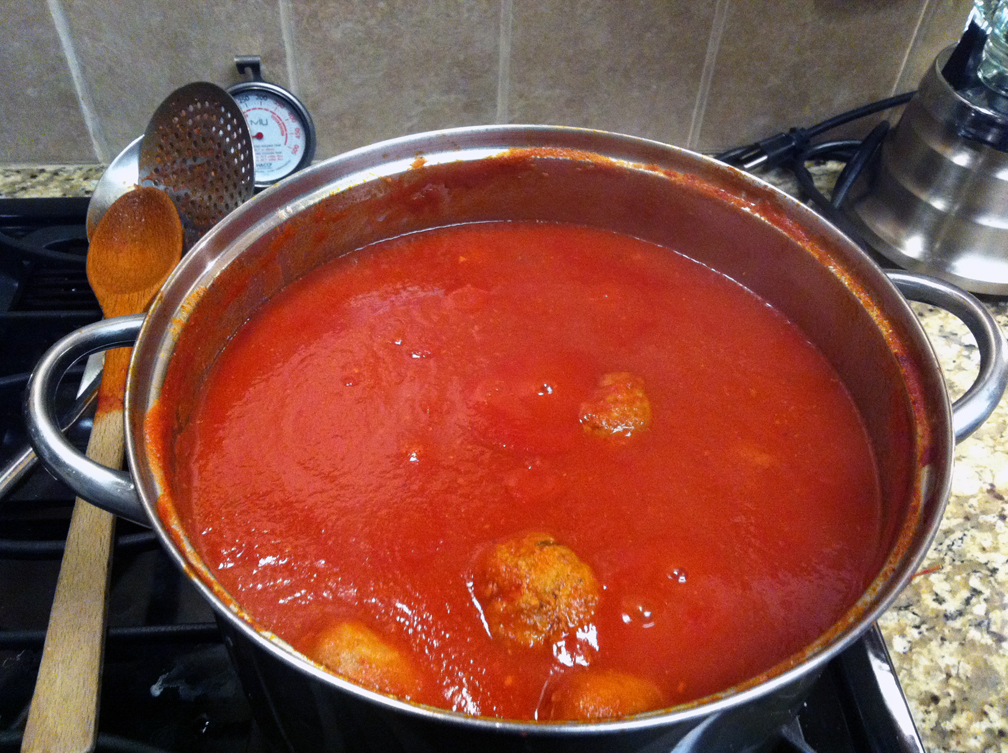
In increments, so that everything is blended well, combine ground chuck, garlic, chopped parsley, eggs, breadcrumbs, Parmesan cheese, and salt and pepper. (If you prefer, substitute garlic salt for the garlic in the meatballs.) Keeping a small bowl of water nearby, wet your hands and break off the meat into about 2-inch pieces, rolling into meatballs. Continue the process, wetting your hands as you go. (Take a look at the picture above; the meatball simmering in the pot is the size you’re going for. And take care not to overdo it with the breadcrumbs; you want the meatballs to adhere, but you don’t want them to be dry.) When all of the meatballs have been made, set aside in the refrigerator in a covered bowl.

Chop the canned tomatoes and put them in a large pot, adding one can of water and three cans of tomato paste. Stir well to combine, then add water to the pot until you’ve filled the pot slightly halfway. (Too much water and your sauce will be thin and, well, watery. Plus, when you add your meat and the sauce begins to boil and then simmer, too much water will make the sauce boil over. Trust me: you don’t want that.)

Over medium heat, begin bringing this mixture to the boil, adding salt, pepper, garlic salt to taste along with the sugar before it gets to the boiling point. (Let your taste preferences be your guide in terms of how much seasoning to use. I sprinkle everything fairly liberally to begin with, stir and simmer, and then check my seasonings a couple of times throughout the cooking process.) Add the wine and the Parmesan cheese to the sauce, and stir well, bringing to a boil.

Add the sausage to the sauce.

Add the meatballs to the sauce.

Return everything to a boil, then reduce the heat to low and simmer slowly for four hours. Continue to stir the pot, using a wooden spoon, and scrape up from the bottom in case you’ve let the heat get too high and the sauce starts to burn. The secret here is a SLOW, STEADY SIMMER. If your dinner is delayed for some reason, one of the beautiful aspects of this recipe is that you can keep this pot of sauce simmering for an extra hour. Make sure that you cook it for the full four hours, though, because you want to make sure that your meat is done. Check the sausage before serving; if it’s pink inside, keep simmering it, and the sauce, until done.

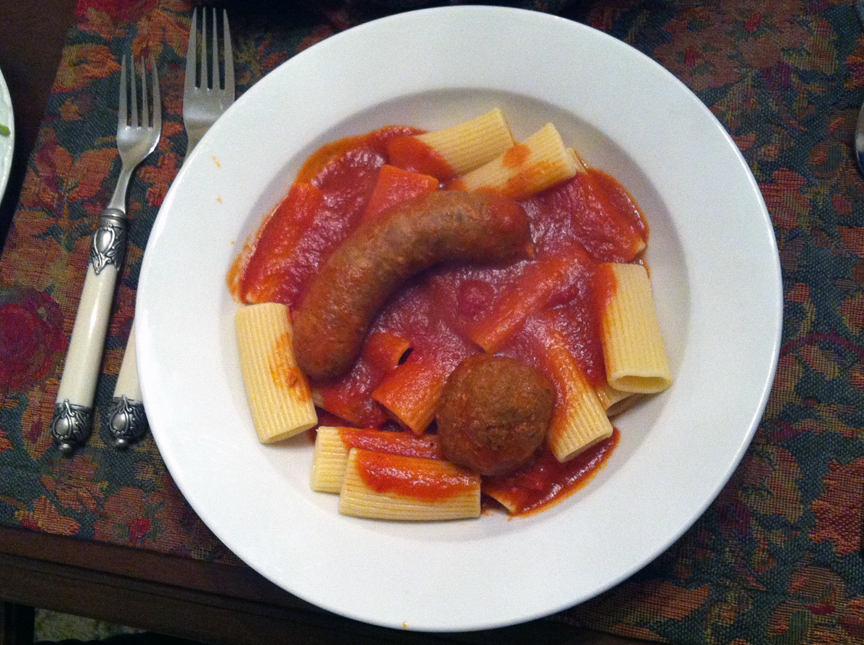
This is a hearty sauce, so serve it over a substantial pasta like rigatoni, rather than a delicate angel hair pasta. Toss together a green salad, add a loaf of crusty Italian bread, and mangia!

*Mimi is John’s nickname for me.

** A word about the Parmesan cheese. If I’m economizing (and aren’t nearly all of us economizing?) I’ll use Kraft grated Parm. But on the rare occasions when we’re splurging, I’ll grate fresh Parmigiano-Reggianno cheese for this recipe; I firmly believe in using the freshest, best ingredients that one can afford, and there’s nothing like the real thing.

P.S. Your entire house will smell amazing while you’re cooking this sauce!

Share this:

  • Click to share on Facebook (Opens in new window) Facebook
  • Click to share on X (Opens in new window) X
  • Click to share on Pinterest (Opens in new window) Pinterest
  • Click to share on LinkedIn (Opens in new window) LinkedIn
  • Click to email a link to a friend (Opens in new window) Email
  • Click to print (Opens in new window) Print
  • Click to share on Tumblr (Opens in new window) Tumblr
  • Click to share on Pocket (Opens in new window) Pocket
  • Click to share on Reddit (Opens in new window) Reddit
Like Loading...

To the Middle and Beyond! (What Will We Do with Longevity?)

28 Monday Nov 2011

Posted by themidlifesecondwife in Midpoints, The Healthy Life

≈ 7 Comments

Tags

Boomer Project, boomers, Life, middle-age, midlife, the 60s generation

All right, it’s time for a reality check. Unless I live to be 110, I’m technically past my midlife shelf life—so far over the rainbow as to be nearly under it. (But what was I going to call this blog, anyway? The Over-the-Hill Second Wife? The Old Second Wife? To Infinity and Beyond with the Midlife Second Wife? These are hardly euphonious, and the first two less than complimentary.) I was reminded—painfully—of the disparity between my chronological age (55) and a more accurate midpoint (say, 40 or so), this morning while catching up on my local newspaper reading. The Richmond Times-Dispatch runs a monthly column, “Viva the Vital!” by a boomer named Matt Thornhill; he’s president of the Boomer Project, based here in my adopted hometown. The Boomer Project provides advice and information about our robust demographic to organizations and corporations. For example, did you know that we Boomers and our elders spend $3.5 trillion dollars annually on goods and services? But back to Thornhill and his Thanksgiving Day column. He started things off with a quote by comedienne Rosanne Barr, who said: “C’mon, I ain’t living to age 106, so I am waaay past the halfway point.”

Ouch. Thanks, Rosanne. Thanks, Matt. No, really—thanks. Because this got me thinking—always a good exercise when writing a blog.

Many of us in our 50s and 60s don’t feel old. Do we? And if we’re careful and follow all of the good advice out there, Thornhill reminds us that thanks to the miracle of modern medicine and technologies, the new normal is such that we could very well live—and live well—into our 80s and beyond. And if such is the case, we’ve got a good 20 to 30 years to fill.

It’s nice to have the extra time. But what are we going to do with it?

Thornhill writes that he and his colleagues at the Boomer Project “believe that boomers are going to fulfill their ‘promise’ as a generation by individually living out their own personal promise or agenda.” You might recall that ours is the generation that intended to change the status quo in the 1960s. Thornhill quotes Tom Brokaw, who famously chronicled our generational predecessors in The Greatest Generation. Apparently Brokaw thinks that we baby boomers squandered our opportunity to make a lasting, positive difference in the world.

I’m happy to read that Thornhill disagrees with Brokaw’s assessment. And here’s where we can take up the challenge. If you believe, as Thornhill does, that we still have the opportunity, in the next 20 years, to apply “our collective wisdom and experience from our ever-increasing trips around the sun, [then] our legacy as a generation is in front of us.” We can effect positive change on “companies, organizations, governments, each other and other generations,” as long as we “live our promise.” And Thornhill believes that it is our personal promises, as boomers, that will make the difference; he predicts that most of them will be outwardly focused.

What is your promise—to yourself, your family, your community? I’ve already made one or two—and I should mention that these are nothing like New Year’s resolutions. When the opportunity is appropriate, I’ll share my promise on the blog. But I would love to know what the boomers among you think:

Did we, as a generation, blow our chance to leave a lasting and positive legacy? Or is the best, as Frank Sinatra sang, yet to come?

Share this:

  • Click to share on Facebook (Opens in new window) Facebook
  • Click to share on X (Opens in new window) X
  • Click to share on Pinterest (Opens in new window) Pinterest
  • Click to share on LinkedIn (Opens in new window) LinkedIn
  • Click to email a link to a friend (Opens in new window) Email
  • Click to print (Opens in new window) Print
  • Click to share on Tumblr (Opens in new window) Tumblr
  • Click to share on Pocket (Opens in new window) Pocket
  • Click to share on Reddit (Opens in new window) Reddit
Like Loading...

Still Life With Bone Scan

27 Sunday Nov 2011

Posted by themidlifesecondwife in The Life Poetic

≈ 8 Comments

Tags

Illness, Life, Poetry

Négatif

Image via Wikipedia

Still Life with Bone Scan

She is smaller than
before.
Tomorrow
she’ll be smaller still,
aging into herself,
erasing her self.

The doctor’s
at the door,
in his hands, an analog
of her.
It’s smaller still—
this negative image,
this paper doll—
her skull coyly tilted
to one side, defenseless,
her arms stretched wide.

Hiding, the tumor—
benign but not benevolent—
in what he called
“a symbiotic kinship
with the brain.”

How far removed, this
milky miniature, this flattened
pattern of a mother?
How far removed
from she who strode
through rooms in
Sicilian joy or aggravation,

who posed on the DeSoto’s hood—
perfectly manicured and coiffed—
an elegant arm draped
over my father’s shoulder,
smiling at the camera?

Sorrowful mother,
small amid the chalky sheets,
(the wires translating
each heartbeat onto a screen,
yet another analog)

the fact of her life
as lines on a graph.

Share this:

  • Click to share on Facebook (Opens in new window) Facebook
  • Click to share on X (Opens in new window) X
  • Click to share on Pinterest (Opens in new window) Pinterest
  • Click to share on LinkedIn (Opens in new window) LinkedIn
  • Click to email a link to a friend (Opens in new window) Email
  • Click to print (Opens in new window) Print
  • Click to share on Tumblr (Opens in new window) Tumblr
  • Click to share on Pocket (Opens in new window) Pocket
  • Click to share on Reddit (Opens in new window) Reddit
Like Loading...
← Older posts
Newer posts →

Twitter Updates

Tweets by midlife2wife

Company

  • 183,389 Guests since 8/24/11

Receive notifications of new posts by email.

Join 1,202 other subscribers

Topics

  • Current Events
  • Food for Thought
  • Giveaways
  • House and Garden
  • Humor Me
  • Indulgences
  • Inspiring Women
  • LifeStyles
  • Love
  • Midpoints
  • Monday Morning Q & A
  • Money Matters
  • Nostalgia
  • Portraits of the Artist
  • Product Reviews
  • Relationships and Family Life
  • Remarriage
  • Second Weddings
  • Second Wife Hall of Fame
  • Secrets to a Happy Relationship
  • Special Events
  • Technology
  • The Beautiful Life
  • The Cultured Life
  • The Healthy Life
  • The Life Poetic
  • The Musical Life
  • The Reading Life
  • The Well-Dressed Life
  • The Writing Life
  • Transitions
  • Travel
  • Well-Dressed
  • What's the Buzz?

RSS Feeds

  • RSS - Posts
  • RSS - Comments

Archives

  • July 2019 (1)
  • December 2014 (1)
  • November 2014 (1)
  • October 2014 (2)
  • August 2014 (1)
  • June 2014 (2)
  • May 2014 (2)
  • April 2014 (3)
  • March 2014 (3)
  • February 2014 (3)
  • January 2014 (4)
  • December 2013 (9)
  • November 2013 (2)
  • October 2013 (3)
  • September 2013 (6)
  • August 2013 (5)
  • July 2013 (6)
  • June 2013 (2)
  • May 2013 (3)
  • April 2013 (1)
  • March 2013 (1)
  • January 2013 (3)
  • December 2012 (7)
  • November 2012 (7)
  • October 2012 (12)
  • September 2012 (9)
  • August 2012 (6)
  • July 2012 (4)
  • June 2012 (5)
  • May 2012 (4)
  • April 2012 (1)
  • March 2012 (10)
  • February 2012 (8)
  • January 2012 (9)
  • December 2011 (10)
  • November 2011 (30)
  • October 2011 (18)
  • September 2011 (12)
  • August 2011 (2)

Networks

NetworkedBlogs
Blog:
The Midlife Second Wife ™
Topics:
Relationships, Life, After 50
 
Follow my blog

bloglovin

The Blogs of Others

  • A Baby Boomer Woman's Life After 50
  • A.B. Westrick
  • An Empowered Spirit
  • Apart from my Art
  • Author Meg Medina
  • Better After 50
  • Books is Wonderful
  • Darryle Pollack: I Never Signed Up For This
  • Diana Patient: Photography
  • Empty House, Full Mind
  • GenerationBSquared
  • Grandma's Briefs
  • Grown and Flown
  • Midlife at the Oasis
  • Midlife Boulevard
  • Midlife Mixtape
  • Reason Creek
  • Relocation: The Blog
  • Romancing Reality
  • Second Lives Club
  • The Boomer Rants
  • WHOA Network
  • WordCount

COPYRIGHT © 2011 — 2024  Marci Rich and The Midlife Second Wife™ Keyword Communications, LLC. All Rights Reserved.

Blog at WordPress.com.

  • Subscribe Subscribed
    • The Midlife Second Wife ™
    • Join 450 other subscribers
    • Already have a WordPress.com account? Log in now.
    • The Midlife Second Wife ™
    • Subscribe Subscribed
    • Sign up
    • Log in
    • Report this content
    • View site in Reader
    • Manage subscriptions
    • Collapse this bar
 

Loading Comments...
 

    %d